Valencia vs Lisbon for Expats 2026: The Honest Comparison

A 1-bedroom in Valencia costs $1,463/month in the city center. A 1-bedroom in Lisbon runs $1,350. That $113/month difference is almost irrelevant — what's not irrelevant is that Valencia gives you 150 Mbps fiber, 50 coworking spaces, and 30°C summers with 65% humidity you can actually live in. Lisbon gives you Widely Spoken English, an Excellent healthcare rating, and a city that already knows how to absorb expats because it's been doing it for a decade. These are not the same city at different price points. They're two different answers to the same question: where in Western Europe can I actually afford to live well?
🧮 Before the Numbers, Run Your Numbers
These two cities affect your FIRE timeline differently. See the exact impact for your situation:
- Compare these cities side-by-side → — plug in both city names and see every metric head-to-head
- Geo-Arbitrage Calculator — see how your specific income and expenses map to each city's costs
- FIRE Calculator — how many years does each city shave off your timeline?
Quick read: most people spend roughly the same per month in Valencia and Lisbon — the gap is narrow. What differs is what you get for that money. Valencia's lower utilities ($145 vs $173) and dramatically faster internet make it the cleaner operational base. Lisbon's English proficiency and Excellent healthcare rating make it the easier landing.
🏘️ Where You'll Actually Live
Valencia
Ruzafa is where people end up when they arrive in Valencia wanting to be "central." It delivers: dense with coffee shops, natural wine bars, Mercado de Russafa on weekends, and an international crowd that's been settling in long enough to feel local rather than transient. Rents in Ruzafa and the surrounding L'Eixample have climbed accordingly — plan for $1,463/month for a decent one-bedroom.
Benimaclet is where they move after six months. It's a university neighborhood 20 minutes by bike from the city center — quieter, genuinely local, meaningfully cheaper. You don't find many people who've lived in Valencia for two years still paying Ruzafa prices. El Carmen is the historic center option: beautiful buildings, slightly louder at weekends, beloved by people who treat proximity to the Mercado Central as a non-negotiable.
Cabanyal, the old fishing neighborhood near the beach, is the one that surprises people. It was genuinely rough a decade ago and still has blocks that aren't finished gentrifying. The tradeoff: you're five minutes from Playa de la Malvarrosa, rents are lower than central neighborhoods, and the weekend morning atmosphere along the beach is the specific thing Valencia regulars tell newcomers about.
No neighborhood in Valencia carries a serious safety warning. The crime index of 33 is low for a city of 824,000, and the areas where Valencia has friction are pickpocketing in the old town around El Carmen — the same petty theft you'd get in any tourist-heavy historic center.

Lisbon
Lisbon's neighborhood map is more complicated and the stakes of getting it wrong are higher. Chiado and Príncipe Real are the premium central options — genuinely beautiful, walkable to everything, and priced to match. Avenida da Liberdade is the formal address, more business than lived-in.
Santos sits just south of Chiado and is the neighborhood the city page specifically names. It's smaller, younger, and more local than the tourist core — independent restaurants, a Monday flea market, and far less foot traffic from day-trippers.
Push across the river to Almada and you'll find the $824/month rents for a 1-bedroom outside the center — real savings, a ferry commute that most people enjoy in principle and tolerate in practice. Odivelas and Amadora on the north side are cheaper still but require more local knowledge to navigate comfortably.
The safety picture in Lisbon is legitimately good. Safety Index of 70 (vs Valencia's 62.82), Crime Index of 28 (vs Valencia's 33). The real concern is specific and predictable: Tram 28 and Rossio Square are pickpocket territory, not because Lisbon is unsafe but because they concentrate tourists with bags and phones out. Stay off Tram 28 if you have anything irreplaceable on you. Everything else is standard urban common sense.
Short-Term Stays
Test a Lisbon Neighborhood Before You Sign a Lease
Spending 30–60 days in Almada, Santos, or Príncipe Real before committing to a long-term rental can save you thousands. Browse furnished apartments on VRBO to find your fit first.
We may earn a commission if you book through this link, at no extra cost to you. Affiliate Disclosure
💻 The Workday
Valencia's 150 Mbps average internet speed is the headline number, and it holds up. Fiber-optic is standard in most buildings — not just marketed, actually available. The 50 coworking spaces spread across the city mean you're never more than a metro stop from a professional workspace; Wayco and Vortex are the established names with multiple locations. Time zone is CET/CEST — 6 hours ahead of US Eastern, which means your 9 AM client calls happen at 3 PM here. For anyone with primarily European clients or async workflows, this is essentially frictionless.
Lisbon runs at 112 Mbps and 34 coworking spaces — still solid infrastructure, just less of it. The coworking scene is genuine; this is a city where Web Summit permanently relocated its conference, which tells you something about how seriously the local ecosystem takes remote work. The time zone is the same as Valencia (WET/WEST, effectively matching CET in summer). For US East Coast calls, both cities face the same 5–6 hour gap.
The operational advantage goes to Valencia: faster internet, more coworking density, lower utilities. For someone whose workday depends on reliable infrastructure and doesn't want to troubleshoot connectivity issues, Valencia is the cleaner base.
💰 The Real Monthly Cost
Monthly cost for a single person living comfortably in Valencia:
- Rent (1BR, Ruzafa/L'Eixample): $1,463
- Utilities (electricity, water, fiber): $145
- Food (local restaurants + groceries): $350
- Transport (metro pass + occasional Cabify): $60
- Healthcare (private cover): $85
- Misc (gym, going out, day trips): $100
- Total: ~$2,203/month
Monthly cost in Lisbon on the same lifestyle:
- Rent (1BR, Chiado/Santos): $1,350
- Utilities: $173
- Food (restaurants + groceries): $350
- Transport (Metro + occasional Uber): $55
- Healthcare (private insurance): $85
- Misc: $100
- Total: ~$2,113/month
Annual difference: ~$90/month × 12 = ~$1,080/year — effectively a wash. The cities are priced within rounding error of each other for a comparable lifestyle. The difference is what you get for that money, not how much you spend.
Both cities represent significant savings against a typical US urban budget. Against $3,500/month US spending, you're saving roughly $1,300/month in either city — about $15,600/year that can go toward your FIRE number instead of rent and utilities.
For FIRE planning specifically, Lisbon's score of 63/100 is on record from the city page. Valencia's FIRE score isn't displayed in the same format. Use the FIRE Calculator to model both cities against your actual numbers. If you're thinking about this comparison through a Couple's FIRE lens, both cities become considerably more attractive — the fixed costs don't double for two people.
📊 The Comparison Table
Monthly cost (comfortable) | ~$2,203 | ~$2,113 |
1BR rent, center | $1,463 | $1,350 |
1BR rent, outside | $995 | $824 |
Utilities/month | $145 | $173 |
Internet speed | 150 Mbps | 112 Mbps |
Coworking spaces | 50 (Abundant) | 34 (Abundant) |
Safety Index | 62.82/100 | 70/100 |
Crime Index | 33/100 | 28/100 |
Digital Nomad Score | 80/100 | 68/100 |
FIRE Score | 60/100 | 63/100 |
Summer temp | 30°C | 28°C |
Winter temp | 12°C | 8°C |
Humidity | 65% | 70% |
Air Quality (AQI) | 35 | 45 |
English proficiency | Common in Tourist Areas | Widely Spoken |
Expat community | Large & Active | Large & Active |
Healthcare | Good | Excellent |
Top neighborhoods | Ruzafa, Benimaclet, El Carmen, Cabanyal | Santos, Chiado, Príncipe Real |
Airport | VLC (8km) | LIS |
Want to run these numbers for your specific income? Compare Valencia and Lisbon directly →
🧳 The Expat Community (And What Kind)
Both cities have large, active expat communities — but the character is different enough to matter.
Valencia's international crowd has accelerated in the last three to four years. It still has the shape of somewhere mid-discovery: the people who've been there five years are slightly smug about it, the people who arrived in the last two years are still surprised it works so well, and new arrivals are multiplying. InterNations ranking it the world's best retirement city brought attention; the digital nomad visa brought younger remote workers. The community mixes retirees from the UK and Northern Europe with 30-something Americans on nomad visas. English gets you through daily life in tourist-facing businesses; outside that, you're in Spanish (and sometimes Valencian) territory. Landlords, local bars, your neighbor — Spanish is the operating language.
Lisbon's expat scene is older and more stratified. The NHR tax regime (now replaced by IFICI, the incentivized tax status for new residents) built one layer of financially-motivated movers. Web Summit and the tech relocation wave built another. Brazilian Portuguese speakers form their own parallel community. English proficiency is genuinely high — "Widely Spoken" on the city page is accurate and extends beyond tourist areas into government offices, clinics, and everyday interactions in a way that Valencia's "Common in Tourist Areas" doesn't. This matters most in your first six months, before your Spanish is functional.
If you want to integrate into local life, Valencia is actually more accessible despite the language gap — it's smaller, more neighborhoody, and the expat scene hasn't yet fully colonized specific areas into expat bubbles. Lisbon's Príncipe Real can feel, on a Saturday afternoon, like you've wandered into an international conference where everyone is networking.

🛡️ Safety — Specifically
Valencia's crime index of 33 is lower than Madrid, lower than Barcelona, and lower than most cities its size in Southern Europe. The safety concern in daily life reduces to: watch your phone and bag in El Carmen and around the Mercado Central during tourist hours. That's it. There are no neighborhoods in Valencia where locals tell newcomers not to walk.
Lisbon's crime index of 28 is better still — and the safety notes on the city page are specific and useful. Tram 28 is a pickpocket school bus; if you're using it, use it like a local (aware, bag in front). Rossio Square has the same energy. The Mouraria area immediately north of Alfama, which was genuinely rough fifteen years ago, is now safe enough that guidebooks recommend fado bars there. Violent crime in both cities is rare enough to not be a real planning consideration for expats.
Lisbon wins the safety comparison on paper (70 vs 62.82 Safety Index). In practice, both cities are safe enough that most expats stop thinking about it within a month.
🌤️ Climate — What the Tourism Brochure Skips
Valencia gets 30°C summers and 12°C winters, with 65% average humidity and an air quality index of 35. Three things to know that the brochure doesn't mention: first, the humidity in July and August makes 30°C feel meaningfully hotter than 30°C inland — the sea air is warm and damp, not cooling. Second, Valencia's autumn is when things get genuinely dangerous: the DANA (cold drop) weather phenomenon, where cold air meets warm Mediterranean moisture, causes the flash flooding that devastated the region in October/November 2024. That flood killed over 200 people and destroyed entire communities south of the city. The city itself was largely spared, but the risk is real and underreported in expat content. Third: the best months listed on the city page are May, June, and August — September is conspicuously absent because it sits in the heart of DANA season.
Lisbon gets 28°C summers, 8°C winters, 70% humidity, and an AQI of 45 — above the WHO guideline of 15 μg/m³. The cooler summers are genuinely more comfortable than Valencia's for people who don't tolerate heat well. The winters are mild but genuinely grey and wet from November through February; the Atlantic influence means more overcast days than Valencia's Mediterranean clarity. The best months (March, April, May, September, October, November) bracket both ends of summer, which tells you something: Lisbon in August is 28°C and packed with European tourists, which makes the city feel smaller and more expensive than it is the rest of the year.
Both cities sit near sea level (Valencia at 15m elevation). Neither gets meaningful winter cold. If you're choosing on climate, the honest answer is: Valencia for sun quantity, Lisbon for summer livability.

🤫 What Nobody Tells You About Living Here
Valencia
The flood risk is real and it's not just historical. The October 2024 DANA event should be required reading for anyone considering the Valencia metro area. The city itself has better drainage infrastructure than the surrounding horta (agricultural plain), but "Valencia" as searched by expats often includes towns like Paiporta and Alfafar that took catastrophic damage. Before renting, check whether your specific address is in a flood zone — the Confederación Hidrográfica del Júcar has maps. This is not a reason to avoid Valencia; it's a reason to know where you're renting.
The second thing: Valencia's English coverage drops fast outside tourist areas. Your landlord will communicate in Spanish. The hardware store, the pharmacy (usually fine), the local bar — Spanish. Most expats treat this as a feature rather than a bug, but if you're arriving expecting Lisbon-level English penetration, you'll be surprised.
Lisbon
The bureaucracy is not a stereotype — it's an operational reality. Getting a NIF (tax number), opening a bank account at a Portuguese bank (Millennium BCP and Caixa Geral de Depósitos are the main options), and registering for residency all involve in-person processes, appointments that book weeks out, and documents that require certified translations. Expats who arrive expecting digital-first government processes consistently underestimate how long setup takes. Budget two to three months before you feel administratively settled.
Expat Essential
Stop Losing Money on Every USD → EUR Transfer
Moving to Lisbon or Valencia means converting dollars to euros every month. Most banks charge 3–5% in hidden fees. Wise uses the real mid-market exchange rate with a small transparent fee — on a $2,200/month budget that's potentially $50–100 back in your pocket every month.
We may earn a commission if you sign up through this link, at no extra cost to you. Affiliate Disclosure
The second thing: rents have risen sharply since 2019 and have not come back down. The $1,350/month figure on the city page for a 1BR center is an average — in Chiado and Príncipe Real specifically, $1,500–1,700 for a decent apartment is realistic. The neighborhoods where you find $1,000 and under require either distance or compromise on condition. This is not unique to Lisbon, but the gap between "Lisbon on paper" and "Lisbon for the apartment you actually want" is wider than in Valencia.

🗺️ Why Not Both? The Sequencing Argument
Spain and Portugal share a land border and a similar tax framework for foreign residents — the Spanish Non-Lucrative Visa and Portugal's equivalent serve similar purposes. If you're doing an extended Iberian exploration, Valencia then Lisbon (or reverse) is a natural route: same time zone, 2.5-hour direct flight on Vueling or Ryanair, low switching cost.
The case for Valencia first, Lisbon second: spend the initial months in a city where your infrastructure works perfectly and you're not fighting bureaucracy, then move to Lisbon once your Portuguese paperwork situation is less urgent. The case for Lisbon first: get the hard administrative stuff done in a city where English proficiency makes it tolerable, then relax into Valencia once you're sorted.
Neither sequence is wrong. What doesn't work is assuming the two cities are interchangeable stops — they're not.
🏆 The Verdict by Persona
The Digital Nomad with US Clients: Valencia. Faster internet, more coworking spaces, and lower operational costs mean less friction in your workday. The time zone gap to the US is identical.
The Early Retiree on a Fixed Income: Lisbon, narrowly. The Excellent healthcare rating, higher Safety Index, and Widely Spoken English reduce the friction of daily life. The FIRE score of 63 is on record; Valencia's equivalent isn't published in the same format.
The Couple Moving Together for the First Time: Valencia. The lower utilities, the beach access, and the neighborhood character of Ruzafa and Benimaclet make it an easier landing. Getting set up in Lisbon while simultaneously building a shared life adds bureaucratic weight at the wrong moment.
The Person Who Needs to Actually Speak to Locals: Valencia if you have functional Spanish; Lisbon if you don't. This is the single most practical differentiator in daily life.
The Someone Chasing Sun: Valencia, no contest. 300 days of sunshine versus Lisbon's Atlantic grey winters. If cloud cover in January makes you miserable, Lisbon's mild temperatures don't compensate.
The Person Who Wants to Feel Like a Local in 12 Months: Valencia. Lisbon's expat density means you can live entirely within an international bubble without trying. Valencia still requires engaging with the city on its own terms.

✅ The Final Call
Go to Valencia if: Your work requires reliable fast infrastructure and you want to optimize your setup cost; you have workable Spanish or are committed to learning it; you want a city that rewards deeper integration over time; you care about beach access as a regular part of life, not just a weekend option.
Go to Lisbon if: You're arriving without any Spanish or Portuguese and need English to function from day one; your healthcare situation means you want the Excellent-rated system rather than Good; you're drawn to the Atlantic coast and cooler summers; you want the city with a more established decade-long expat playbook.
Go somewhere else entirely if: You need your FIRE number to be genuinely low — both cities, at $2,100–2,200/month comfortable, are mid-tier Southern European costs. For real cost compression, look at Medellín, Colombia, Georgia, or Albania. If budget is the primary driver, neither Valencia nor Lisbon is the right answer.
FAQ
Click any question to expand the answer.
📚 Dig Deeper
- Valencia city page — full data, scores, and neighborhood breakdown
- Lisbon city page — full data, pros/cons, and expat notes
- Spain country guide — visa pathways, NLV details, tax overview
- Portugal country guide — IFICI incentive regime, D8 nomad visa, NHR successor
- Portugal vs Spain: The Ultimate Expat Showdown 2026 — country-level comparison for context
- Move to Spain: Complete Expat & Retiree Guide 2026 — everything before you book the flight
- Retire in Spain: Visas, Costs & Best Places (2026) — Spain-specific retirement planning
- Best Places to Live in Spain for Expats in 2026 — where Valencia fits in the broader Spain picture
- Spain Non-Lucrative Visa: Step-by-Step 2026 Guide — the visa most retirees and remote workers use for Spain
- Expat Health Insurance: Complete Coverage Guide — navigate the healthcare decision in both countries
- Italy vs Greece: Which Mediterranean Life Wins in 2026? — if you're still exploring the Mediterranean options
- FIRE & Retire Abroad: Early Retirement on the Cheap — where Valencia and Lisbon fit in the global FIRE picture
- Geo-Arbitrage Calculator — run your specific income against both cities
- FIRE Calculator — model your retirement timeline in Valencia vs Lisbon

Da Nang vs Chiang Mai (2026): Which City Wins?
Da Nang vs Chiang Mai for expats and digital nomads in 2026. Real monthly costs, neighborhood breakdowns, and a direct recommendation.

Best Places to Live in Spain for Expats in 2026: Costs, Cities & Hidden Gems Ranked
Valencia from €1,400/mo, Málaga for nomads, Alicante for retirees — ranked breakdown of Spain's best expat cities with real 2026 costs.
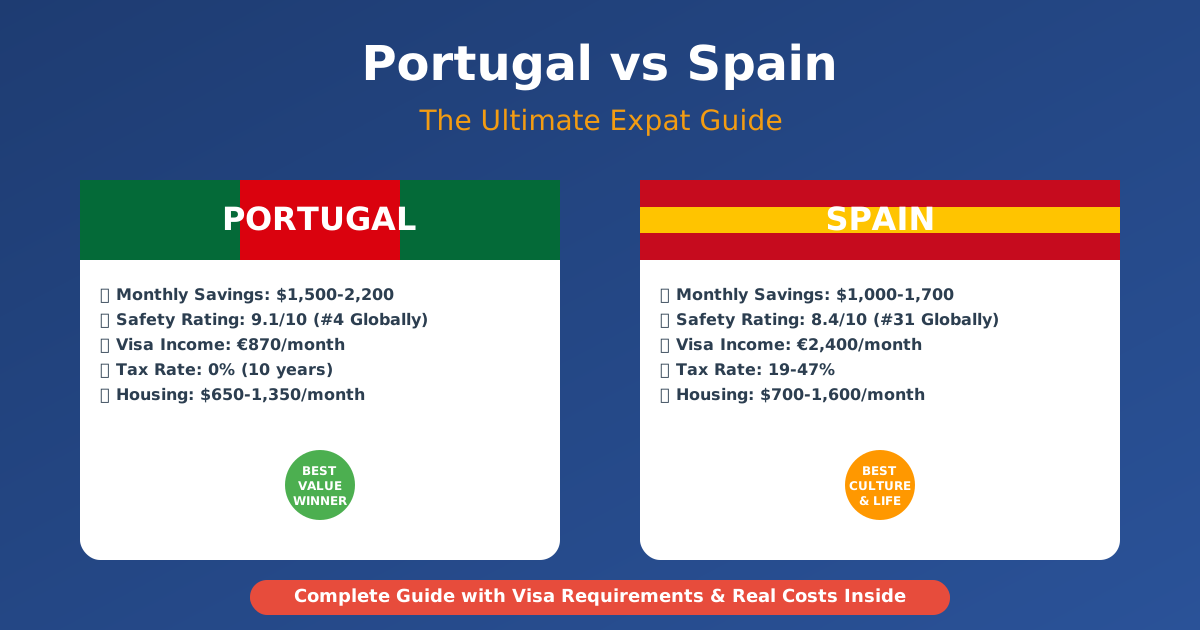
Portugal vs Spain: Which is Better for Expats & Remote Workers?
Choosing between Portugal and Spain? Complete 2026 comparison of costs, visas, lifestyle, and everything you need to make your international move.

Why I Chose Cyprus Over Portugal, Dubai, and Estonia
One Spanish entrepreneur legally cut her tax bill from 45% to under 9% by moving to Cyprus in 60 days. Here are the exact steps and real numbers.