5 Day-Counting Mistakes That Get Snowbirds and Expats in Residency Trouble

If you split your year between places - winters in Florida, summers up north, a few months abroad - you already know day counts matter. What most people get wrong isn't the counting itself. It's which test they're counting for, what counts as a day, and what happens when the paperwork doesn't match the number.
"Residency" isn't one thing. There's federal tax residency, which decides whether the US taxes a foreign national as a resident. There's state residency, which decides which state gets to tax a US citizen or resident who lives in two places. And there's domicile - the legal concept of where your true home is - which sits underneath the state question. Each has its own rules, and confusing them is where the trouble starts. Here are five mistakes that can undo an otherwise careful day count.
1. Treating "183 days" as a universal safe harbor
The 183-day number is real, but it belongs to specific tests, and those tests don't all work the same way or apply to the same people.
At the federal level, 183 days is part of the Substantial Presence Test (SPT) - and the SPT concerns foreign nationals, not US citizens. It determines whether a non-US citizen is treated as a US resident for federal tax purposes. US citizens are taxed on their worldwide income no matter how many days they spend abroad, and green card holders are generally treated as residents under the green card test - subject to treaty tiebreaker rules and to the status being revoked or abandoned. For citizens, day counts come up most often in state residency questions: which state is your domicile, and whether another state can tax you as a statutory resident.
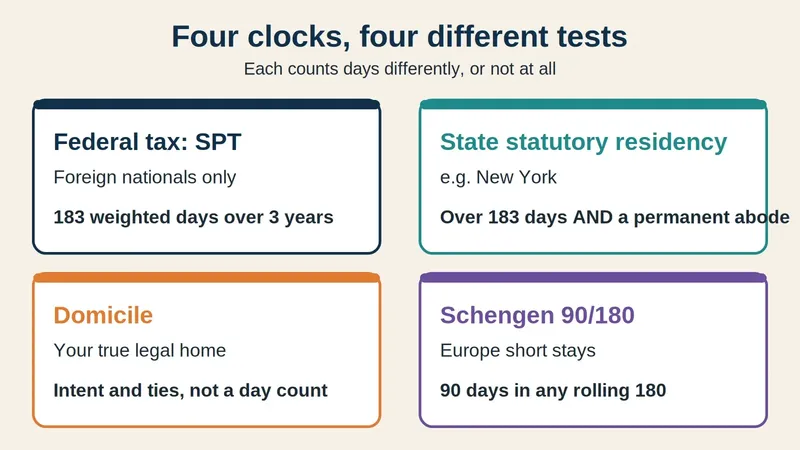
New York is the classic example. Under NY Tax Law § 605(b)(1)(B), you are a New York resident for tax purposes if you maintain a permanent place of abode in the state and spend, in the aggregate, more than 183 days of the taxable year there. Under the current statute that applies whether or not you are domiciled in New York for any portion of the year, with an exception for active-duty military service - so a snowbird whose legal home is Florida can still be taxed as a New York resident. Other states have their own versions, with their own definitions of what counts as a day and what counts as a permanent place of abode.
So there is no single safe harbor. A snowbird who keeps their New York days to 175 isn't a statutory resident - the day prong isn't met, with or without a place in the state. But if New York is still their domicile, day counting alone won't protect them: domicile makes you a New York resident unless you fit a narrow statutory exception, such as keeping no New York abode, maintaining one elsewhere, and spending no more than 30 days in the state (§ 605(b)(1)(A)). Domicile is about intent and ties - where you vote, where your driver's license is, where your family and business life are centered - not just a day count. New York's own nonresident audit guidelines describe how auditors weigh these factors when they challenge a claimed change of domicile.
And if your travel includes Europe, there's a third clock entirely: the Schengen area's 90/180 rule, a rolling window that looks backward 180 days from every single day you're there.
2. Miscounting the Substantial Presence Test's three-year formula
For foreign nationals, the SPT is one route to US federal tax residency, and it's not a simple 183-day count. Per the IRS, you meet the test for a given year only if you were physically present in the US on at least 31 days during the current year, AND at least 183 days during a three-year period that counts all of your current-year days, one-third of the prior year's days, and one-sixth of the days in the year before that.
The weighting is the trap. The IRS's own example makes it concrete: a person present in the US for 120 days in each of three consecutive years totals 180 weighted days - 120 + 40 + 20 - and does not meet the test. But add just a few extra days in the current year, or shift the pattern slightly, and the same traveler crosses the line. Someone who repeats an identical travel schedule every year can meet the SPT without ever spending 183 days in the US in any single calendar year, because the current year's days count at full weight while the earlier years still contribute a third and a sixth.
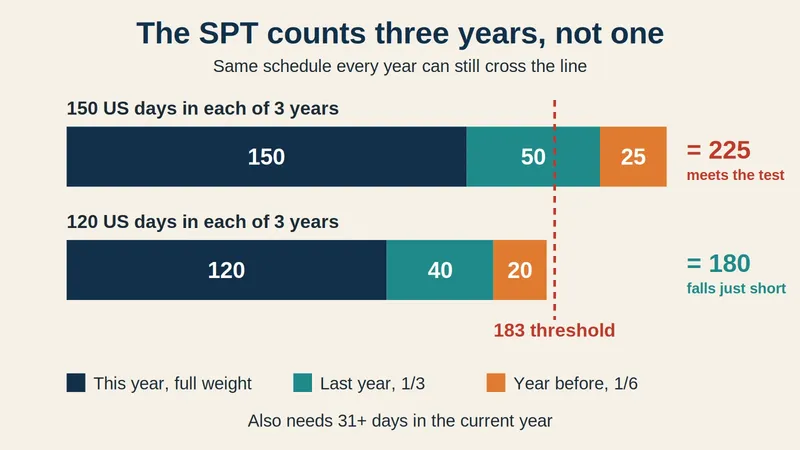
Run the formula once and you'll see why consistency is the risk: 150 days this year, 150 last year, and 150 the year before totals 150 + 50 + 25 = 225 weighted days, well over the line. Even a lighter pattern - 120, 90, and 60 - totals 120 + 30 + 10 = 160, below the threshold on those days - but only until the current year creeps up. The current year carries triple the weight of last year and six times the weight of the year before, so a longer-than-usual stay this year moves your weighted total far more than the same extra days would have last year.
The mistake people make is tracking only the current calendar year and ignoring the prior two. If your pattern is consistent - say, the same five months in the US every year - you need to run the weighted formula, not just check whether this year's number is under 183.
3. Assuming partial days don't count
Cross the border at 11 PM for a late dinner and head home the next morning: how many US days is that? For SPT purposes, two.
Per IRS Publication 519, you are treated as present in the United States on any day you are physically present in the country at any time during the day. There is no 24-hour requirement and no "majority of the day" rule for the SPT. A one-hour visit counts as a full day of presence.
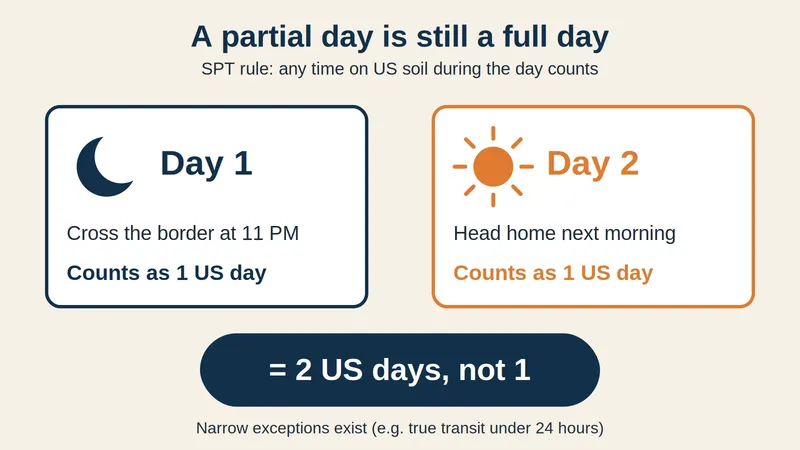
Pub 519 carves out narrow, conditional exceptions: days you're in the US for less than 24 hours while genuinely in transit between two places outside the US (stopping for a business meeting breaks transit status); days you're temporarily present as a regular crew member of a foreign vessel on a route between the US and a foreign country; days you intended to leave but couldn't because of a medical condition that arose while you were in the US; days regular commuters cross in from Canada or Mexico to work; and days certain members of a NATO force or civilian component are present under a NATO visa. And qualifying days as an exempt individual (more on them next) don't count either. But outside those exceptions, every partial day is a day.
This matters most for people who live near the border or make frequent short trips - a consultant flying in for a two-day client meeting has added two days to their SPT count, and a snowbird who "just stops by" a northern home in May and November may be adding days to a state statutory residency count. New York's regulation, 20 NYCRR 105.20(c), counts "presence within New York State for any part of a calendar day" as a day in the state - though it disregards presence solely to board a plane, ship, train, or bus to a destination outside the state, or while traveling through the state to one. State rules vary, so check the specific state you're dealing with - and assume the strict reading unless you've confirmed otherwise.
4. Missing the exceptions that could save you - and their paperwork
Here's where the audience distinction really matters. The exceptions in this section are for foreign nationals subject to the SPT. They don't apply to US citizens, whose residency questions are state domicile and statutory residency questions.
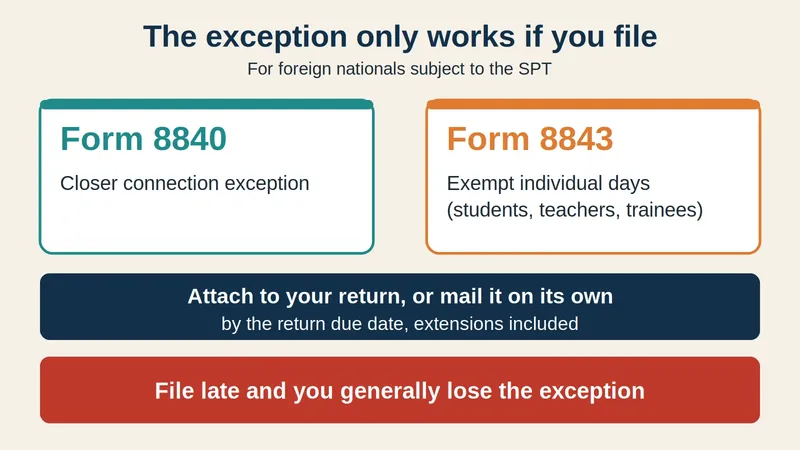
The closer connection exception. Even if you meet the SPT, you may still be treated as a nonresident alien if you were present in the US fewer than 183 days during the year, maintained a tax home in a foreign country for the whole year, had a closer connection to that country than to the US, and had not applied for, or taken steps toward, lawful permanent resident status. (A separate variant covers people who moved their tax home from one foreign country to another mid-year.) The catch, per the IRS, is that you must claim the exception by filing Form 8840. If you file a US income tax return, the form goes in attached to that return; if you don't have to file a return, you mail it to the IRS on its own by the return's due date, extensions included. File late and you generally cannot claim the exception at all, whatever the underlying facts - outside a narrow relief provision for people who can show they took reasonable steps to learn and meet the filing requirements. That makes this a paperwork failure, not a substantive one.
Exempt individuals. Certain visa holders are "exempt individuals" whose days of presence don't count toward the SPT at all: students on F, J, M, or Q visas; teachers and trainees on J or Q visas; foreign-government-related individuals on A or G visas (other than A-3 or G-5); and professional athletes temporarily in the US to compete in charitable sports events. The exemption has conditions. Students, teachers, and trainees must substantially comply with their visa terms, and category-specific time limits and exceptions apply - Publication 519 spells out how long each category can exclude days. And for students, teachers, trainees, athletes, and anyone claiming the medical-condition exclusion, the exemption isn't self-executing: you must file Form 8843 annually, even if you have no US income and no obligation to file a tax return. Like Form 8840, it attaches to your Form 1040-NR if you file one, and otherwise goes to the IRS on its own by that return's due date, extensions included. File late and you can lose the day exclusions the form exists to document - subject to the same narrow clear-and-convincing relief as Form 8840.
Each of these categories carries conditions a short article can only summarize - check the IRS pages linked above for your situation.
5. Not keeping a record you can produce later
Every dispute described above eventually comes down to evidence. Day counts aren't evaluated on what you remember; they're evaluated on what you can show.
New York's nonresident audit guidelines describe what auditors actually examine when they test a day count: credit card and bank statements, toll records, phone records, calendars, travel itineraries, and more. Auditors reconstruct your year from third-party records, and those records may corroborate - or contradict - the day count you claim. The same logic applies to the SPT: if the IRS questions your presence days, contemporaneous documentation is far easier to defend than a reconstruction made under pressure.
Ready to Rewire your Life?
Sign up to receive updates and insights.
By submitting your email address, you will receive a free subscription to RA Postcards and special offers from Rewire Abroad and our affiliates. You can unsubscribe at any time, and we encourage you to read more about our Privacy Policy.
The mistake is assuming you'll rebuild the year when you need to. Twelve months later, you won't remember whether that border crossing was March 14 or March 16, and your credit card statement may say something different from your memory anyway.
The fix is boring and tool-agnostic: record each day's location as it happens, in whatever system you'll actually maintain - a spreadsheet, a calendar, a notebook, an app. What matters is that the log is contemporaneous (made at the time, not reconstructed later), complete (every day, including the boring ones at home), and backed by the receipts that corroborate it. Keep the boarding passes, the hotel folios, and the statements for the years that matter. If a day count is ever challenged, a contemporaneous record puts you in a far stronger position than memory alone.
Planning a longer stay abroad, not just a trip? Our guides cover the visa, tax and insurance decisions behind the day count: retiring abroad, working remotely as a digital nomad, and moving abroad.
The bottom line
Day counting fails in predictable ways: treating one number as universal when each test is different, ignoring the SPT's three-year weighting, forgetting that partial days count, missing the exception forms that must be filed, and keeping no record until it's too late to make one. None of these require exotic knowledge to avoid - just knowing which rules apply to you, counting for those rules, and writing it down as you go.
One last note on scope: this piece is about how the counting rules work, not about your specific situation, and every rule mentioned has conditions and exceptions beyond what fits here. Federal and state residency questions turn on facts - where your ties are, what forms you've filed, what your visa status is - and the stakes of getting them wrong are high enough that anyone approaching a threshold should talk to a qualified tax professional before relying on a day count alone.

Quinn Moran
Quinn Moran is the founder of iReside, a tax-residency and visa day-tracking app. Full disclosure: he founded and runs the company.
https://ireside.ai
Snowbird Retirement Abroad: Split Your Time Between 2 Countries
Master the art of snowbird retirement abroad. Learn visa strategies, tax rules, and destinations for splitting time between countries in retirement.

FIRE & Retire Abroad: Early Retirement in Low-Cost Destinations
Use FIRE principles with international living to accelerate your path to financial independence. Explore top affordable countries with FIRE.

Fan Your FIRE: How to Live in Argentina on $800–$1,200 a Month (Yes, Really!)
Yes, you can live well in Argentina on $800–$1,200/mo. Real cost breakdown, visa options, best cities, and what's changed in 2026.

The Expat’s Health Insurance Handbook: Navigating Coverage Overseas
Master healthcare with this guide - compare insurance, get expert tips on choosing the right policy, and avoid common pitfalls on coverage abroad.