Healthcare Independence: FIRE Without Employer Insurance

So, you've just hit your FIRE number at 35, ready to tell your boss exactly what you think about those Monday morning meetings. But then reality hits – you're about to lose that sweet employer health insurance that's been covering your family's medical needs. 😰
For many aspiring early retirees, healthcare represents the final boss battle in their FIRE journey. While you've mastered investing, optimized your expenses, and calculated your withdrawal rates down to the penny, the prospect of paying $2,000+ monthly for family health insurance can make even the most determined FIRE seeker consider staying chained to their desk job.
But here's the thing: thousands of early retirees have cracked the healthcare independence code, and many are living healthier, less stressful lives than their traditionally employed counterparts. From ACA marketplace optimization to HSA maximization strategies that turn healthcare costs into tax-advantaged investments, this guide will show you exactly how to maintain quality healthcare coverage without employer dependency.
By the end of this article, you'll understand the complete healthcare independence playbook, including specific strategies that could save you tens of thousands annually while maintaining excellent coverage for your family.
Why Healthcare Independence Appeals to Different FIRE Seekers
Healthcare independence isn't just about early retirement – it's about life flexibility and security that appeals across various financial independence paths.
Traditional FIRE Enthusiasts find healthcare independence liberating because it removes the "golden handcuffs" keeping them in unfulfilling jobs. When you're not dependent on employer benefits, you can pursue passion projects, start businesses, or take career breaks without healthcare anxiety.
Geographic Arbitrage Seekers discover that healthcare independence often pairs perfectly with location flexibility. Many FIRE achievers use ACA marketplace plans while living in lower-cost areas domestically, or explore international healthcare options in countries like Portugal where quality care costs significantly less.
Lean FIRE Practitioners on tighter budgets benefit enormously from healthcare optimization strategies. Understanding ACA subsidies, HSA maximization, and alternative coverage models can be the difference between achieving financial independence in your 40s versus your 60s.
Coast FIRE Followers use healthcare independence as a bridge strategy, maintaining coverage while pursuing lower-stress work or part-time opportunities that might not offer traditional benefits.
The key insight? Healthcare independence isn't just a FIRE strategy – it's a life optimization tool that provides flexibility, potentially better coverage, and often significant cost savings compared to traditional employer plans.
Understanding Your Healthcare Independence Options
ACA Marketplace: Your Primary Weapon
The Affordable Care Act marketplace has become the backbone of healthcare independence for early retirees. Despite political drama and media headlines, the ACA marketplace offers robust coverage options that many FIRE achievers find superior to their previous employer plans.
Silver Plan Strategy: Most healthcare-independent retirees gravitate toward Silver plans for optimal subsidy capture. Silver plans are the only tier where Cost Sharing Reductions (CSRs) apply, potentially reducing your deductibles and out-of-pocket maximums by thousands.
Income Optimization for Subsidies: Here's where FIRE planning gets strategic. Premium tax credits phase out at 400% of the Federal Poverty Level (about $54,000 for individuals, $111,000 for families of four in 2024). Smart early retirees structure their taxable income through Roth conversions, capital gains harvesting, and withdrawal timing to maximize subsidies.
Zara, a 33-year-old software engineer who FIRE'd with $1.2M, pays just $180 monthly for a Gold plan by keeping her taxable income at $35,000 through strategic Roth conversions. Her equivalent employer plan would have cost $850 monthly with a higher deductible.
Healthcare Sharing Ministries: The Controversial Alternative
Healthcare sharing ministries (HSMs) like Medi-Share, Liberty HealthShare, and Samaritan Ministries have gained popularity among FIRE communities, particularly those with religious affiliations or philosophical objections to traditional insurance.
How They Work: Members pay monthly "shares" (typically $200-500 for families) and agree to help cover each other's medical expenses above certain thresholds. It's essentially crowdfunded healthcare with faith-based principles.
The FIRE Appeal: Lower monthly costs and community support attract many early retirees. Some HSMs offer additional perks like telehealth services and wellness programs.
Critical Limitations: HSMs aren't insurance and don't guarantee payment. They typically exclude pre-existing conditions, mental health services, and preventive care. Most importantly, they don't satisfy ACA requirements, potentially triggering tax penalties.
Kai, a 29-year-old FIRE blogger, used Liberty HealthShare for three years, saving approximately $400 monthly compared to ACA marketplace plans. However, when he developed a chronic condition, the ministry classified it as pre-existing and declined coverage, forcing him back to the ACA marketplace at higher premiums due to the gap in coverage.
HSA Maximization: The Triple Tax Advantage
Health Savings Accounts represent the holy grail of FIRE healthcare planning – the only account offering deductible contributions, tax-free growth, and tax-free withdrawals for qualified expenses.
The Early Retirement HSA Strategy:
- Maximize contributions while employed ($4,150 individual, $8,300 family for 2024)
- Invest aggressively in low-cost index funds (treat it like a retirement account)
- Pay current expenses out-of-pocket and save receipts
- Reimburse yourself decades later tax-free from the grown HSA balance
This strategy essentially converts your HSA into a stealth IRA with better tax treatment. Phoenix, a 38-year-old early retiree, accumulated $85,000 in her HSA over 12 years while paying medical expenses separately. She can now reimburse herself tax-free for any medical expenses incurred since opening the account, effectively accessing her HSA funds penalty-free before age 65.

ACA Marketplace Mastery for FIRE
Income Engineering for Maximum Subsidies
The ACA marketplace operates on Modified Adjusted Gross Income (MAGI), creating opportunities for strategic income management during early retirement.
The Subsidy Sweet Spot: Premium tax credits are most generous between 150-250% of Federal Poverty Level. For a family of four, this translates to roughly $46,000-$77,000 in annual income – perfectly aligned with many lean FIRE budgets.
Advanced Income Strategies:
Geographic Arbitrage Within the US: Healthcare premiums vary dramatically by location. The same Silver plan might cost $400 in rural Alabama versus $800 in San Francisco. Many FIRE achievers relocate to lower-premium areas during their healthcare marketplace years.
State | Average Silver Premium (Individual) | Subsidy Threshold (400% FPL) |
|---|---|---|
Alabama | $389 | $54,360 |
Florida | $456 | $54,360 |
California | $613 | $54,360 |
New York | $701 | $54,360 |
Timing Enrollment Strategically: Open enrollment runs November 1 - January 15, but qualifying life events (like leaving employer coverage) trigger special enrollment periods. Plan your FIRE transition to optimize enrollment timing.
Plan Selection Strategy
Actuarial Value Understanding: Bronze plans cover 60% of expenses, Silver 70%, Gold 80%, and Platinum 90%. However, this doesn't mean higher tiers are always better for FIRE achievers.
The Silver Plan Advantage: Only Silver plans qualify for Cost Sharing Reductions if your income falls below 250% FPL. A Silver plan with CSRs often provides better value than Gold plans at similar premium costs.
Network Considerations: Narrow networks are common in ACA plans, but many FIRE achievers find this acceptable trade-off for lower premiums. Research whether your preferred doctors and hospitals participate before enrollment.
HSA Optimization for Early Retirees
The FIRE HSA Timeline Strategy
Phase 1: Accumulation (Pre-FIRE):
- Maximize annual contributions
- Choose High Deductible Health Plans (HDHPs) specifically for HSA eligibility
- Invest HSA funds in low-cost index funds
- Pay medical expenses out-of-pocket when possible
Phase 2: Bridge Years (Early Retirement):
- Continue HSA contributions if maintaining HDHP coverage
- Use accumulated HSA funds for current medical expenses
- Consider international healthcare arbitrage opportunities
Phase 3: Traditional Retirement (65+):
- HSA becomes additional retirement account
- Withdraw for any purpose after 65 (taxed as ordinary income)
- Maintain tax-free status for medical expenses
HSA Investment Strategies
Most HSA providers offer investment options beyond basic savings accounts. Fidelity, Schwab, and Vanguard offer HSA accounts with access to low-cost index funds.
Asset Allocation Considerations:
- Conservative Approach: Keep 1-2 years of maximum out-of-pocket expenses in cash/stable value
- Aggressive Approach: Invest entire HSA balance in stock index funds, pay expenses separately
- Balanced Approach: 60/40 stocks/bonds allocation matching your overall portfolio
Ravi, a 42-year-old FIRE achiever, accumulated $127,000 in his HSA over 15 years by maximizing contributions and investing in total stock market index funds. His average annual return of 8.2% far exceeded the 0.05% interest rate of the default savings option.
International Healthcare Arbitrage
The Geographic Healthcare Advantage
Many FIRE achievers discover that high-quality healthcare abroad costs a fraction of US prices, even without insurance. This creates opportunities for "healthcare arbitrage" – strategically accessing medical care in lower-cost countries.
Medical Tourism Destinations:
- Portugal: EU-standard healthcare at 60-70% lower costs than US
- Thailand: World-class private hospitals, particularly strong in surgery and dental work
- Mexico: Convenient for US residents, excellent value for routine care
- Czech Republic: High-quality care with English-speaking doctors
Strategic Considerations: Maintain US-based insurance for emergencies while planning routine care internationally. Many procedures that cost $10,000+ in the US can be obtained for $2,000-3,000 abroad with superior service.
Aria, a 35-year-old early retiree, needed knee surgery that would have cost $45,000 in the US with her high-deductible plan. She traveled to Portugal, received the surgery at a top hospital for $8,000, and spent three weeks recovering in Lisbon – total cost including travel and accommodation was $12,000.
Tools & Resources for Healthcare Independence
Before making any major healthcare decisions, these tools can help you evaluate your options and optimize your strategy:
Financial Planning & Optimization:
- FIRE Calculator: Model how healthcare costs impact your FIRE timeline and adjust your savings targets accordingly
- FIRE Procrastination Calculator: See how delaying healthcare independence planning affects your long-term costs
- Geo-Arbitrage Savings Calculator: Calculate potential savings from relocating to lower healthcare cost areas
Location & Planning Resources:
- Country Search Tool: Filter destinations based on healthcare quality and costs if considering international options
- Country Directory: Comprehensive healthcare information for countries popular with FIRE expats
- Visa Pathways: Explore visa options for countries with attractive healthcare systems
Readiness Assessment:
- Expat Readiness Quiz: Assess your preparedness for international healthcare arbitrage strategies
Additional Essential Resources:
- Healthcare.gov Plan Comparison Tool: Official marketplace for comparing ACA plans and calculating subsidies
- HSA Bank Comparison Websites: Research investment options and fees across different HSA providers
- Medical Tourism Facilitators: Companies like PlacidWay and Medical Tourism Corporation for international healthcare planning
Real Experiences & Case Studies
Case Study 1: The Suburban Family Strategy
Background: Marcus and Luna, both 41, achieved FIRE with $2.1M and twin 8-year-old daughters (Sage and River). Previously paid $1,850 monthly for employer family coverage.
Strategy: Relocated from expensive San Francisco suburb to Austin, Texas. Selected ACA Silver plan with CSR subsidies by keeping taxable income at $85,000 through strategic Roth conversions.
Results: Monthly premium dropped to $340 with $1,500 family deductible (vs. $4,000 on employer plan). Annual healthcare costs decreased by $18,000 while improving coverage quality.
Key Insight: Geographic arbitrage within the US can be as effective as international moves for healthcare savings.
Case Study 2: The Solo Lean FIRE Approach
Background: Zoe, 34, achieved lean FIRE with $625,000 after aggressive saving on a teacher's salary. Health-conscious with minimal medical history.
Strategy: Combined healthcare sharing ministry (Medi-Share) with catastrophic travel insurance and HSA maximization during working years.
Results: Monthly healthcare costs of $199 vs. $450 for equivalent ACA coverage. Used savings to fund international travel and volunteer work.
Challenges: Had to pay out-of-pocket for preventive care and annual physicals. Anxiety about coverage gaps for potential serious conditions.
Current Status: Switched to ACA Silver plan after two years when eligible for subsidies, now pays $127 monthly with full preventive coverage.
Case Study 3: The International Arbitrage Model
Background: Finn and Nova, 38 and 35, achieved FIRE with $1.4M and embraced location independence with two young children (Orion and Lyra).
Strategy: Maintain US ACA coverage for emergencies while living internationally. Access routine healthcare in countries with national health systems or low-cost private care.
Results: Pay $280 monthly for US Bronze plan while living in Portugal, where their children receive free healthcare through national system and adults pay €30-50 for private consultations.
Total Annual Healthcare Costs: $4,800 (US premiums) + $800 (Portuguese private care) = $5,600 vs. estimated $16,000 for comparable US coverage.
Advanced Strategies and Considerations
Healthcare Independence and Tax Planning
Healthcare costs create unique tax planning opportunities for early retirees:
Medical Expense Deductions: If your medical expenses exceed 7.5% of AGI, you can itemize these deductions. With strategic income management, this threshold becomes more achievable.
State Tax Considerations: Some states don't tax HSA contributions or withdrawals, while others do. Factor this into your FIRE location planning.
International Tax Implications: US expats still owe taxes on worldwide income but may qualify for Foreign Earned Income Exclusion or Foreign Tax Credits that affect healthcare subsidy calculations.
Long-term Care Planning
Traditional long-term care insurance is expensive, but early retirees have alternative strategies:
Self-Insurance: Build additional savings specifically for potential long-term care needs International Options: Countries like Portugal offer excellent long-term care at significantly lower costs HSA Strategy: Maximize HSA contributions throughout your career to cover future long-term care expenses tax-free
Consideration | Employer Coverage | ACA Marketplace | Healthcare Sharing Ministry |
|---|---|---|---|
Monthly Cost | $850-1,500 | $200-800 | $150-400 |
Network Size | Large | Moderate | Varies |
Pre-existing Conditions | Covered | Covered | Often Excluded |
Preventive Care | Full Coverage | Full Coverage | Limited |
Administrative Hassle | Low | Moderate | Moderate |
Geographic Flexibility | Limited | High | High |
Getting Started: Your Action Plan
Phase 1: Assessment and Planning (6-12 months before FIRE)
Financial Analysis:
- Calculate your current healthcare costs including premiums, deductibles, and out-of-pocket expenses
- Model different income scenarios and corresponding ACA subsidy levels
- Analyze HSA maximization opportunities in your remaining working years
- Research healthcare costs in your target retirement location
Coverage Research:
- Explore ACA marketplace plans in your area using Healthcare.gov
- Interview insurance brokers who specialize in individual coverage
- Research healthcare sharing ministries if aligned with your values
- Connect with local FIRE community members who've made the transition
Phase 2: Optimization and Preparation (3-6 months before transition)
Income Strategy Development:
- Plan Roth conversion schedules to optimize subsidy eligibility
- Structure investment accounts to control taxable income timing
- Consider geographic relocation for better premium rates
- Maximize final year HSA contributions
Healthcare Provider Coordination:
- Confirm your preferred doctors accept ACA marketplace plans
- Schedule important check-ups and procedures while still employer-covered
- Obtain copies of medical records and prescription histories
- Research international healthcare options if considering expat life
Phase 3: Enrollment and Transition (0-3 months)
Enrollment Execution:
- Time your employer coverage termination to trigger Special Enrollment Period
- Compare plans carefully, considering total cost including deductibles
- Enroll in chosen coverage with effective date immediately following employer plan termination
- Set up automatic premium payments and understand claims processes
Ongoing Management:
- Track medical expenses meticulously for tax purposes
- Monitor income levels to maintain subsidy eligibility
- Plan annual enrollment reviews and potential plan changes
- Build relationships with new healthcare providers
Ready to Rewire your Life?
Sign up to receive updates and insights.
By submitting your email address, you will receive a free subscription to RA Postcards and special offers from Rewire Abroad and our affiliates. You can unsubscribe at any time, and we encourage you to read more about our Privacy Policy.
Final Thoughts & Next Steps
Healthcare independence represents one of the final frontiers in achieving true financial independence. While the transition from employer-sponsored coverage might seem daunting, thousands of early retirees have successfully navigated this challenge and emerged with better coverage at lower costs.
The key insight is that healthcare independence isn't just about finding alternative insurance – it's about optimizing your entire approach to health and wellness. From strategic income management that maximizes ACA subsidies to HSA optimization that creates decades of tax-free medical funding, healthcare independence can actually accelerate your path to FIRE while providing better health outcomes.
Remember that healthcare needs and regulations evolve constantly. What works perfectly for your FIRE transition today might need adjustment in five years. Build flexibility into your strategy, maintain emergency funds for unexpected medical costs, and stay connected with the FIRE community for ongoing insights and support.
The freedom to pursue your passions without worrying about losing health benefits is one of the most liberating aspects of financial independence. By mastering healthcare independence, you're removing the final golden handcuff that keeps many people trapped in unfulfilling jobs.
Your journey to healthcare independence starts with understanding your options, modeling different scenarios, and taking action. The tools and strategies in this guide provide the foundation – now it's time to customize the approach for your specific situation and take the leap toward true financial and lifestyle freedom. 🚀
Ready to take the next step? Start by using the planning tools mentioned above to model your specific healthcare independence scenario. Connect with others who've made the transition successfully, and remember that the peace of mind from controlling your own healthcare destiny is worth the initial complexity of making the switch.
Have you successfully achieved healthcare independence, or are you planning your transition? Share your experiences and questions in the comments below – the FIRE community thrives on sharing real-world insights and supporting each other through these important life transitions.
Related Resources for Your FIRE Journey
Healthcare and International Living:
- Healthcare Abroad vs US: Complete Cost Comparison - Detailed analysis of healthcare quality and costs across popular expat destinations
- Medicare vs International Health Insurance - Essential reading for those considering healthcare arbitrage strategies
- Overseas Health Coverage: Expat Insurance Guide - Comprehensive coverage options for Americans living abroad
FIRE Strategy and Optimization:
- FIRE Tax Optimization Playbook - Advanced strategies for minimizing taxes during accumulation and withdrawal phases
- The 4% Rule in 2025: Latest Research Updates - Critical updates to withdrawal strategies that affect healthcare budgeting
- Achieve FIRE Faster: 7 Steps to Financial Independence - Accelerate your timeline to healthcare independence
Geographic Arbitrage for FIRE:
- Americans Retire Overseas: Complete Guide - Legal and practical considerations for international healthcare independence
- FIRE Abroad: Real Geographic Arbitrage Stories - Real experiences from couples who achieved healthcare independence abroad
- Retire Abroad Early: Low-Cost Destinations - Countries where healthcare independence is most affordable
Financial Tools and Planning:
- The Latte Myth: Why Small Expenses Don't Matter for FIRE - Focus on what really impacts your healthcare independence timeline

The Expat’s Health Insurance Handbook: Navigating Coverage Overseas
Master healthcare with this guide - compare insurance, get expert tips on choosing the right policy, and avoid common pitfalls on coverage abroad.
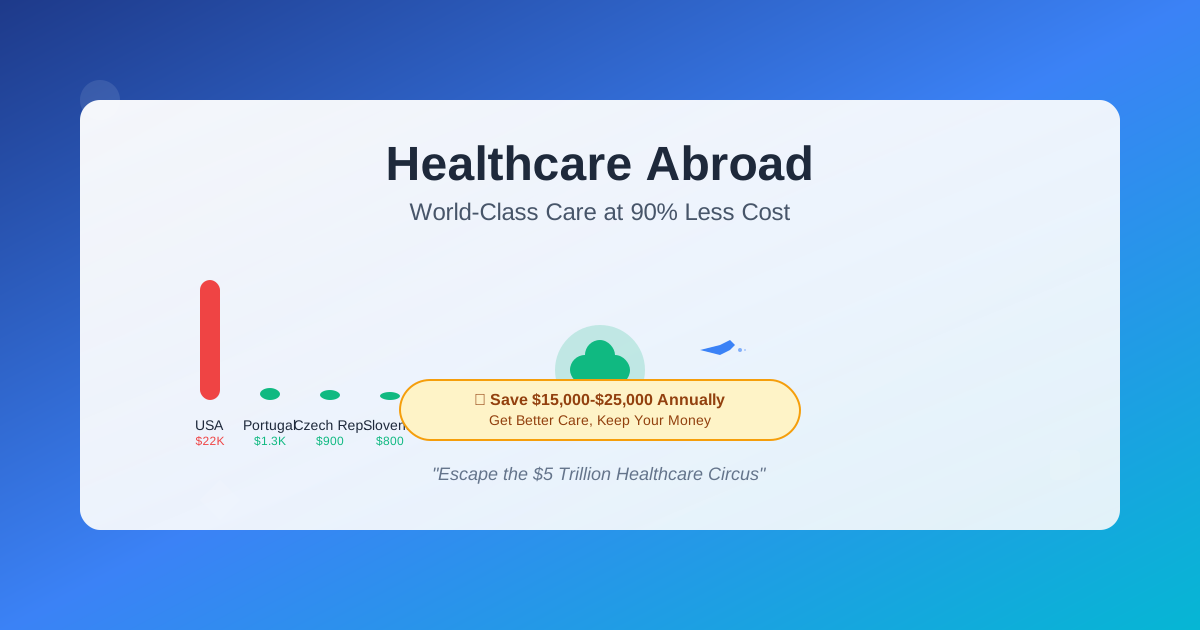
Healthcare Abroad: Your Escape Route from America's $5 Trillion Medical Circus
Worried about healthcare overseas? Discover countries with world-class, affordable healthcare—and why moving abroad is the smartest health decision.

The Real Cost of Keeping Your US Doctor While Living Abroad
Complete breakdown of telemedicine costs, prescription transfers, and insurance complications when maintaining US healthcare abroad. Real budgets.
Medicare vs. International Health Insurance: The $50,000 Decision
Medicare doesn't work abroad. Discover how international health insurance could save you $50,000+ while overseas. Complete guide for expats 65+.