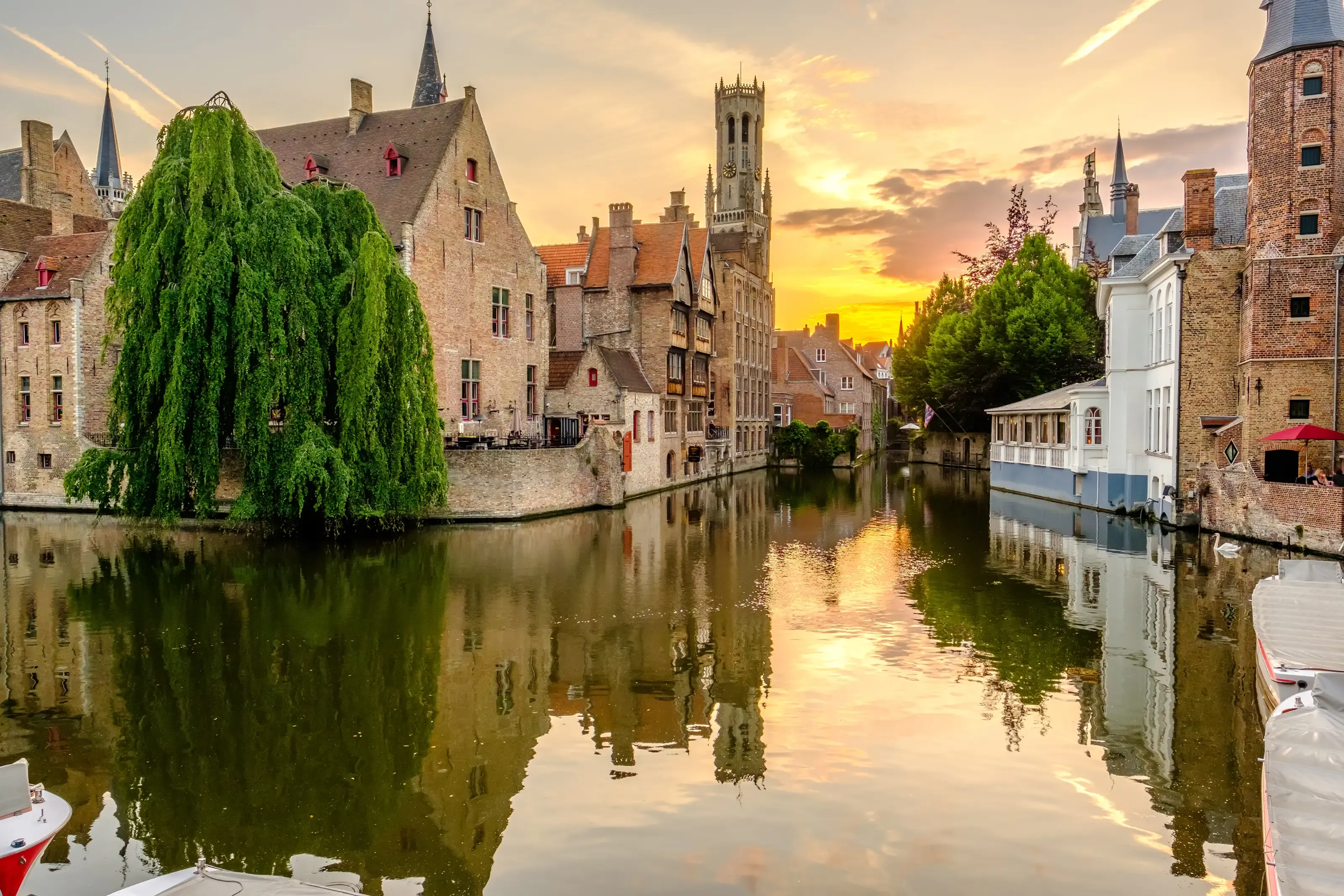
Brugge, Belgium
Data updated Sep 3, 2026
📊 Scores
Best fit: FIRE / Geoarbitrage (score: 69)
Bruges, Belgium: A Guide for Retirees, FIRE Seekers, and Digital Nomads
Bruges is the most beautiful city in Belgium and the hardest to actually live in, and those two facts are connected. The historic center is a near-perfectly preserved medieval town of canals, cobbled lanes, stepped gables, and a skyline ruled by the Belfry, so complete that UNESCO listed the whole core as World Heritage and the rest of the world calls it the Venice of the North. It is also a small city of around 120,000 people that absorbs several million visitors a year, which means the same beauty that pulls you in has turned the center into something closer to an open-air museum than a neighborhood. The honest question about Bruges is not whether it is stunning, because it overwhelmingly is. It is whether you can build a normal daily life inside a postcard. For a particular kind of retiree, the answer is yes. For almost everyone else, Bruges is a place to visit for a weekend, not a place to move. If you want a real Flemish city of similar charm without the theme-park problem, Ghent is half an hour away.
What you're actually moving into
There are two Bruges, and confusing them is the single biggest mistake newcomers make. The first is the egg-shaped historic center inside the ring canal, the part on every postcard, where the Markt, the Burg, the Belfry, the Church of Our Lady, and the Béguinage sit among the canals and the day-tripper crowds. Almost nobody who moves here for the long term lives in the heart of that. The shops are geared to tourists, the prices follow, the streets fill and empty on the tourism calendar, and ordinary daily infrastructure is thin.
The second Bruges is where residents actually live: the surrounding districts like Sint-Andries, Sint-Michiels, Sint-Kruis, and Assebroek, quieter residential areas just outside the center with normal supermarkets, schools, and a calmer rhythm, plus the coastal port district of Zeebrugge, which is industrial and a world away from the medieval core. Choose the center for romance and you will tire of the crowds; choose the outskirts and you get a peaceful, well-kept, safe town with the beautiful core a short bike ride away whenever you want it.
The character throughout is quiet, wealthy, orderly, and older. Bruges does not have the student energy of Ghent or the commercial buzz of Antwerp. It is Flemish and Dutch-speaking, the pace is slow, the nightlife is modest, and the social world skews settled and local. That calm is the entire appeal for some people and the deal-breaker for others. If you want coast and a bit more life, Ostend is fifteen minutes away by train, and Kortrijk gives you a larger West Flanders city inland.
The weather
Same gray, mild, maritime climate as the rest of Belgium, with a coastal edge. Sitting near the North Sea, Bruges gets the wind and the damp a little stronger than the inland cities, with frequent drizzle, a lot of overcast days, and short winter daylight that bottoms out around a half-past-four sunset in December. No extremes, no air conditioning needed, comfortable year-round, and gray most of it. The lack of sun is the adjustment, not the cold.
Cost of living
Bruges splits in two on cost the same way it splits on everything else. Property inside or near the historic center is scarce, protected, and priced for its scenery, so the romantic option is the expensive one. Move to the residential outskirts and the numbers ease, generally landing below Brussels and Antwerp, which makes the quiet edges of Bruges one of the more reasonable places to live well in Flanders, as long as you are not paying the tourist premium for a canal view.
The money reality is the Belgian one, and it is the opposite of a geoarbitrage pitch. The country uses the euro, so dollar earners carry currency risk on income and savings. And Belgium taxes residents on worldwide income, with a top marginal rate near 50 percent plus a communal surcharge, a flat 30 percent on dividends, and, new for 2026, a 10 percent tax on capital gains from financial assets above an annual exemption. Bruges is calmer and, on the outskirts, cheaper than the big cities, but it is not a place your money stretches in any absolute sense. The complete tax picture, and how it lands differently for an employee versus a retiree, is in our guide to moving to Belgium.
The beautiful-trap problem
This is the section that decides whether Bruges works for you. A historic center optimized for visitors is, by definition, not optimized for residents. In high season the lanes are packed, the central squares belong to tour groups, and the businesses that survive are the ones that sell to people passing through, not the ones a household needs week to week. The city has spent years trying to manage overtourism, limiting day-trip buses and cruise arrivals, which tells you how real the pressure is. Live in the core and you are living inside that flow. The honest move is to treat the center as your gorgeous backyard and live just outside it.
Even on the quiet edges, the smallness is the constraint. Bruges has a thin job market built mostly on tourism and the Zeebrugge port, a modest social and cultural scene compared to Ghent or Antwerp, and the same Dutch-language administration as the rest of Flanders. The registration wall is identical to everywhere else in Belgium: you need an address before you can register, a registration before you get a national number, and that number before you can finish a bank account, the health system, or most contracts, capped by a home visit from a local officer to confirm you live there. Plan for weeks, learn some Dutch, and be honest with yourself about whether quiet and beautiful is enough, or whether you will miss having a city around you.
Getting around, healthcare, and connections
For daily movement Bruges is excellent. The center is compact and largely closed to through traffic, so you walk or bike everywhere, and the residential districts are easy to cover by bike or local bus. For a small city the rail connections are strong: Ghent is about half an hour away, Brussels around an hour, Ostend and the coast fifteen minutes, so you are not stuck despite the town's size. Many residents live here happily without a car.
Healthcare is a Belgian strength and Bruges is well covered, anchored by the large AZ Sint-Jan hospital, with the rest of the country's system behind it. Care is high quality and, once you are inside the mandatory health-fund system, costs are a fraction of US prices. The catch is the familiar entry sequence: register, join a fund, and carry private insurance in the gap before coverage begins.
Belgium's visa options
Belgium has no retirement visa, no passive-income visa, and nothing like the off-the-shelf digital nomad visas Spain or Portugal offer. Bruges has a thin job market, so the employment route is less common here than in the big cities, and most people who settle arrive as self-sufficient retirees, remote earners, or the spouse of an EU citizen.
If you do have a job offer, you arrive on the single permit, applied for by your employer through the Flanders regional authority.
If you are self-employed or work remotely, the route is the self-employed professional card, which RewireAbroad also catalogs as the Belgium Digital Nomad Visa. It expects a viable business plan and proof your activity serves a Belgian economic interest, so it is heavier than a true nomad visa, but it is the door that exists for location-independent earners.
If your spouse is an EU citizen, that is the cleanest path available.
The reason to put up with the bureaucracy is the long game. Five years of legal residence can lead to a Belgian passport, which is an EU passport, with dual citizenship allowed. The current language requirement is A2, with an announced tightening toward B1 and a nationality exam, so starting sooner is the safer bet. The full visa, tax, and citizenship math is in our guide to moving to Belgium.
Who Bruges is for
Bruges is for the retiree who genuinely values calm, beauty, safety, and a slow pace over convenience, community, and career, and who is willing to live on the residential edge rather than in the tourist core. For that person, it is one of the loveliest places in Europe to settle, walkable, secure, well-kept, and a short ride from a world-class historic center they can enjoy on their own terms. If quiet and beautiful is the whole goal, Bruges delivers it better than almost anywhere.
It is the wrong city for the FIRE or cheap-living seeker, because the Belgian tax and cost reality applies and the romantic option carries a tourist premium. And it is the wrong city for the digital nomad, full stop: it is small, older, quiet, short on coworking and scene, dominated by tourism, and run in Dutch, with no dedicated nomad visa to ease the way.
The honest summary is the one the brochures will not give you. Visit Bruges, fall for Bruges, and then think hard about whether you want to live in a postcard or just keep one. For most people the right answer is to base yourself in Ghent or on the coast and treat Bruges as the day trip it was built to be. For the right retiree, the quiet outskirts of the most beautiful town in Belgium are a genuinely good place to grow older.
Visa, tax, and cost figures verified June 2026. Belgium introduced a capital gains tax on financial assets in 2026 and has announced tighter citizenship language rules, and figures shift, so confirm current requirements with a licensed immigration or tax professional before you apply. Full detail in our guide to moving to Belgium.
🏚️ Cost of Living
💰 Budgets and Costs
Grocery Basket
Eating Out
Utilities & Lifestyle
Housing
A 1BR in the center runs about $1050/mo. If your income is in another currency, bank FX fees add up. A multi-currency account can cut that cost.
See low-fee transfersWe may earn a commission at no cost to you.
💰 Real Spend Reports
🛡️ Safety & Crime
(Higher is safer)
(Lower is safer)
Brugge is genuinely one of Europe's safest cities—violent crime is rare and street theft minimal compared to larger Belgian cities. The medieval center feels secure day and night, though petty pickpocketing occurs in crowded tourist areas near the Markt and canal zones. Avoid the Sint-Michiels neighborhood after dark and exercise standard urban caution with valuables. Scams are uncommon; the main concern is bicycle theft. For an American expat, this is an exceptionally safe choice with excellent policing and community trust.
🏥 Healthcare
🌤️ Climate
Best Months
Climate Notes
Maritime climate influenced by the North Sea, featuring mild summers and cool winters.
💻 Digital Nomad
Community Notes
| Name | Price/mo | Notes |
|---|---|---|
| Bar d'Office Brugge | $275 | Located near the city center, Bar d'Office offers a vibrant and social coworking environment with flexible desk options, meeting rooms, and a focus on community events, making it ideal for expats seeking connections. |
| Regus Brugge | $250 | Regus offers a professional and reliable coworking space in Brugge, with multiple locations providing serviced offices, meeting rooms, and business lounges, suitable for remote workers seeking a structured environment. |
| Startit @ Brugge | $220 | Located in the heart of Brugge, Startit provides a modern and collaborative workspace with various membership options, high-speed internet, and networking opportunities, appealing to digital nomads and freelancers. |
Planning to live in Brugge long-term? Belgium Digital Nomad Visa lets remote workers live legally with a minimum income of $765/month.
View full requirements →Working remotely from Brugge? Nomad health insurance covers you across borders, month to month.
See nomad insuranceWe may earn a commission at no cost to you.
🧳 Expat Life
Expat Life Notes
Brugge is world-famous for its beauty, offering a safe, slow-paced lifestyle with universal English.
Pros
- ✓ Fairy-tale aesthetics
- ✓ Extremely safe
- ✓ High English proficiency
Cons
- ✗ Massive tourist crowds
- ✗ Quiet nightlife
- ✗ Housing market is tight
🛂 Visa Options for Belgium
Many long-stay visas require proof of health insurance. Compare international health plans before you apply.
Compare health insuranceWe may earn a commission at no cost to you.
Earning over $765/mo? You may qualify for a Belgium visa.
Answer 10 questions and get a personalized match in under 2 minutes.
Could living/working in Brugge cut years off your work life?
With a 1-bedroom in the center at $630/mo, your FIRE number here might be much lower than you think.
Moving to Brugge? Estimate what an international move would cost and compare mover quotes.
Estimate my move costShare This Guide
Brugge won't stay this cheap forever.
Cost-of-living and visa updates for Brugge and the rest of Belgium. Free with RA Postcards.
By submitting your email address, you will receive a free subscription to RA Postcards and special offers from Rewire Abroad and our affiliates. You can unsubscribe at any time, and we encourage you to read more about our Privacy Policy.