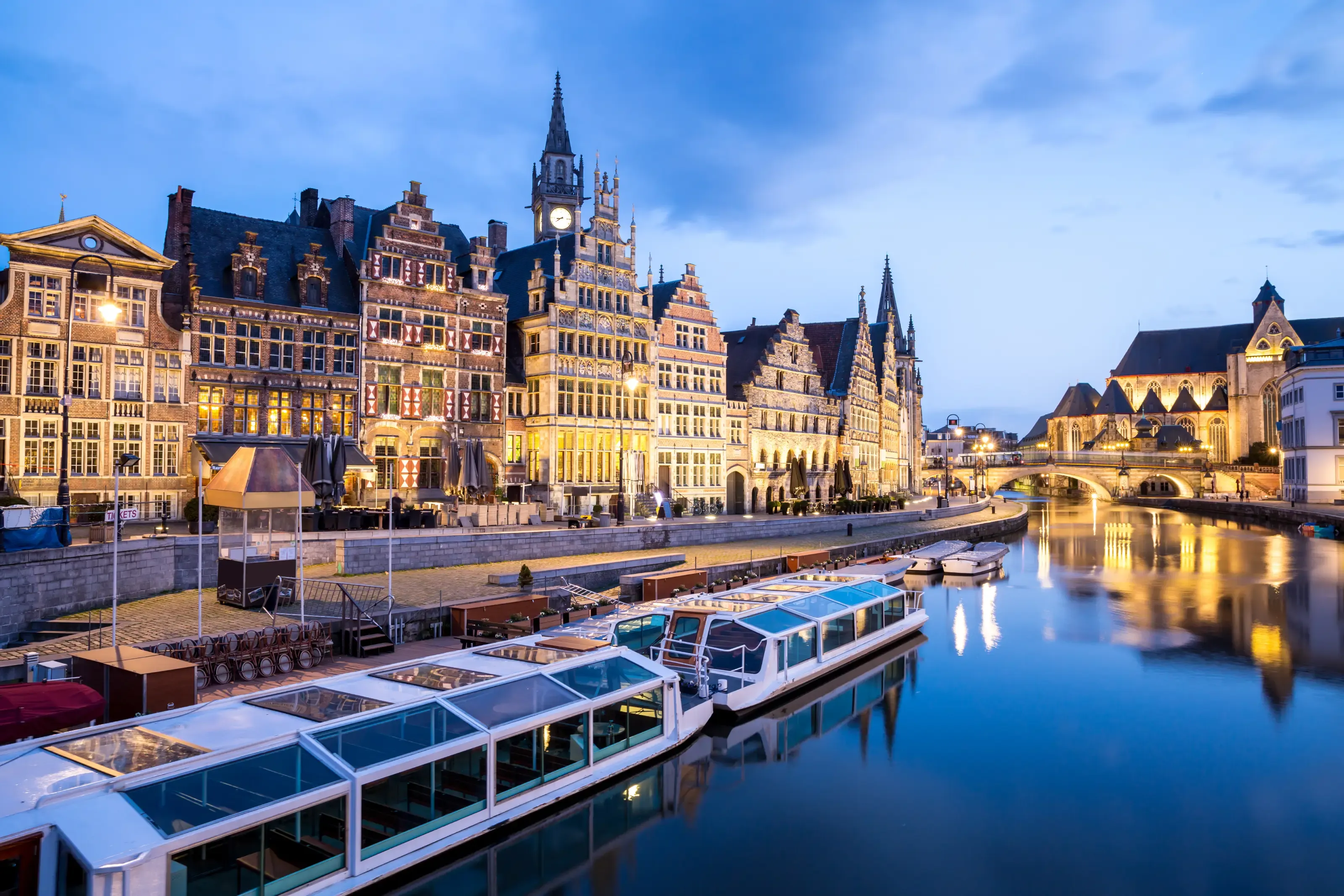
Gent/Ghent, Belgium
Data updated Sep 3, 2026
📊 Scores
Best fit: Digital Nomad (score: 80)
Ghent, Belgium: A Guide for Retirees, FIRE Seekers, and Digital Nomads
People move to Ghent for the city itself, not for a bargain, because Belgium is not a bargain. What you get for the price is one of the best-looking and most livable cities in Western Europe: a medieval Flemish core of guild houses and canals, a car-free center you can cross on foot or by bike, a serious food scene, and the loose, year-round energy of a major university town. Ghent scores 73 out of 100 overall on Rewire Abroad, with a standout 89 for retirees, and it runs 20 to 25 percent cheaper than Brussels, which makes it the value pick inside an expensive country rather than a cheap destination in absolute terms. What you should know before you romanticize it is that the trade for all that quality is a high cost of living, one of the heaviest tax regimes in Europe, daily life that happens in Dutch, and a sky that is gray more often than it is blue.
What you're actually moving into
Ghent is compact and built for people, not cars. The historic center sits where the Leie and Scheldt rivers meet, and the postcard version of it, the Graslei and Korenlei waterfront lined with stepped-gable facades, is also a place people actually live and work. The center is largely car-free, which sounds like a detail until you try to take a furniture delivery and learn the driver cannot get within two blocks of your door. You bike, you walk, you take a tram, or you wait. Most residents settle the question in week one by buying a secondhand city bike and joining the flow.
Where you live shapes both your budget and your daily life. The center and Patershol, the old cobbled quarter dense with restaurants, are the most walkable and the most expensive. Move a short ride out to Sint-Amandsberg, Ledeberg, or Gentbrugge and the rent drops noticeably while you stay firmly inside Ghent. The Vrijdagmarkt square anchors the social center of the old town, and the Friday market that gives it its name still runs.
The expat scene here is different from Brussels in a way that matters. Ghent is a Flemish university city of roughly a quarter million people with around fifty thousand students at Ghent University, so the dominant energy is local and young, not transient and international. There is no large plug-and-play nomad bubble to disappear into. That cuts both ways. You will be more embedded in Belgian life and less able to coast in English than you would in Brussels, which is a feature if integration is the point and a friction if it is not.
The weather, with the part the brochures skip
Ghent has a mild maritime climate with no real extremes. Summers are cool, winters are rarely harsh, and you will not need air conditioning or fight brutal heat. That is the upside, and it is real.
The asterisk is the gray. This is the North Sea, so the city is overcast and wet for a large share of the year, with frequent drizzle rather than dramatic storms. Winters are short on daylight in a way North Americans underestimate: in December the sun sets around half past four in the afternoon. The green you came for is green because it rains. None of this is a dealbreaker, and plenty of people grow to like the soft light and the café culture it produces, but if your mental image was sunshine, recalibrate. Keep a rain jacket by the door from October to March and use it most days.
Cost of living
Ghent is affordable only relative to Brussels, London, or Amsterdam, not in absolute terms. A single person living a comfortable mid-range life budgets around 2,650 dollars a month, which is well under Brussels but well over most of the geoarbitrage destinations people compare it to. Lean and local, with a cheaper flat and home cooking, you can run lower, but Belgium sets a high floor.
Rent is the main lever. A one-bedroom in the center runs about 920 dollars, and the same money or less gets you something larger out in Sint-Amandsberg or Ledeberg. Groceries are reasonable by European standards, and the city's markets and bakeries reward eating what Belgium actually produces. Eating out is where budgets climb, because Ghent's food scene is good enough that you will want to use it.
Here is the money reality, and it is the opposite of the dollar-economy, no-tax pitch you see in Panama or other havens. Belgium uses the euro, so dollar earners carry currency risk on income and savings. More importantly, Belgium taxes residents on worldwide income, with a top marginal rate near 50 percent plus a communal surcharge, a flat 30 percent on dividends, and, new for 2026, a 10 percent tax on capital gains from financial assets above an annual exemption. Ghent is not a place your money stretches further. It is a place you pay full European price for a high quality of life and a strategic upside. The full breakdown, including how the 2026 tax changes land for an employee versus a retiree, is in our honest guide to moving to Belgium.
The language and paperwork problem
This is the section that matters most if you are moving here rather than just visiting, and it is Ghent's version of the thing every honest city guide buries. Ghent is in Flanders, so daily administration happens in Dutch. Brussels is officially bilingual and forgiving of French and English; Ghent is not, and that changes the texture of every official errand.
Registering as a resident is the first wall. You need an address before you can register, you need to register before you get a national number, and you need that number before you can finish opening a bank account, joining the health system, or signing most contracts. Then a neighborhood officer visits your home, often unannounced, to confirm you actually live at the address on your paperwork, and nothing downstream moves until that check clears. Miss the visit and the clock resets. None of it is insurmountable, but it is slow, it is in Dutch, and it rewards people who learn some of the language and budget patience. Plan for weeks, not days.
Getting around, healthcare, and connections
You do not need a car in Ghent, which is rare for a city this pleasant. The car-free center, the trams, and a flat, bike-friendly layout make daily life easy without one. What you do get is connection. Ghent to Brussels is about half an hour by train, and Belgium's rail hub puts Paris, Amsterdam, and London within roughly two to three hours. For someone who wants a quiet home base and frequent access to the rest of the continent, the location is hard to beat.
Healthcare is a genuine strength. Belgium runs a high-functioning system built on mandatory affiliation with a health fund, and Ghent has a large university hospital in UZ Gent alongside the usual clinics and specialists. Care is good and, once you are inside the system, costs are a fraction of US prices. The catch is the entry sequence: you need to register, join a health fund, and carry private insurance in the gap before your coverage starts, which loops back to the paperwork section above.
Belgium's visa options
Belgium is honest about who it wants, and it is not retirees on passive income. There is no retirement visa, no passive-income visa, and nothing like the off-the-shelf digital nomad visas that Spain or Portugal hand out. The routes that exist are these.
If you have a job offer, you arrive on the single permit, applied for by your employer through the relevant regional authority, with timelines and salary thresholds that differ across Flanders, Wallonia, and Brussels.
If you are self-employed or work remotely, the route is the self-employed professional card, which RewireAbroad also catalogs as the Belgium Digital Nomad Visa. It expects a viable business plan and proof your activity serves a Belgian economic interest, so it is more paperwork than a true nomad visa, but it is the door that exists for location-independent earners.
If your spouse is an EU citizen, that is the cleanest path available, and you should take it.
The reason any of this is worth the bureaucracy is the long game. Five years of legal residence can lead to a Belgian passport, which is an EU passport, with dual citizenship allowed. The current language bar is A2, though the government has announced a tightening toward B1 and a nationality exam, so the calculus favors starting sooner rather than later. The visa, tax, and citizenship math is laid out in full in our guide to moving to Belgium.
Who Ghent is for
Ghent is close to ideal for the retiree or relocating professional who wants serious Western European city life, healthcare that works, world-class train access, and a real path to an EU passport, and who can absorb the cost and the tax to get it. Inside Belgium it is the value pick, beautiful, walkable, and cheaper than Brussels without feeling like a compromise, which is why it scores 89 for retirees. If a European base and long-term optionality are what you are buying, Ghent delivers.
It is the wrong city for the pure FIRE or cheap-living seeker. Its 60 FIRE score is the honest signal: Belgium's taxes and costs cap how fast you actually save, so if your goal is to stretch a portfolio as far as it will go, your money works harder almost anywhere in the geoarbitrage tier than it does here.
For the digital nomad it is a maybe. The quality of life, the car-free living, and the connections to the rest of Europe are excellent, but the admin is in Dutch, there is no dedicated nomad visa, and the social world skews local and student rather than the coworking-and-cocktails scene of Lisbon or Tbilisi. Go in wanting what Ghent actually is, a gorgeous, serious Flemish university city with a passport upside, rather than what a cheap-and-sunny city guide trained you to expect.
Visa, tax, and cost figures verified June 2026. Belgium introduced a capital gains tax on financial assets in 2026 and has announced tighter citizenship language rules, and figures shift, so confirm current requirements with a licensed immigration or tax professional before you apply. Full detail in our guide to moving to Belgium.
🏚️ Cost of Living
💰 Budgets and Costs
Grocery Basket
Eating Out
Utilities & Lifestyle
Housing
A 1BR in the center runs about $920/mo. If your income is in another currency, bank FX fees add up. A multi-currency account can cut that cost.
See low-fee transfersWe may earn a commission at no cost to you.
💰 Real Spend Reports
🛡️ Safety & Crime
(Higher is safer)
(Lower is safer)
Gent is genuinely safe for expats, with low violent crime and a well-policed city center. Petty theft and bike theft are the main concerns—secure belongings and use sturdy locks. Avoid the Sint-Jacobs area late at night and exercise standard urban caution in less-touristy neighborhoods. The city's compact, walkable layout and strong police presence make it comfortable for remote workers and retirees. No significant geopolitical risks. Overall: a solid choice for Americans seeking a secure European base.
🏥 Healthcare
🌤️ Climate
Best Months
Climate Notes
Oceanic climate with mild summers and cool, damp winters.
💻 Digital Nomad
Community Notes
| Name | Price/mo | Notes |
|---|---|---|
| Bar d'Office | $250 | Located in the heart of Ghent, Bar d'Office offers a vibrant and social coworking environment with a focus on community. It's a great option for expats looking to connect with other professionals and enjoy a lively atmosphere. |
| Fosbury & Sons Ghent | $400 | Fosbury & Sons offers a premium coworking experience with stylish design and high-end amenities. Situated in a renovated historical building, it provides a sophisticated workspace for remote workers seeking a professional environment. |
| Spaces Ghent Meeting Center | $280 | Part of the IWG network, Spaces Ghent Meeting Center provides a reliable and well-equipped coworking space with flexible options. Its central location and professional services make it a convenient choice for digital nomads. |
| The Desk | $220 | The Desk offers a more budget-friendly coworking option in Ghent, without sacrificing essential amenities. It's a good choice for remote workers who prioritize affordability and a functional workspace. |
Planning to live in Gent/Ghent long-term? Belgium Digital Nomad Visa lets remote workers live legally with a minimum income of $765/month.
View full requirements →Working remotely from Gent/Ghent? Nomad health insurance covers you across borders, month to month.
See nomad insuranceWe may earn a commission at no cost to you.
🧳 Expat Life
Expat Life Notes
A stunning student city that is safer and more manageable than Brussels. English is widely used.
Pros
- ✓ Walkable historic center
- ✓ Safe
Cons
- ✗ Rainy
- ✗ Dutch needed for residency
🛂 Visa Options for Belgium
Many long-stay visas require proof of health insurance. Compare international health plans before you apply.
Compare health insuranceWe may earn a commission at no cost to you.
Earning over $765/mo? You may qualify for a Belgium visa.
Answer 10 questions and get a personalized match in under 2 minutes.
Could living/working in Gent/Ghent cut years off your work life?
With a 1-bedroom in the center at $736/mo, your FIRE number here might be much lower than you think.
Moving to Gent/Ghent? Estimate what an international move would cost and compare mover quotes.
Estimate my move costShare This Guide
Gent/Ghent won't stay this cheap forever.
Cost-of-living and visa updates for Gent/Ghent and the rest of Belgium. Free with RA Postcards.
By submitting your email address, you will receive a free subscription to RA Postcards and special offers from Rewire Abroad and our affiliates. You can unsubscribe at any time, and we encourage you to read more about our Privacy Policy.