US Taxes for Americans Abroad: What You Still File and Pay
Rewire Abroad guide. Last checked October 8, 2026. Figures cover tax years 2025 and 2026.
Not tax advice. This guide explains how the main US rules work for citizens and green card holders who move abroad. Rules change and your situation may differ, so confirm anything important with the IRS or a US expat tax preparer before you act.
Moving abroad does not end your US tax obligations. The United States taxes citizens and green card holders on worldwide income, wherever they live. What changes is how you file, which exclusions and credits you can use, and which extra reports you owe once you have accounts and investments overseas. This guide covers the rules that matter most for people planning a move, in the order you are likely to meet them.
The short version
- You generally still file a US federal return every year on worldwide income, even if you owe nothing.
- The Foreign Earned Income Exclusion (FEIE) lets you exclude up to $132,900 of foreign earned income for 2026 ($130,000 for 2025), but only for earned income and only if you qualify.
- Self-employment tax is not reduced by the FEIE. Freelancers usually still owe it unless a totalization agreement applies.
- If your foreign accounts together topped $10,000 at any point in the year, you must file an FBAR with FinCEN.
- Foreign-domiciled mutual funds and ETFs can trigger punishing PFIC tax rules.
- Your old state may still claim you as a resident after you leave.
- Penalties for missed forms can be severe even when no tax is due.
1. Who has to file
US citizens and green card holders generally have to file a federal return when their income is above the filing threshold, regardless of where they live or where the income comes from. Living abroad gets you an automatic two-month extension (more on deadlines below), not an exemption. Claiming the FEIE or the Foreign Tax Credit requires filing a return, so even if your US tax comes to zero you still file.
2. The Foreign Earned Income Exclusion (FEIE)
The FEIE lets qualifying taxpayers exclude a capped amount of foreign earned income from US income tax.
- Limit: $132,900 for tax year 2026 and $130,000 for 2025. The limit is adjusted for inflation each year. A return you file in 2026 for 2025 uses the 2025 figure.
- Per person: each qualifying spouse can claim their own exclusion.
- How to claim it: file Form 2555 with your return. You must file a return to claim it.
- Earned income only: wages and self-employment income for work you perform abroad. Dividends, interest, capital gains, rental income, and most pensions do not qualify.
- Not an exemption above the cap: income over the limit is taxed. Under the stacking rule, that remaining income is taxed at the rates that would have applied if you had not excluded anything, so it starts in a higher bracket.
- Partial years: the maximum is prorated by the number of qualifying days in the tax year, so the year you move usually gets a smaller exclusion.
To claim the FEIE you need three things: foreign earned income, a tax home in a foreign country, and a pass on one of the two residency tests below.
3. The two FEIE tests
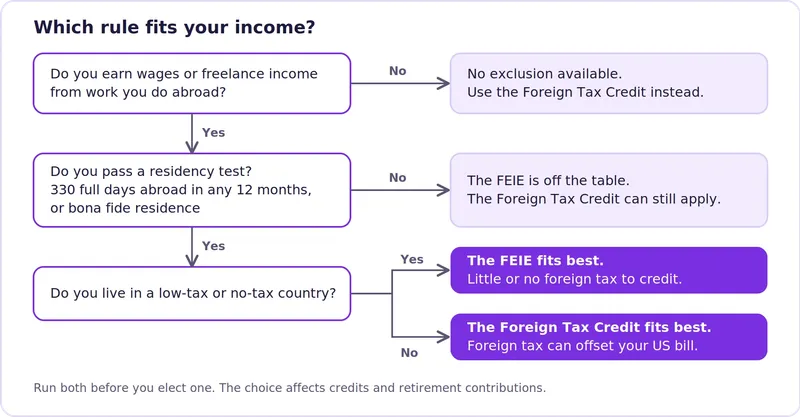
Physical Presence Test. You must be physically present in one or more foreign countries for at least 330 full days during any period of 12 consecutive months. The days do not have to be consecutive, and the 12-month window does not have to match the calendar year. A full day is a complete 24-hour day, midnight to midnight, so travel days into and out of the US usually do not count. Time in the US eats into your 35 allowed days.
Bona Fide Residence Test. You must be a genuine resident of a foreign country for an uninterrupted period that includes an entire tax year. It looks at your intentions and ties, such as a lease, local registration, and how long you plan to stay, rather than counting days. Being a tourist does not qualify.
If you cannot meet either test, you cannot claim the FEIE, but you may still use the Foreign Tax Credit.
4. FEIE or Foreign Tax Credit?
The Foreign Tax Credit (Form 1116) reduces your US tax by the income tax you paid to a foreign country. You cannot claim a credit for tax on income you excluded under the FEIE, so you generally pick one approach per income stream.
- The FEIE tends to work best when you live in a low-tax or no-tax country.
- The Foreign Tax Credit tends to work best when you live in a high-tax country, because the foreign tax you pay can offset most or all of your US bill, and it also covers income the FEIE doesn't, like investment income.
- The choice has knock-on effects on credits and retirement contributions, so run both before you elect one.
5. Self-employment tax and Social Security
This is the rule most often missed by remote workers.
- Freelancers and contractors: the FEIE does not reduce self-employment tax. You owe 15.3% on 92.35% of your net self-employment earnings (12.4% Social Security plus 2.9% Medicare), even if the exclusion eliminates your income tax. A freelancer who excludes $100,000 can still owe roughly $14,000 in self-employment tax.
- Employees of a US company: wages from a US employer generally stay subject to US Social Security and Medicare tax, even if you work from another country. Wages from a foreign employer for work performed abroad are generally not, but the structure matters.
- Totalization agreements: the US has Social Security agreements with roughly 30 countries. In those countries you usually pay into one system, not both, and a certificate of coverage proves which one. Without an agreement, there is no formal way out of US self-employment tax.
Check whether your destination has a totalization agreement before you plan around savings numbers.
6. FBAR: reporting foreign accounts
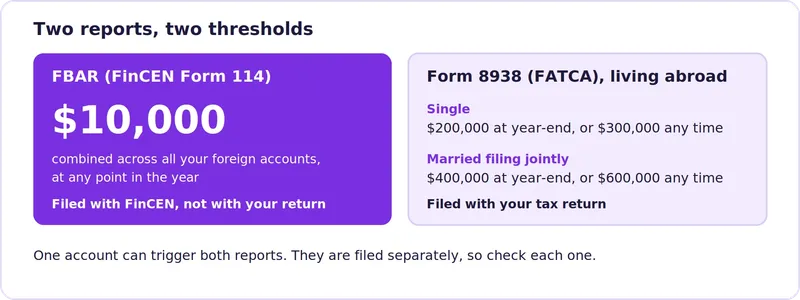
The Report of Foreign Bank and Financial Accounts (FBAR, FinCEN Form 114) is required if you have a financial interest in or signature authority over foreign financial accounts whose combined maximum value exceeded $10,000 at any time during the calendar year.
- It's aggregate: three accounts at $4,000, $3,500, and $3,000 total $10,500, so you file for all three.
- It's not an IRS form: you file it electronically with FinCEN through the BSA E-Filing System, separate from your tax return.
- Deadline: April 15, with an automatic extension to October 15.
- Penalties: non-willful failures are generally capped per year, while willful violations can reach the greater of about $100,000 or 50% of the account balance, per year.
If you move savings abroad, even briefly, you will probably cross this threshold. Our Currency Transfer Planner helps you model the transfer. The FBAR is a reporting step you should plan for alongside it.
7. FATCA: Form 8938
Form 8938 is a separate disclosure filed with your tax return when your specified foreign financial assets pass a higher threshold. For taxpayers living abroad, the thresholds are:
Filing status | Year-end value | Any time in the year |
Single | $200,000 | $300,000 |
Married filing jointly | $400,000 | $600,000 |
Thresholds for people living in the US are much lower, so they change if you spend part of the year back home. An account can need both an FBAR and a Form 8938, because the two reports overlap but are filed separately.
8. The PFIC trap
A Passive Foreign Investment Company (PFIC) rule applies punitive tax and reporting to many non-US funds. Most mutual funds and ETFs that are domiciled outside the US, including European UCITS ETFs, are PFICs for US taxpayers. You may owe tax at the highest rates plus an interest charge on gains, and you file a separate Form 8621 for each fund each year.
The test is where the fund is domiciled, not where you live. US-domiciled funds are generally not PFICs. Many expats avoid the problem by keeping their investments in US-domiciled funds. If a local bank or adviser offers you a fund, ask whether it is a PFIC before you buy. Some foreign pensions and insurance products can be PFICs too.
9. State taxes
Leaving the country does not automatically end your state tax residency. Some states, California among them, are known for being hard to leave, and they may keep taxing you until you can show you've broken your ties. What tends to matter is your domicile, meaning where your home is intended to be, plus ties like a home, a driver's license, voter registration, and family. Read your old state's rules before you go, and keep records of the date and facts of your departure.
10. The year you move
The move year is usually the messiest return you will file. Expect to deal with:
- A prorated FEIE, since you only count the days that qualify.
- Income split between US and foreign sources, and between earned and unearned.
- Selling a home, a car, or investments before you leave.
- Your old state's rules for part-year residents.
- Opening your first foreign accounts, which can trigger the FBAR.
If you are planning a move, a short session with an expat tax preparer before you leave is often cheaper than fixing the return afterward.
11. Deadlines
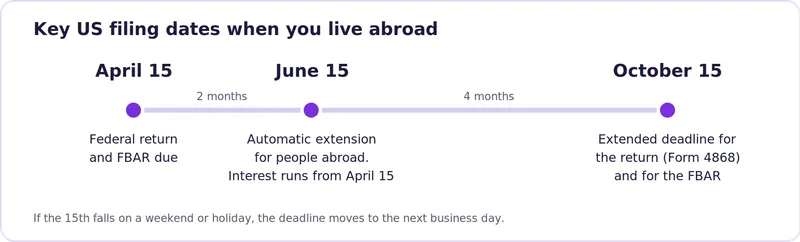
- April 15: the usual due date for your federal return.
- June 15: taxpayers living abroad get an automatic two-month extension to file. Interest still runs on any tax you owe from April 15.
- October 15: you can request a further extension with Form 4868.
- FBAR: April 15, with an automatic extension to October 15.
12. If you have missed years
Many expats find out about these rules years late. The IRS runs Streamlined Filing Compliance Procedures for people whose failure to file was non-willful. Talk to a tax attorney or enrolled agent who handles expat cases before you file anything late, since the right path depends on your facts.
Checklist before you move
- Confirm which FEIE test you will rely on and mark the dates.
- Check whether your destination has a totalization agreement with the US.
- Find out your destination's tax residency rules and any special regime for new arrivals.
- Plan state tax residency: decide when and how you will break ties.
- Check your investments for PFICs, and keep them in US-domiciled funds where you can.
- Add up the foreign accounts you expect to open, and plan for the FBAR (and Form 8938 if you are over the threshold).
- Talk to an expat tax preparer about the move year.
Find Your Ideal Expat Visa
10 quick questions to match you with the right visa.
Where do you hold a passport?
Determines which visas are open to you. If you hold multiple passports, pick the one you would apply with.
Tax in your destination
US rules are only half the picture. Most countries also tax residents, often once you pass a threshold around 183 days, though rules vary. Some digital nomad visas and special regimes reduce or exempt tax on foreign-sourced income, and others do not. A tax treaty or the Foreign Tax Credit can limit double taxation. Use our Country Tax Comparison to see income, capital gains, and dividend tax rates by country, and confirm the rates for your situation with the local tax authority before you decide.
Tax is one filter among several. Browse countries and cities to compare cost of living and lifestyle, take the Visa Quiz or browse all visas to see which route fits your income, and price the shipment with the Move Cost Estimator.
Model your numbers
- Geo-Arbitrage Planner: a quick savings estimate for a city pair.
- Advanced Geo-Arbitrage Simulator: model FEIE, state tax, and your FIRE timeline side by side.
- Country Tax Comparison: income, capital gains, and dividend tax by country.
- Currency Transfer Planner: plan the transfer of savings in stages.
- Move Cost Estimator: budget shipping and get mover quotes.
- Visa Quiz: get matched to visas that fit your income and nationality.
- Visas: browse digital nomad, retirement, and investor visas.
- Countries and Cities: research where to live.
Investing from abroad
These are educational planning tools, not investment or tax advice. Foreign-domiciled funds can trigger PFIC rules, so check any holding with an expat tax preparer before you buy.
- FIRE Procrastination Penalty Calculator: see what delaying your investing costs.
- High-Yield Investment Calculator: run the numbers on high-yield investments.
- DRIP vs NAV Growth Calculator: compare dividend reinvestment strategies.
- Dividend Portfolio Shield: estimate the cost of protective puts.
Official sources
- IRS:Foreign earned income exclusion, physical presence test
- IRS:About Form 2555
- IRS:Publication 54, Tax Guide for US Citizens and Resident Aliens Abroad
- FinCEN:BSA E-Filing System (FBAR)
Need help with your return?
A preparer who handles expat returns can tell you what to send before you leave and what to file after you arrive. Talk to an expat tax preparer. We may earn a commission at no cost to you. See our affiliate disclosure.

Why Americans Are Choosing to Retire Overseas
Discover why more Americans are retiring abroad and explore the best destinations, cost comparisons, and real-life expat stories.

Global Retirement Guide: Tax-Friendly Destinations & Estate Planning for Americans
Discover top tax-friendly countries for American retirees and essential estate planning tips to secure your financial future abroad.
.svg)
Retire Abroad Tax Guide: Complete IRS Requirements for US Expats
Master US tax obligations when you retire abroad. Complete guide to FBAR, FATCA, tax treaties, and foreign income exclusion for US retirees overseas.
The FIRE Tax Optimization Playbook: Save $10K+ Annually
Master advanced tax strategies to accelerate your FIRE journey. Mega backdoor Roth, tax-loss harvesting, HSA optimization, and geographic arbitrage.