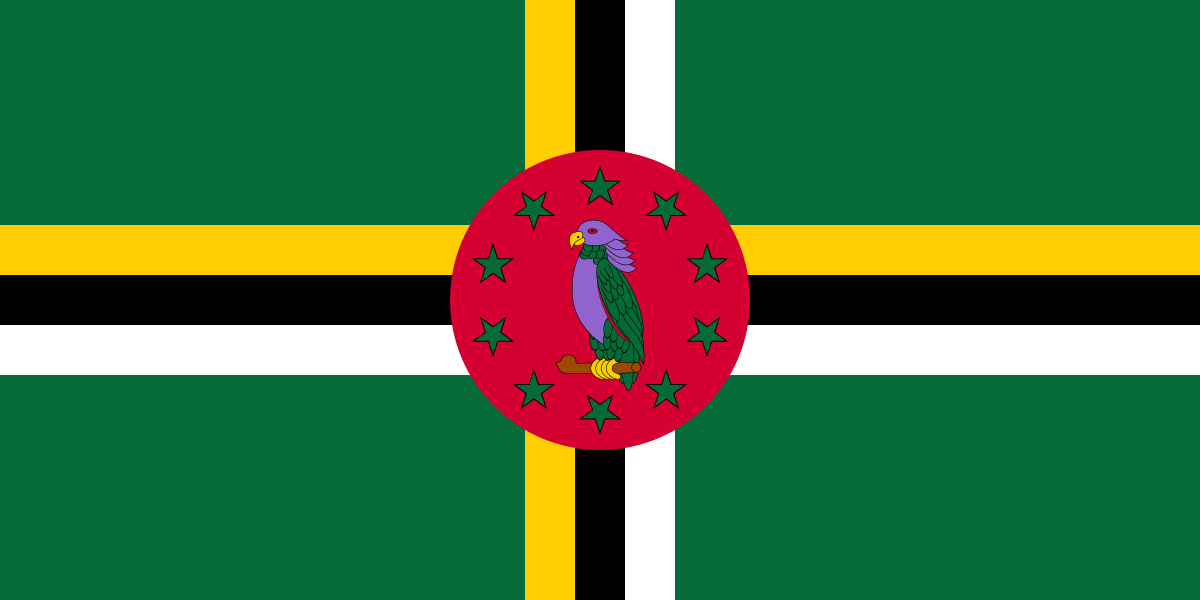
Dominica
Data updated Sep 16, 2026
Overall Score
61.4
Good
Avg. Rent (1BR)
$284
-83% vs US Avg
Safety Index
64.3
COL Index
34.4
Dominica is a serious option for a very specific type of person: someone who wants a genuinely low-cost English-speaking Caribbean base, does not need urban infrastructure, and can tolerate island logistics in exchange for near-zero crowds and a slower pace. The island is not a digital nomad hub and it is not trying to be. It suits early retirees or FIRE individuals with $2,000 to $3,000 per month who want to live outside the tourist circuit without the language barrier that comes with most of Central America. Dominica is also one of the few countries in the world where citizenship by investment starts around $100,000 via its Economic Citizenship Programme, which some Americans pursue for travel flexibility, though it does not change US tax obligations.
The numbers here are among the lowest you will find in the Caribbean. Living costs without rent run roughly $974 per month for a single person, and a one-bedroom in a city center runs about $284 per month. That puts a realistic all-in budget for a single person at $1,300 to $1,600 per month if you are cooking at home, driving a used car, and not eating at restaurants built for cruise passengers. The marketing tends to skip the import-heavy grocery prices. Roseau is not Chiang Mai. A box of cereal or a bottle of decent wine will cost more than you expect because nearly everything consumable arrives by container ship, and that markup is real and consistent.
The practical friction starts with getting there. Dominica has no international jet service. You are routing through Barbados, Antigua, or another hub, often on LIAT or a regional carrier, which adds cost and unreliability to every trip. Healthcare is the other honest concern. The healthcare index of 53.9 reflects a system that handles routine care adequately but has real limitations for anything complex. Medical evacuations to Barbados or Martinique happen, and they are expensive without proper coverage. Infrastructure took a significant hit from Hurricane Maria in 2017 and recovery has been uneven. Roads in the interior are steep and sometimes rough. Power and internet outages are more frequent than in Panama or Mexico, which matters if you are working remotely with client calls.
US citizens owe taxes to the IRS regardless of where they live, so moving to Dominica changes your lifestyle costs but not your filing obligations. Dominica has no tax treaty with the United States, which means you cannot use treaty provisions to reduce double taxation. Your main tools are the Foreign Earned Income Exclusion, which lets you exclude up to $126,500 in earned income for 2024 if you pass the bona fide residence or physical presence test, and the Foreign Tax Credit, which offsets US tax with taxes paid to Dominica. Dominica does tax residents on local income, but most expats living on foreign-sourced retirement income or investment distributions will find their Dominican tax exposure minimal. FBAR and FATCA reporting requirements apply as always if your foreign accounts exceed the relevant thresholds.
Recommended Destinations in Dominica
Best for Retirees
Best for Geoarbitrage
Best for Remote Workers
- Capital
- Roseau
- Official Language
- English
- Time Zone
- UTC-04:00
- Region
- Latin America
- Population
- 71,991
- Healthcare Index
- 53.9
- Internet Speed
- 25 Mbps
View on Interactive Map
Explore data visually
🏙️ Top Cities in Dominica
Explore cost of living, walkability scores, and expat ratings for individual cities in Dominica.
CoL Index: 34
Est. Total: ~$934/mo
CoL Index: 34
Est. Total: ~$1,233/mo
CoL Index: 34
Est. Total: ~$2,173/mo
How far does $1,500 go in Dominica?
With a monthly budget of $1,500, you can live comfortably in Dominica. After accounting for an average rent of $$284, you have approximately $1,216remaining for daily expenses.
Calculate your FIRE timeline with these costs →💰 Cost of Living in Dominica
Relative to New York City (NYC = 100). A lower number means it's cheaper.
🛒 Grocery & Family Costs
Family Costs
Can I afford to live in Dominica?
Comfortable (1.0×): balanced baseline lifestyle. Adjusts day-to-day costs only — rent is unaffected.
Dominica
You could save
1,743/mo
Monthly Costs
Attractiveness Scores
Based on national averages. City-level costs may vary. Browse cities in Dominica →
⚕️ Healthcare System
Our Top Pick for Nomads: SafetyWing
Flexible, subscription-based health cover for remote workers in Dominica.
Get Covered with SafetyWing →Looking for more options? Check Ekta.
An estimation of the overall quality of the health care system. Higher is better.
Quality & Affordability:
Dominica's government provides free primary healthcare for its citizens at major healthcare centers and numerous clinics. The system is grounded in a strong primary healthcare approach.
Insurance Insights:
Public healthcare services are free, with private options available for those seeking specialized care.
🛂 Visa & Residency Pathways
🛂 Visa Services
Ready to apply for a Dominica visa?
Get help with your application — tourist, long-stay, and residency visas processed online.
General Overview
Available Visa Types:
🛂 Visa Matcher
See which Dominica visas you qualify for
Answer 10 quick questions and get matched to the right visa for your situation.
Free · No signup required to see results
Detailed Visa Options
📈 Investor Visa
Investment Details
Path to Citizenship
🛡️ Safety & Stability
An estimation of overall safety level. Higher is better.
World Bank political stability estimate, rescaled to 0-100. Higher is better.
Safety Notes:
Crime Rate: Low. Dominica is generally safe, with occasional petty crimes.
Types of Crime: Theft and burglary, particularly in tourist areas.
Kidnapping Risk: Very low; no significant threat reported.
🏦 Taxation & Finance
🏦 Tax Snapshot
FEIE Interaction
FTC Utility: low
Dominica's top personal income tax rate is 25%, which is lower than the top US federal rate of 37%. For many US expats, the FEIE is the preferred mechanism. If Dominican income tax is actually paid, a foreign tax credit can reduce US liability on income exceeding the FEIE limit, but the relatively low Dominican rates mean the FTC offsets less US tax than in higher-tax jurisdictions.
Presence Day Count Notes
The physical presence test requires 330 full days outside the US in any 12-month period. Dominica is an eligible foreign country for this purpose. Days spent in Dominica count toward the 330-day requirement.
FBAR Trigger Notes
US persons with financial accounts at Dominican institutions exceeding $10,000 in aggregate must file FinCEN 114. Dominica's banking sector includes several offshore-licensed banks under the National Bank of Dominica and a handful of smaller commercial banks. Account holders should track all accounts including those at ECCU-member institution branches.
401k/IRA Treatment
Pension Income
Foreign pension income remitted to or received in Dominica by a tax resident may be subject to income tax at the standard progressive rates. Dominica does not maintain a comprehensive list of exempt pension types equivalent to treaty countries. Rate depends on total taxable income.
Locally TaxedSocial Security
No US-Dominica tax treaty exists. US Social Security benefits received by a Dominican resident are foreign-source income. Dominican tax practice generally does not tax foreign pension-type income for non-domiciled individuals, but formal statutory guidance is limited.
Not Taxed LocallyRoth Distributions
Roth distributions are generally after-tax contributions returned to the account holder. Dominican tax law does not have specific provisions addressing Roth accounts. Because Dominica taxes on a territorial or remittance basis for certain income types, in practice many foreign-source distributions may not be taxed, but this carries uncertainty given the absence of a treaty and limited published guidance.
Not Taxed LocallyUS 401k/IRA Distributions
Dominica has no tax treaty with the United States. US 401k and IRA distributions received by a resident of Dominica would be treated as foreign-source income and potentially subject to Dominican income tax under general rules. The applicable rate depends on total income and the standard progressive brackets (0%, 15%, 25%). No specific exemption or treaty protection exists.
Locally TaxedCapital Gains Tax
Dominica does not levy a capital gains tax on individuals or corporations. Gains from asset disposals are generally not subject to tax.
No capital gains tax exists in Dominica. Asset disposals do not generate a separate taxable event for either individuals or companies.
Dividend Tax Rate
Dominica imposes withholding tax on dividends paid to non-residents. Dividends received by residents from Dominican companies are generally exempt from further income tax at the individual level. The standard withholding rate on dividends paid to non-residents is 15%.
withholding
Rate: 15.0%
Applied to dividends paid to non-resident recipients
exempt
Rate: 0.0%
Dividends received by resident individuals from local companies are generally not subject to additional income tax
Tax Treaties Notes:
Dominica does not have an income tax treaty with the United States, which may result in potential double taxation for U.S. citizens residing in Dominica. However, the two countries have an intergovernmental agreement to implement FATCA, facilitating the exchange of tax information.
Retiree Tax Benefits:
No specific tax benefits for foreign retirees have been identified in Dominica. U.S. citizens must comply with U.S. tax obligations on their global income.
Cost Savings vs. U.S.:
Dominica offers a lower cost of living compared to the United States, with affordable housing and utilities, making it appealing for retirees.
Recommended services for Dominica
Recommended Partner
Fidelity →Recommended Partner
IBKR →Recommended Partner
bordr →Recommended Partner
My Expat Taxes →☀️ Climate & Environment
Seasonal Variations:
Dominica has a tropical climate with two main seasons: a dry season from December to May and a wet season from June to November. The island receives abundant rainfall, especially in the interior, and is prone to hurricanes during the wet season.
😊 Quality of Life
🌐 Infrastructure & Connectivity
Recommended services for Dominica
Recommended Partner
Traveling Mailbox →Recommended Partner
US Global Mail →Recommended Partner
HideMy.Name →Recommended Partner
Veepn →Frequently Asked Questions about Dominica
Click any question to expand the answer.
Share This Guide
Planning Your Move to Dominica?
Estimate shipping costs in 60 seconds. Compare sea freight vs. air freight and get free quotes from verified international movers.
Estimate your move to Dominica →Powered by Sirelo. Free quotes from verified movers.
Not Sure Which Visa Fits Dominica?
Take the 2-minute quiz to see which visas you qualify for in Dominica and beyond.
Take the 2-Minute Quiz →Dominica's rules change. We'll tell you when.
Visa, tax, and cost updates for Dominica, before they catch you out. Free with RA Postcards.
By submitting your email address, you will receive a free subscription to RA Postcards and special offers from Rewire Abroad and our affiliates. You can unsubscribe at any time, and we encourage you to read more about our Privacy Policy.