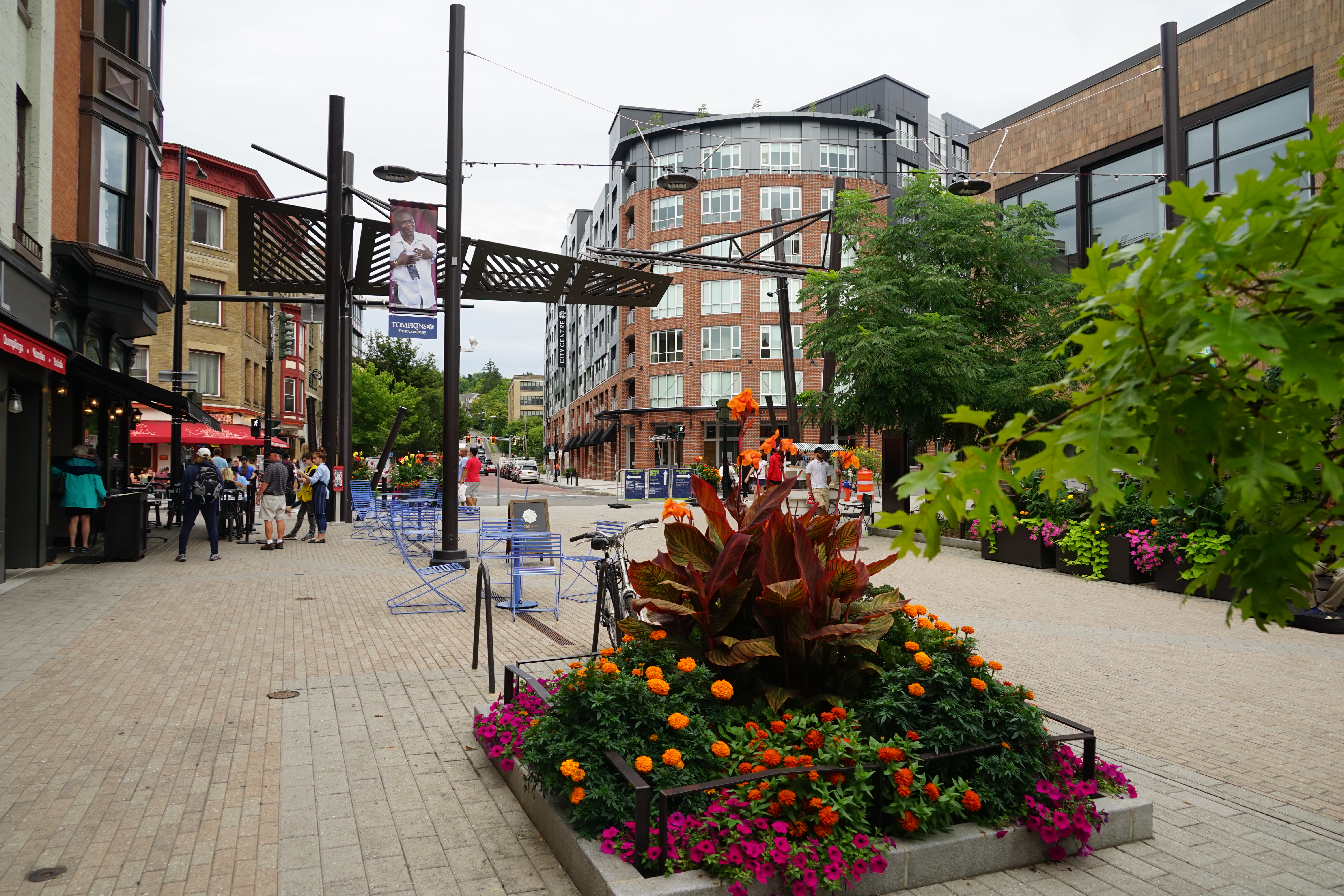
Cornell and Ithaca College employ roughly 40% of the local workforce directly, making this a university-dependent economy with limited diversification. Beyond academia, tourism, healthcare, and the local food movement (farmers market, craft breweries, farm-to-table restaurants) generate secondary income. Remote work is common among expats here—the universities attract researchers and academics, but freelancers and digital nomads also settle in because of the intellectual atmosphere and reliable internet. Job hunting outside education is competitive; most non-academic employment pays modestly.
Rent for a one-bedroom in the city center runs $1,950/month—steep for upstate New York, driven by student demand and limited supply. TCAT buses are free for Cornell/IC students but cost others $1.25 per ride; a car is nearly essential for errands outside downtown. Healthcare is solid (Cayuga Medical Center is competent), and no visa complications exist for US citizens. Bureaucracy is standard American. The real friction: winters dump 70–80 inches of snow annually, and the town empties during summer and winter breaks, creating a ghost-town feel.
Winters are brutal and long; summers are mild and gorgeous. The food scene punches above its weight—local farms, breweries, and restaurants reflect genuine agricultural roots, not tourism theater. Cultural offerings (live music, theater, galleries) are robust for a town this size, though the expat community is small and transient. Weekends mean hiking the gorges, farmers market browsing, or driving to nearby Finger Lakes wineries. Ithaca suits remote workers, academics, and people who genuinely enjoy snow and don't mind isolation.
Estimate the cost of moving to Ithaca, NY, United States
Get a free moving cost estimate for moving to Ithaca, NY, United States. Takes 10 seconds.
How much are you shipping?
When are you moving?
Powered by Sirelo. Free quotes from international movers.
🏚️ Cost of Living
💰 Budgets and Costs
$2,314/mo, one person, rent included
Selected: budget lifestyle
Ithaca, NY at the budget tier comes to about $2,314 a month for one adult, with $1,700 of that going to rent. Beyond rent the estimate covers $174 on groceries, $80.00 on dining out, $51.00 on entertainment and lifestyle, $264 on utilities and connectivity and $45.00 on transport.
Rent
$1,700/mo
1BR outside the centre
Groceries
$174/mo
75% of mid-range grocery spend
Dining out
$80.00/mo
4 inexpensive meals
Entertainment & lifestyle
$51.00/mo
1 cinema trip, 8 cappuccinos
Utilities & connectivity
$264/mo
utilities, mobile, internet
Transport
$45.00/mo
Monthly pass
Budgets (excl. rent)
Single person$614/mo
Excludes rent. The total above is all-in, rent included.
$2,563/mo, one person, rent included
Selected: mid-range lifestyle
Ithaca, NY at the mid-range tier comes to about $2,563 a month for one adult, with $1,700 of that going to rent. Beyond rent the estimate covers $232 on groceries, $200 on dining out, $122 on entertainment and lifestyle, $264 on utilities and connectivity and $45.00 on transport.
Rent
$1,700/mo
1BR outside the centre
Groceries
$232/mo
Staples basket scaled to a full month
Dining out
$200/mo
10 inexpensive meals
Entertainment & lifestyle
$122/mo
gym, 2 cinema trips, 12 cappuccinos
Utilities & connectivity
$264/mo
utilities, mobile, internet
Transport
$45.00/mo
Monthly pass
Budgets (excl. rent)
Single person$863/mo
Excludes rent. The total above is all-in, rent included.
$3,345/mo, one person, rent included
Selected: comfortable lifestyle
Ithaca, NY at the comfortable tier comes to about $3,345 a month for one adult, with $2,167 of that going to rent. Beyond rent the estimate covers $325 on groceries, $360 on dining out, $184 on entertainment and lifestyle, $264 on utilities and connectivity and $45.00 on transport.
Rent
$2,167/mo
1BR in the centre
Groceries
$325/mo
140% of mid-range grocery spend
Dining out
$360/mo
6 inexpensive meals + 6 mid-range meals
Entertainment & lifestyle
$184/mo
gym, 4 cinema trips, 20 cappuccinos
Utilities & connectivity
$264/mo
utilities, mobile, internet
Transport
$45.00/mo
Monthly pass
Budgets (excl. rent)
Single person$1,178/mo
Excludes rent. The total above is all-in, rent included.
Estimates for one adult, built from this city's average prices and the usage shown for each tier. Your spending will differ with how often you eat out and where you live.
A 1BR in the center runs about $2166.67/mo. If your income is in another currency, bank FX fees add up. A multi-currency account can cut that cost.
Ithaca is genuinely one of the safest mid-sized cities in the US, with a strong community-oriented culture anchored by Cornell University and Ithaca College. Walking at night is generally safe, even in downtown areas, and residents report high comfort levels. The college presence creates a youthful, engaged population invested in neighborhood safety. This isn't reputation inflation—crime rates consistently rank well below national averages.
Property crime (petty theft, car break-ins) occurs occasionally, particularly near campus areas where students congregate, but violent crime is rare. Avoid isolated gorge trails after dark and be cautious with valuables in high-traffic student zones. Solo female travelers report feeling secure; harassment is uncommon. The main risk is opportunistic theft rather than predatory crime. Winter weather poses more practical hazards than criminal activity.
Ithaca benefits from stable local governance, reliable police presence, and minimal political instability. As a progressive college town in upstate New York, it experiences typical American civic dynamics without corruption concerns or safety infrastructure issues. For Americans 30-65 considering relocation, this is a low-risk choice—ideal if you value walkability, community engagement, and genuine safety over urban amenities. The trade-off is limited nightlife and smaller job market outside academia.
Ithaca, NY has a safety index of 62.5/100. Petty theft and lost belongings are the most common problems for newcomers. Compare travel insurance before you go.
See how Ithaca, NY's healthcare compares with Milwaukee, WI
🌤️ Climate
Summer Temp
22°C
Winter Temp
-4°C
Humidity
68%
Air Quality Index
35
Pollution Index (lower is better)
20.5
Climate Index (higher is better)
60.42
Annual Rainfall
1245 mm
Best Months
MayJunSepOct
Climate Notes
Ithaca has a humid continental climate with cold, snowy winters (December–February) and mild summers, offering distinct seasons ideal for those seeking seasonal variety.
Commute & Property
Commute Time Index
18.4
Price to Income Ratio
3.87
Indices last read Nov 12, 2026.
💻 Digital Nomad
Avg Internet Speed
210 Mbps
Internet (monthly)
$50/mo
Coworking Availability
Abundant
Coworking Spaces Nearby
0
Digital Nomad Score
82/100
Community Notes
Ithaca is a vibrant college town with a strong focus on sustainability and education.
A community-focused coworking space in downtown Ithaca, CoLab offers a collaborative environment with various membership options. It's known for its supportive atmosphere and is conveniently located near restaurants and shops, making it ideal for digital nomads.
Located in the heart of Ithaca's downtown Commons, Regus provides a professional and flexible workspace solution. It offers a range of options from hot desks to private offices, suitable for remote workers seeking a structured environment with easy access to amenities.
See how Ithaca, NY's digital nomad life compares with Milwaukee, WI
🧳 Expat Life
English Proficiency
Widely Spoken
Expat Community
Large & Active
Top Neighborhoods
Cayuga Heights, Fall Creek, Collegetown
Banks Nearby
20
ATMs Nearby
2
Expat Life Notes
Ithaca is a vibrant university town (Cornell and Ithaca College) with an extremely intellectual and progressive community.
Pros
✓ High education level
✓ Amazing waterfalls and hiking
✓ Safe and artistic
Cons
✗ Expensive property
✗ Cold winters
✗ Isolated from major cities
🏘️ Neighborhoods in Ithaca, NY
Areas of Ithaca, NY that expats often consider.
Conditions can change from one block to the next, and these descriptions are general guides, not safety assessments. Before choosing where to stay or live, check current travel advisories, talk to people who live there, and visit in person if you can.
Downtown Ithaca
Vibrant urban, walkable, central
Downtown is the heart of Ithaca, offering easy access to restaurants, shops, and cultural attractions like the State Theatre. It's popular with students and young professionals, so expect a lively atmosphere. Walkability is excellent, but parking can be challenging, and noise levels can be higher than in residential areas. Ideal for those who want to be in the center of the action.
Fall Creek
Historic, residential, scenic gorge
Fall Creek is a charming neighborhood known for its historic homes and proximity to the Fall Creek gorge. It's a mix of families, students, and long-term residents. While walkable to downtown, some areas are hilly. The neighborhood offers a quieter, more residential feel than downtown, but still provides easy access to amenities.
South Hill
Residential, hilly, scenic views
South Hill offers stunning views of Ithaca and Cayuga Lake. It's primarily residential, with a mix of single-family homes and apartments. While beautiful, it's less walkable than downtown or Fall Creek, and a car is often necessary. It's a good option for those seeking a quieter, more suburban environment.
Collegetown
Student-centric, lively, convenient
Collegetown is located adjacent to Cornell University and is dominated by student housing and businesses catering to students. Expect a very lively and sometimes noisy environment, especially during the academic year. While convenient to Cornell, it may not be the best choice for retirees or those seeking a quiet residential area. Rent prices are often inflated due to student demand.
West Hill
Quiet, residential, family-friendly
West Hill is a primarily residential area with a mix of housing options. It's generally quieter and more family-oriented than other parts of Ithaca. While less walkable to downtown, it offers a more suburban feel and is close to parks and natural areas. A car is recommended for getting around.
Cayuga Heights
Upscale, residential, established community
Cayuga Heights is an affluent village adjacent to Ithaca, known for its well-maintained homes and quiet streets. It's popular with Cornell faculty and staff. While offering a high quality of life, it's less walkable to downtown Ithaca and has higher housing costs. It's a good option for those seeking a more suburban and established community.
Northside
Up-and-coming, diverse, community-focused
Northside is a diverse and increasingly popular neighborhood with a strong sense of community. It's undergoing revitalization, with new businesses and housing options emerging. It offers a mix of housing styles and is relatively walkable to downtown. It's a good option for those seeking a more affordable and community-oriented environment.
Page 1 of 2
Could living/working in Ithaca, NY cut years off your work life?
With a 1-bedroom in the center at $2167/mo, your FIRE number here might be much lower than you think.
At the mid-range tier, one adult needs about $2,563 a month in Ithaca, NY, rent included, with $1,700 of that going to rent. That leaves roughly $863 for everything except housing.
In Ithaca, NY, a one-bedroom runs $2,167 in the center and $1,700 outside it and three bedrooms come to $3,368 in the center and $2,133 outside it, per month.
Average monthly net salary in Ithaca, NY is $2,994. That is 117% of the $2,563 mid-range monthly budget.
Ithaca, NY scores 62.5 on the safety index (higher is safer) and a crime index of 37.5 (lower is safer).
Average internet speed in Ithaca, NY is 210 Mbps. A home connection costs about $50/mo.
In Ithaca, NY, summer averages 22°C, winter averages -4°C and annual rainfall is 1245 mm.
A one-bedroom apartment in the city center costs about $2,167 per month, which is above the national average but below major cities like Boston and NYC. The cost of living index is 80.8 (NYC=100), making it more affordable than NYC but pricier than rural upstate New York.
Ithaca has a walkability score of 80, indicating most errands and daily needs can be done on foot. While a car is helpful for trips to more rural areas and winter driving, many residents get by without one, especially near downtown and Cornell.
Tight. Most stable employment is university-related. Tourism, healthcare, and small businesses exist but pay modestly. Remote work is the realistic path for most expats; local job hunting outside education is frustrating.
Expect cold, snowy winters and warm, humid summers. Spring and fall are beautiful but short, with significant temperature swings. Be prepared for all four seasons and pack accordingly.
Ithaca is generally safe, but petty crime like theft does occur, especially in the downtown area and near the Commons. Violent crime is rare. Use common sense and be aware of your surroundings, especially at night.
For budget-friendly options, look at areas like South Hill or the West End. For a bit more space and a quieter atmosphere, consider Cayuga Heights or Collegetown Terrace, but expect higher rents. Downtown offers convenient access to amenities but can be pricier.
A one-bedroom apartment in Ithaca's city center costs about $2,167 per month. Prices vary by location and amenities, but this is the current average for central Ithaca.
Ithaca has a cost of living index of 80.8 (NYC=100) and monthly costs without rent of $1280, but 1BR rent averages $2166.67. Healthcare quality is excellent and the safety index is 85, making it viable for early retirement with consistent income.
Ithaca has generally good internet speeds, with most providers offering reliable broadband. You can expect download speeds of 100 Mbps or higher in most areas, making it suitable for remote work and video conferencing.
Yes, there are a few coworking spaces in Ithaca, such as the Ithaca Generator and various shared office spaces. These provide a good option for digital nomads looking for a professional workspace and networking opportunities.
Ithaca has a decent public transportation system (TCAT), but it's not as comprehensive as in larger cities. Walking and biking are viable options, especially in the downtown area and near Cornell University. However, a car is still helpful for exploring the surrounding region.
Yes, as an American city, virtually all doctors in Ithaca are native English speakers. The healthcare system is generally good, with access to specialists and hospitals. Cornell Health provides services for students and the community.
Ithaca has a vibrant social scene, driven by the presence of Cornell University and Ithaca College. There are numerous restaurants, bars, and cultural events. While not a huge expat hub, you'll find welcoming communities and opportunities to connect with locals and other international residents.
As a US citizen, you'll still be subject to US taxes even while living in Ithaca. Be aware of obligations like the Foreign Earned Income Exclusion (FEIE) and Foreign Bank Account Reporting (FBAR). Consult a tax professional specializing in expat taxes for personalized advice.
Ithaca's cost of living index is 80.8 (NYC=100), with a monthly cost of $1,280 for a single person excluding rent. A 1BR in the city center averages $2,166.67 per month, so budgeting carefully in lower-cost neighborhoods can help stretch retirement income.
Wegmans is a popular choice for a wide selection and reasonable prices. GreenStar Cooperative Market offers organic and locally sourced options. There are also smaller ethnic grocery stores for specific ingredients.
Monthly costs for a single person without rent in Ithaca are $1280, so dining out choices directly affect your budget. With a cost of living index of 80.8, eating out is generally affordable but cooking at home can help keep spending in check.
Cost-of-living and visa updates for Ithaca, NY and the rest of United States. Free with RA Postcards.
By submitting your email address, you will receive a free subscription to RA Postcards and special offers from Rewire Abroad and our affiliates. You can unsubscribe at any time, and we encourage you to read more about our Privacy Policy.