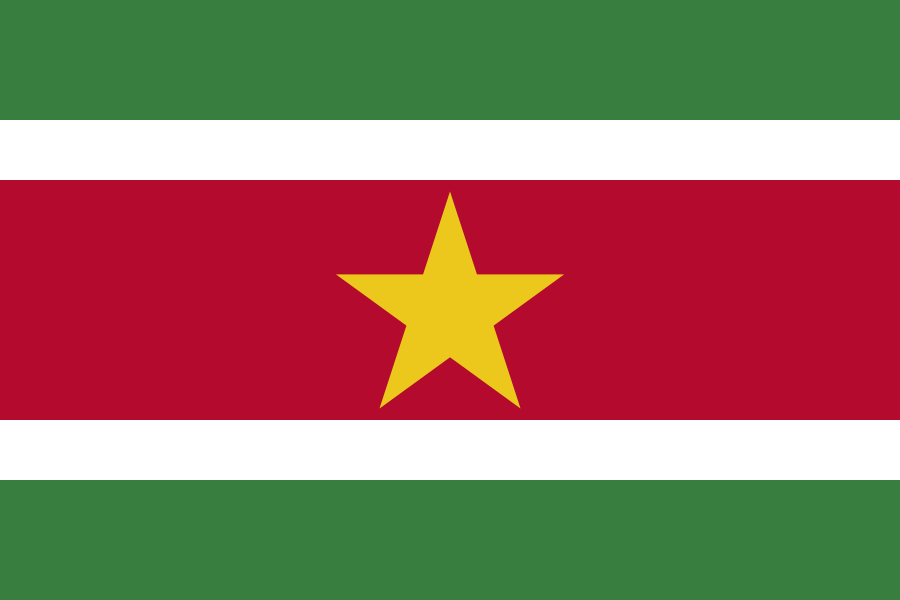
Suriname
Data updated Oct 14, 2026
Overall Score
54.3
Good
Avg. Rent (1BR)
$455
-73% vs US Avg
Safety Index
44.8
COL Index
40
Overall Score
54.3
GoodEstimated Cost
$962/mo
single person, incl. rent
Verdict
Best for retirees
based on our recommended destinations
Suriname works for a narrow type of person: someone with a connection to the Dutch-speaking Caribbean, a remote job that doesn't require fast reliable internet every single day, or an interest in the interior rainforest and the Maroon and Indigenous communities that live there. It is not a retirement play and not a digital nomad play, because Suriname does not offer a retiree visa and has no dedicated digital nomad visa. If you're coming, you're coming for a specific reason, not because someone sold you a visa path.
The raw numbers look cheap: a basic meal out runs $13.28, a liter of gasoline is $1.14, and utilities for a decent-sized apartment come to $37.67. What the budget math misses is that a new compact car runs $25,000 flat, with no cheaper range given, and private school for a kid can run as high as $4,648.01 a year if you want anything beyond the public system. The headline cost of living is real, but the moment you need a car, international schooling, or private healthcare, the "cheap country" math falls apart fast.
The friction is healthcare and internet quality. Suriname's public health law covers a basic package of care through 43 public clinics and regional hospitals, but resource limitations may lead people to seek private care, which means budgeting extra on top of the headline numbers. Internet is workable but not fast: the country's internet performance can be inconsistent, so if your income depends on video calls, test your actual connection before committing.
On taxes, Suriname's brackets run from 0% up to SRD 18,000 to a top rate of 38% above SRD 80,000, with capital gains generally taxed at ordinary rates up to 38% and dividends withheld at 25% for non-residents, all of which only matter if you become tax resident there. As a US citizen you still file with the IRS regardless of where you live, and the Foreign Earned Income Exclusion for 2026 lets you exclude up to $132,900 of earned income, with a foreign housing exclusion base of $21,264 and a cap of $39,870 if your rent and utilities qualify. Suriname does not have an income tax treaty with the United States, so don't assume treaty relief from double taxation; run your specific numbers with a cross-border accountant before you move money or sign a lease.
Suriname vs. the South America average
Scores out of 10, shown as the gap between Suriname and the average of the 12 other countries in South America. 3 clear strengths, 5 clear gaps.
- English Speaking+1.2
- Safety+0.7
- Air Quality+0.7
- Cost of Living-0.3
- Healthcare-0.9
- Tax Friendliness-1.0
- Expat Community-1.0
- Residency Pathway-1.2
- Public Transport-3.3
🚚 Moving to Suriname
Planning the move? Compare free quotes from international movers.
Get a free moving cost estimate for moving to Suriname. Takes 10 seconds.
How much are you shipping?
When are you moving?
Powered by Sirelo. Free quotes from international movers.
We may earn a commission if you request quotes through this tool.
Recommended Destinations in Suriname
Best for Retirees
Best for Geoarbitrage
Best for Remote Workers
- Capital
- Paramaribo
- Official Language
- Dutch
- Time Zone
- UTC-03:00
- Region
- Latin America
- Population
- 586,634
- Healthcare Index
- 52.3
- Climate Zones
- tropical
View on Interactive Map
Explore data visually
🏙️ Top Cities in Suriname
Explore cost of living, walkability scores, and expat ratings for individual cities in Suriname.
CoL Index: 40
Est. Total: ~$935/mo
CoL Index: 40
Est. Total: ~$1,185/mo
How far does $1,500 go in Suriname?
With a monthly budget of $1,500, you can live comfortably in Suriname. After accounting for an average rent of $$455, you have approximately $1,045remaining for daily expenses.
Calculate your FIRE timeline with these costs →💰 Cost of Living in Suriname
Relative to New York City (NYC = 100). A lower number means it's cheaper.
Estimate the cost of shipping your belongings to Suriname →
See how Suriname's cost of living compares with Paraguay
🛒 Grocery & Family Costs
Family Costs
Can I afford to live in Suriname?
Comfortable (1.0×): balanced baseline lifestyle. Adjusts day-to-day costs only — rent is unaffected.
Suriname
You could save
1,815/mo
Monthly Costs
Attractiveness Scores
Based on national averages. City-level costs may vary. Browse cities in Suriname →
⚕️ Healthcare System
Our Top Pick for Nomads: SafetyWing
Flexible, subscription-based health cover for remote workers in Suriname.
Get Covered with SafetyWing →Looking for more options? Check Ekta.
An estimation of the overall quality of the health care system. Higher is better.
Quality & Affordability:
Public healthcare services are available, but resource limitations may lead individuals to seek private care, resulting in out-of-pocket expenses.
Insurance Insights:
Public healthcare services are available, but resource limitations may lead individuals to seek private care, resulting in additional expenses.
See how Suriname's healthcare compares with Paraguay
🛂 Visa & Residency Pathways
🛂 Visa Services
Ready to apply for a Suriname visa?
Get help with your application — tourist, long-stay, and residency visas processed online.
General Overview
Process & Requirements:
Suriname's immigration system is 'complex' and not well-documented for independent expats. The main pathway to residency is through employment with a local company or by having direct family ties (e.g., marriage to a Surinamese citizen). The process requires obtaining an authorization for a temporary stay (Machtiging tot Kort Verblijf, MKV) before arrival. There are no well-defined programs for retirees, investors, or digital nomads, making it a challenging destination for those without a work contract.
The process is known to be bureaucratic and slow, with a lack of clear, publicly available information. Most foreign nationals require a local sponsor or legal assistance to navigate the system, which is managed by the Ministry of Foreign Affairs and the Aliens Registration Office.
Residency & Citizenship Notes:
The pathway to permanent residency is 'complex' due to the bureaucratic hurdles. The pathway to citizenship is also 'complex'. After five years of residency, a person can apply for naturalization. The applicant must have a basic knowledge of the Dutch language and Surinamese society. The most significant barrier is that Suriname has very strict rules against dual citizenship. In almost all cases, an applicant must renounce their previous nationality to become a citizen. This makes the path to citizenship an unattractive option for most foreigners.
🛂 Visa Matcher
See which Suriname visas you qualify for
Answer 11 quick questions and get matched to the right visa for your situation.
Free · No signup required to see results
Detailed Visa Options
🧳 Tourist & Short-Stay Information
Extension Notes
The visa-free stay of 90 days is generally not extendable. Source: Surinamese Immigration Service.
General Visa Notes
As of 2022, US citizens no longer require a visa or tourist card and can enter Suriname for up to 90 days for tourism. A passport valid for at least six months and proof of accommodation are needed. The previous 'Entry Fee' was abolished.
Official Source: View Source
🌴 Retirement / Passive Income Visa
This country does not have a dedicated retirement visa, but the following notes provide guidance on pathways for retirees.
Income Notes
Suriname does not have a specific visa category for retirees. Long-term residency is not typically granted for retirement purposes.
Official Source: https://www.consulaatsuriname.nl/visa-en-paspoort-info/
Health Insurance Notes
Suriname does not have a specific visa category for retirees. Long-term residents would need to secure their own private health insurance as they would not be eligible for public schemes.
Official Source: https://www.consulaatsuriname.nl/visa-en-paspoort-info/
💻 Digital Nomad Visa
Income Notes
Suriname does not offer a digital nomad visa. The available visa categories are for tourism, business, or locally sponsored work, with no provision for independent remote work. Source: Ministry of Foreign Affairs, International Business and International Cooperation.
📈 Investor Visa
Investment Details
Investment Options & Notes
Suriname does not have a formal residency by investment program. Foreigners can establish a business, but this requires active management and does not offer a streamlined path to residency based on a capital amount. Source: Ministry of Foreign Affairs, International Business and International Cooperation.
Path to Citizenship
Many long-stay visas require proof of health insurance. Compare international health plans before you apply.
Compare health insuranceWe may earn a commission at no cost to you.
🛡️ Safety & Stability
An estimation of overall safety level. Higher is better.
An estimation of the overall level of crime. Lower is better.
World Bank political stability estimate, rescaled to 0-100. Higher is better.
Safety Notes:
The safety index is moderate, with advice to exercise normal precautions (Level 1). Paramaribo sees higher rates of opportunistic crime.
Types of Crime: Burglary, car theft, and street muggings.
Kidnapping Risk: Few incidents reported, mostly domestic.
🏦 Taxation & Finance
🏦 Tax Snapshot
FEIE Interaction
FTC Utility: medium
Suriname imposes income tax at rates up to 38%, which can exceed US rates on some income bands. For US expats with significant earned income above the FEIE limit (~USD 126,500 for 2024), Foreign Tax Credits on Surinamese taxes paid can reduce US liability. However, the lack of a tax treaty and potential double taxation on certain income types limits overall optimization. FEIE is generally preferred for lower-income earners; FTC may be beneficial for higher earners or those with non-excluded income.
Presence Day Count Notes
The standard 330-day physical presence test applies within any 12-month period. Suriname's entry requirements do not impose unusual barriers to establishing presence. Days spent in Suriname count toward the 330-day threshold.
FBAR Trigger Notes
US persons with Surinamese bank accounts exceeding USD 10,000 aggregate at any point during the year must file FinCEN 114 (FBAR). Suriname uses the Surinamese dollar (SRD); account values must be converted to USD using Treasury rates. FATCA reporting also applies via Form 8938 if thresholds are met.
401k/IRA Treatment
Pension Income
Foreign pension income received by Suriname residents is included in taxable income and taxed at progressive rates up to 38%. No special exemption for foreign pension income exists under domestic law.
Locally TaxedSocial Security
No US-Suriname tax treaty or totalization agreement is in force. US Social Security benefits received by Suriname residents are treated as foreign pension income and subject to Surinamese income tax at progressive rates up to 38%.
Locally TaxedRoth Distributions
No treaty exemption exists. Roth distributions would likely be assessed under domestic rules. Suriname does not recognize the Roth structure specifically. Tax treatment depends on characterization by local authorities; distributions may be treated as foreign income subject to progressive rates.
Locally TaxedUS 401k/IRA Distributions
Suriname has no tax treaty with the United States. US retirement distributions received by a Suriname resident are likely treated as foreign-source income and subject to Surinamese income tax at progressive rates up to 38%. Suriname taxes residents on worldwide income, so distributions from US 401k or IRA accounts received while resident in Suriname are taxable. No treaty protection exists.
Locally TaxedCapital Gains Tax
Suriname does not have a standalone capital gains tax. Capital gains are generally included in taxable income and taxed at ordinary income tax rates, with the top marginal rate of 38%. Gains from disposal of business assets are treated as income. Limited guidance exists on purely personal investment gains for non-residents.
No separate capital gains tax regime exists in Suriname. Gains realized in a business context are taxed as ordinary income under the Income Tax Act. The top marginal personal income tax rate is 38%.
Dividend Tax Rate
Suriname levies a withholding tax on dividends paid to both residents and non-residents. The standard rate is 25% for non-residents. Residents may receive dividends subject to a lower rate of 25% withholding as a final tax in some cases. No tax treaties with the US are in force, so no treaty reduction applies for US persons.
withholding
Rate: 25.0%
Standard withholding rate applicable to dividends paid by Surinamese companies to non-resident shareholders including US persons.
Tax Treaties Notes:
Suriname does not have an income tax treaty with the United States, which may result in potential double taxation for U.S. citizens residing in Suriname.
Retiree Tax Benefits:
No specific tax benefits for foreign retirees exist in Suriname. U.S. citizens must comply with U.S. tax obligations on their global income.
Cost Savings vs. U.S.:
Suriname offers a moderate cost of living compared to the United States, with housing options and healthcare availability that may vary in accessibility.
Pick between Form 2555 (Foreign Earned Income Exclusion) and Form 1116 (Foreign Tax Credit) with an expat tax service.
Get help with my expat taxesWe may earn a commission at no cost to you.
Recommended services for Suriname
Recommended Partner
Fidelity →See how Suriname's taxes compares with Paraguay
☀️ Climate & Environment
Climate Zones:
Our proprietary index measuring annual average PM2.5 concentration. Lower is better (0-5 is good).
Our proprietary index for drinking water quality and sanitation. Higher is better.
Seasonal Variations:
Suriname has a hot, humid, and tropical climate with minimal temperature variation year-round. The country experiences two rainy seasons: April to August and December to early February, and two dry seasons: August to November and February to March.
😊 Quality of Life
Cultural Amenities:
Museums & Cultural Institutions
Suriname is home to several museums, including the Suriname Museum in Paramaribo, which showcases the country's history and culture.
The Fort Zeelandia Museum offers exhibits on the country's colonial past and independence.
Performing Arts
Suriname has a rich tradition of music and dance, with genres like kaseko and kawina playing significant roles.
The Suriname National Theatre hosts various performances, including plays and musical shows.
Cultural Festivals
The Suriname Independence Day on November 25th is celebrated with various cultural events and performances.
The Paramaribo Carnival showcases Surinamese music, dance, and art.
Culinary Culture
Surinamese cuisine includes dishes like roti (flatbread), pom (chicken and vegetable casserole), and saoto soup.
The country's food reflects its diverse ethnic groups and regional influences.
🌐 Infrastructure & Connectivity
Our proprietary ranking of public transit accessibility and reliability.
Internet Reliability:
Suriname has modest fixed broadband speeds with improving infrastructure in populated regions.
Speed & Quality: Fixed broadband speeds are modest, with more limited service outside urban areas.
Availability: Urban availability is fair; rural and interior regions see poor or no service.
Cost: Prices are higher when adjusted for income, with limited ISP competition.
Reliability for Remote Work: Urban connections are usable for standard work; backups suggested in case of outages.
Transportation Network:
Suriname has basic transportation infrastructure with limited development due to small population and economic constraints.
Roads: Limited paved road network mostly along the coast.
Rail: No passenger rail service currently operational.
Domestic Travel: Domestic flights serve interior locations; most transport relies on roads and rivers.
Recommended services for Suriname
Recommended Partner
Traveling Mailbox →Frequently Asked Questions about Suriname
Click any question to expand the answer.
Share This Guide
Suriname's rules change. We'll tell you when.
Visa, tax, and cost updates for Suriname, before they catch you out. Free with RA Postcards.
By submitting your email address, you will receive a free subscription to RA Postcards and special offers from Rewire Abroad and our affiliates. You can unsubscribe at any time, and we encourage you to read more about our Privacy Policy.