
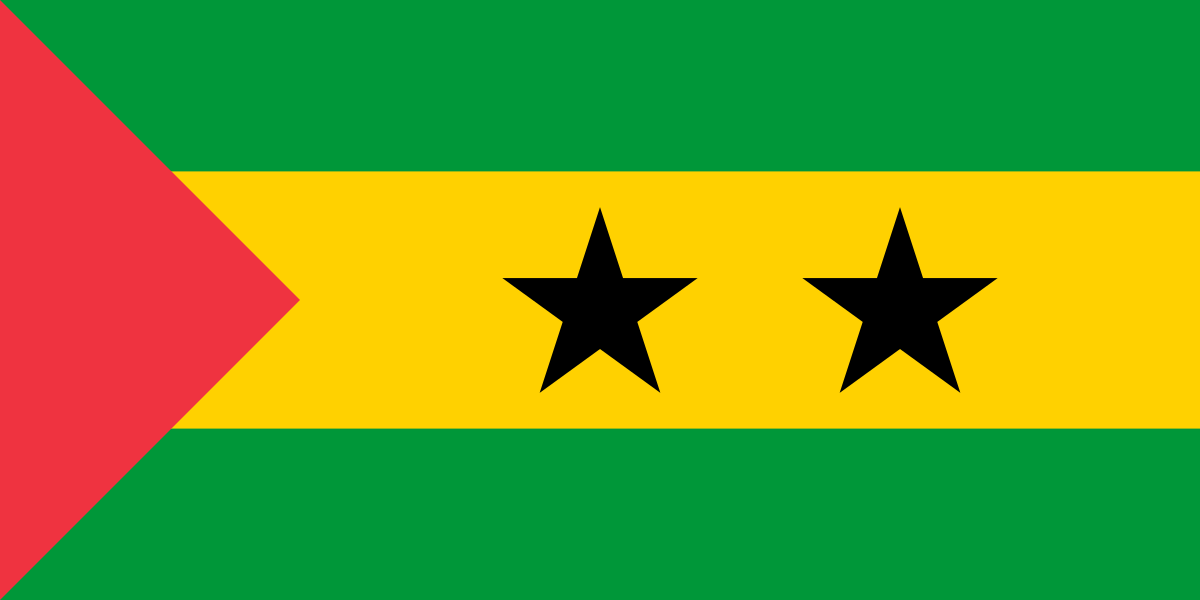
São Tomé and Príncipe
Avg. Rent (1BR)
$270
-84% vs US Avg
Safety Index
64.8
COL Index
32
You'll need to accept that you're moving to one of the smallest and most isolated nations on Earth, a two-island country off the coast of Central Africa with just 219,000 people and no formal retirement visa program. São Tomé and Príncipe doesn't have a dedicated path for retirees — you'll enter on a tourist visa and then apply for temporary residence, which requires either starting a business, proving employment, or demonstrating financial self-sufficiency without a published income threshold. The government evaluates each application individually, and the process is opaque, conducted in Portuguese with limited English-language support. You're also contending with serious infrastructure gaps: intermittent electricity, limited medical facilities that can't handle complex procedures, and expensive imports for anything beyond local produce and fish.
The cost of living appears low on paper — local rent might run $300 to $600 monthly — but your actual expenses will be higher because you'll pay import premiums on most goods Americans consider basic, and you'll likely need to fly to Lisbon or Accra for any serious healthcare. Internet service exists but is unreliable outside the capital, flights connect only through Portugal or nearby African hubs with limited frequency, and banking infrastructure is minimal with few ATMs and patchy card acceptance. The islands are safe and politically stable, but you're trading convenience and connectivity for something approaching genuine remoteness.
This is a destination for someone who genuinely wants to disappear, has solid Portuguese skills or the patience to acquire them, doesn't require consistent modern amenities, and can afford medical evacuation insurance along with periodic trips off-island for healthcare and supplies — not for someone looking for an affordable tropical base with First World conveniences at Third World prices.
Recommended Destinations in São Tomé and Príncipe
Best for Retirees
Best for Geoarbitrage
Best for Remote Workers
- Capital
- São Tomé
- Official Language
- Portuguese
- Time Zone
- UTC
- Region
- Africa
- Healthcare Index
- 48.7
- Internet Speed
- 22 Mbps
View on Interactive Map
Explore data visually
🏙️ Top Cities in São Tomé and Príncipe
Explore cost of living, walkability scores, and expat ratings for individual cities in São Tomé and Príncipe.
View all cities in São Tomé and Príncipe →How far does $2,500 go in São Tomé and Príncipe?
With a monthly budget of $2,500, you can live comfortably in São Tomé and Príncipe. After accounting for an average rent of $270, you have approximately $2,230.00 remaining for daily expenses.
Calculate your FIRE timeline with these costs →💰 Cost of Living in São Tomé and Príncipe
Relative to New York City (NYC = 100). A lower number means it's cheaper.
Can I afford to live in São Tomé and Príncipe?
São Tomé and Príncipe
You could save
2,011/mo
Monthly Costs
Attractiveness Scores
Based on national averages. City-level costs may vary.
⚕️ Healthcare System
An estimation of the overall quality of the health care system. Higher is better.
Quality & Affordability:
São Tomé and Príncipe's public healthcare system offers basic services but struggles with resource limitations and accessibility, especially in rural areas. Private healthcare is limited.
Insurance Insights:
Health insurance is not widespread; most individuals rely on out-of-pocket payments.
🛂 Visa & Residency Pathways
General Overview
Process & Requirements:
São Tomé and Príncipe, a small island nation in the Gulf of Guinea, has a 'clear' but developing residency system. The country is actively seeking foreign investment, particularly in tourism. A residence permit can be obtained by investing in a local business or purchasing property. The financial thresholds are not as high as in many other island nations, making it accessible for entrepreneurs and investors. It is also possible to obtain residency based on a work contract. While there is no formal 'retirement' visa, the investment route can serve this purpose.
The process is managed by the immigration authorities and, while it can be slow due to the size of the administration, the government is generally welcoming to foreign residents who can contribute to the economy.
Residency & Citizenship Notes:
The pathway to permanent residency is 'clear' after five years. The pathway to citizenship is also 'clear'. An individual can apply for naturalization after five years of legal residence in the country. The applicant must have a basic knowledge of the Portuguese language. A major advantage is that São Tomé and Príncipe allows dual citizenship, so renunciation of a previous nationality is not required. The short five-year timeline and acceptance of dual citizenship make it an attractive, if little-known, option.
Detailed Visa Options
🛡️ Safety & Stability
An estimation of overall safety level. Higher is better.
Reflects perceptions of political stability. Higher is better.
Safety Notes:
Crime Rate: Low. São Tomé and Príncipe is relatively tranquil.
Types of Crime: Minor theft and occasional burglary.
Kidnapping Risk: Negligible; no documented cases.
🏦 Taxation & Finance
Tax Treaties Notes:
No US-São Tomé and Príncipe tax treaty. Territorial taxation system.
Retiree Tax Benefits:
Retiree visas require income proof. No taxes on foreign income.
Cost Savings vs. U.S.:
Low costs (e.g., $900/month). Limited infrastructure.
☀️ Climate & Environment
Our proprietary index for drinking water quality and sanitation. Higher is better.
Seasonal Variations:
São Tomé and Príncipe have a tropical climate with high humidity and significant rainfall. The rainy season occurs from October to May, while the dry season spans from June to September.
😊 Quality of Life
Cultural Amenities:
Museums & Cultural Institutions
São Tomé and Príncipe is home to several museums, including the São Tomé National Museum, which showcases the country's history and culture.
The Museum of São Tomé and Príncipe offers exhibits on the country's colonial past and independence.
Performing Arts
São Tomé and Príncipe has a rich tradition of music and dance, with genres like traditional drumming and folk songs playing significant roles.
The São Tomé National Theatre hosts various performances, including plays and musical shows.
Cultural Festivals
The São Tomé and Príncipe Independence Day on July 12th is celebrated with various cultural events and performances.
The São Tomé and Príncipe International Film Festival showcases films from around the world.
Culinary Culture
São Tomé and Príncipe cuisine includes dishes like calulu (vegetable and fish stew), arroz de marisco (seafood rice), and banana fritters.
The country's food reflects its African, Portuguese, and Brazilian heritage.
🌐 Infrastructure & Connectivity
Our proprietary ranking of public transit accessibility and reliability.
Internet Reliability:
São Tomé and Príncipe has basic internet infrastructure with ongoing development efforts.
Speed & Quality: Fixed broadband averages around 22 Mbps in urban areas, with expanding mobile networks.
Availability: Limited to main urban areas, with mobile coverage expanding across the islands.
Cost: Moderate pricing for the region, typically $25-45/month.
Reliability for Remote Work: Basic capability for remote work in urban areas, though speeds may limit bandwidth-intensive activities.
Transportation Network:
São Tomé and Príncipe has basic transportation infrastructure suitable for its small island nation status.
Roads: Limited road network on both main islands, mostly unpaved.
Rail: No railway system due to small size.
Domestic Travel: Small aircraft and boats connect the two main islands.
Frequently Asked Questions about São Tomé and Príncipe
Click any question to expand the answer.