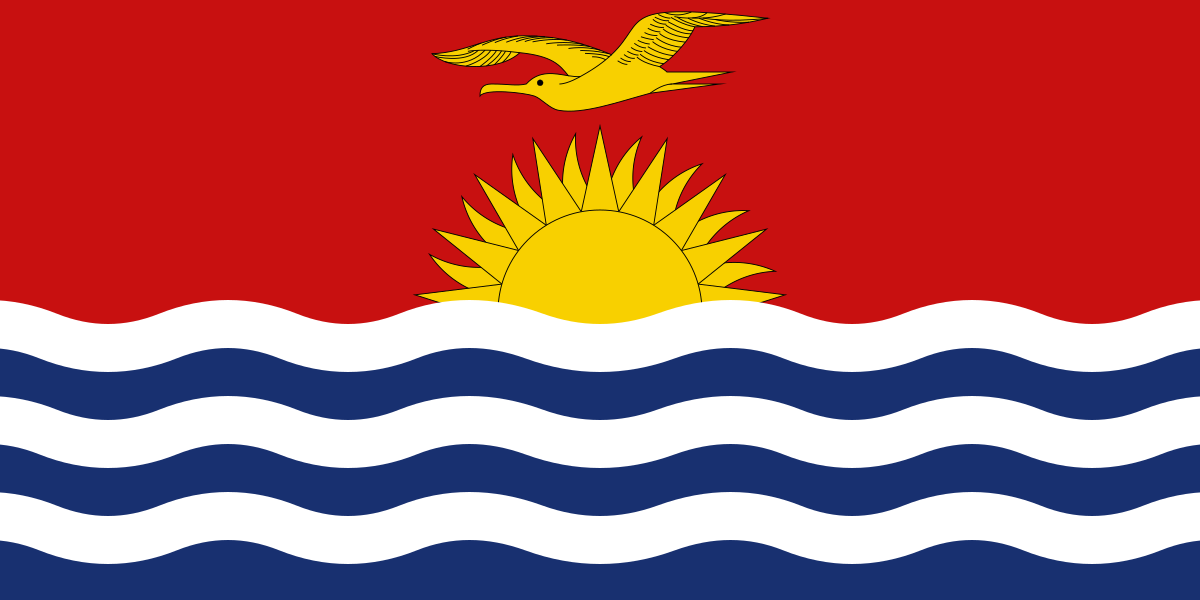
Kiribati
Data updated Oct 14, 2026
Overall Score
54.5
Good
Avg. Rent (1BR)
$829
-51% vs US Avg
Safety Index
64.3
COL Index
45
Overall Score
54.5
GoodEstimated Cost
$892/mo
single person, incl. rent
Kiribati works for almost nobody reading this site, and that's worth saying plainly before anything else. There's no retirement visa, no passive-income visa, and no digital nomad visa, so there's no legal on-ramp for someone who wants to just show up and stay. The people for whom this makes sense are narrow: aid workers, climate researchers, maritime or fisheries contractors, or someone with an existing posting to Tarawa. This is not a lifestyle destination you pick off a shortlist. It's a place you go because a job or a specific project sends you.
The cost numbers look cheap until you account for what they're measuring. Monthly costs excluding rent run around $305, and a one-bedroom in the city center runs $828.63, which together put a basic single-person budget north of $1,100 before you've bought anything imported, which is most things. Numbeo-style averages for a country with almost no retail competition and heavy import dependence understate reality: fuel, packaged food, and anything electronic gets marked up by shipping costs that don't show up cleanly in a cost-of-living index. The headline "cheap island nation" framing ignores that cheap local goods (fish, taro) sit next to expensive everything-else.
The real friction is infrastructure and healthcare, not price. The healthcare index sits at 48.5, which is low enough that anything beyond routine care means evacuation, and international health insurance that explicitly covers medical evacuation isn't optional here, it's the baseline requirement. Safety index of 64.3 is moderate, but English proficiency is rated low outside of government and tourism contexts, so daily logistics, medical consultations, and bureaucracy get harder than the "English is an official language" fact suggests on paper. Shipping delays, irregular flights, and limited banking infrastructure are the kind of friction that doesn't show up until you're already there.
For a US expat, the tax mechanics are straightforward on the American side even if the destination-country specifics are thin. You still file US taxes on worldwide income regardless of where you live, and the Foreign Earned Income Exclusion for 2026 lets you exclude up to $132,900 of foreign-earned income if you qualify under the physical presence or bona fide residence test, with an additional foreign housing exclusion of up to $39,870 (base $21,264) for qualifying housing costs. Kiribati does not have a tax treaty with the United States, so treaty-based relief is not available, and run any cross-border tax position by someone who can confirm Kiribati's local filing obligations directly rather than relying on general assumptions.
Kiribati vs. the Oceania average
Scores out of 10, shown as the gap between Kiribati and the average of the 13 other countries in Oceania. 1 clear strength, 2 clear gaps.
- Cost of Living+0.6
- Safety+0.4
- Tax Friendliness+0.1
- Expat Community-0.1
- Healthcare-0.4
- Residency Pathway-0.4
- Public Transport-1.3
- English Speaking-6.5
🚚 Moving to Kiribati
Planning the move? Compare free quotes from international movers.
Get a free moving cost estimate for moving to Kiribati. Takes 10 seconds.
How much are you shipping?
When are you moving?
Powered by Sirelo. Free quotes from international movers.
We may earn a commission if you request quotes through this tool.
Recommended Destinations in Kiribati
Best for Retirees
Best for Geoarbitrage
Best for Remote Workers
- Capital
- South Tarawa
- Official Language
- English, Gilbertese
- Time Zone
- UTC+12:00
- Region
- Oceania
- Population
- 119,446
- Healthcare Index
- 48.5
- Climate Zones
- tropical
View on Interactive Map
Explore data visually
🏙️ Top Cities in Kiribati
Explore cost of living, walkability scores, and expat ratings for individual cities in Kiribati.
CoL Index: 45
Est. Total: ~$1,140/mo
How far does $1,500 go in Kiribati?
With a monthly budget of $1,500, you can live comfortably in Kiribati. After accounting for an average rent of $$829, you have approximately $671remaining for daily expenses.
Calculate your FIRE timeline with these costs →💰 Cost of Living in Kiribati
Relative to New York City (NYC = 100). A lower number means it's cheaper.
Estimate the cost of shipping your belongings to Kiribati →
See how Kiribati's cost of living compares with New Zealand
🛒 Grocery & Family Costs
Family Costs
Can I afford to live in Kiribati?
Comfortable (1.0×): balanced baseline lifestyle. Adjusts day-to-day costs only — rent is unaffected.
Kiribati
You could save
1,866/mo
Monthly Costs
Attractiveness Scores
Based on national averages. City-level costs may vary. Browse cities in Kiribati →
⚕️ Healthcare System
Our Top Pick for Nomads: SafetyWing
Flexible, subscription-based health cover for remote workers in Kiribati.
Get Covered with SafetyWing →Looking for more options? Check Ekta.
An estimation of the overall quality of the health care system. Higher is better.
Quality & Affordability:
Kiribati's public healthcare system offers basic services, but facilities are limited, especially in outer islands. Serious conditions often require treatment abroad.
Insurance Insights:
International health insurance is essential to cover medical evacuations and treatment in countries with advanced healthcare systems.
See how Kiribati's healthcare compares with New Zealand
🛂 Visa & Residency Pathways
🛂 Visa Services
Ready to apply for a Kiribati visa?
Get help with your application — tourist, long-stay, and residency visas processed online.
General Overview
Process & Requirements:
The immigration system of Kiribati is 'complex' and not designed for individual long-term residency. As a small island nation with limited resources, residency is almost exclusively granted to those with specific employment contracts, often with the government, international aid organizations, or in specialized fields like marine engineering. There are no established programs for retirement, investment, or digital nomads. The process for obtaining a residence permit requires a sponsor and is handled by the Kiribati Ministry of Foreign Affairs and Immigration.
The lack of clear, independent pathways and the reliance on employment for a very small number of available positions make long-term residency a challenge.
Residency & Citizenship Notes:
There is no pathway to permanent residency. The pathway to citizenship is 'complex' and generally not available to foreign residents through naturalization. Citizenship is primarily passed by descent. The law does not have a clear, time-based provision for foreigners to become citizens. In practice, it is not considered a viable path. The country's laws are also restrictive regarding dual citizenship.
🛂 Visa Matcher
See which Kiribati visas you qualify for
Answer 11 quick questions and get matched to the right visa for your situation.
Free · No signup required to see results
Detailed Visa Options
🧳 Tourist & Short-Stay Information
Extension Notes
Extensions can be applied for at the Immigration Office in Bairiki for a fee, but are granted on a case-by-case basis. Source: Kiribati Ministry of Foreign Affairs and Immigration.
General Visa Notes
US citizens are permitted to enter Kiribati visa-free for a stay of up to 30 days. A passport with at least six months' validity from the date of entry is required.
Official Source: View Source
🌴 Retirement / Passive Income Visa
This country does not have a dedicated retirement visa, but the following notes provide guidance on pathways for retirees.
Income Notes
Kiribati does not offer a retirement visa. Long-term residence permits are not available for the purpose of retirement.
Official Source: https://www.mfa.gov.ki/visa-application-procedure-and-information/
Health Insurance Notes
Kiribati does not offer a retirement visa. For any long-term stay, private health insurance is critical as medical facilities are extremely limited and any serious condition requires medical evacuation.
Official Source: https://www.mfa.gov.ki/visa-application-procedure-and-information/
💻 Digital Nomad Visa
Income Notes
Kiribati does not have a digital nomad visa program. Immigration is primarily geared towards tourism and locally-sponsored employment. Source: Kiribati Ministry of Foreign Affairs and Immigration.
📈 Investor Visa
Investment Details
Investment Options & Notes
Kiribati does not have a passive investment visa. A foreign investor must apply for an Investor Permit by submitting a detailed business proposal to the Ministry of Commerce. The investment amount is not fixed and depends on the nature of the approved business.
Official Source: View Source
Path to Citizenship
Citizenship Notes
After 7 years of legal residence, an investor can apply for citizenship. The process is lengthy and requires a formal application to the government. Source: Citizenship Act of Kiribati.
Many long-stay visas require proof of health insurance. Compare international health plans before you apply.
Compare health insuranceWe may earn a commission at no cost to you.
🛡️ Safety & Stability
An estimation of overall safety level. Higher is better.
World Bank political stability estimate, rescaled to 0-100. Higher is better.
Safety Notes:
Crime Rate: Low. Kiribati is generally safe, with low levels of crime.
Types of Crime: Petty theft and burglary, especially in urban areas.
Kidnapping Risk: Very low; incidents are rare and typically not targeted at foreigners.
🏦 Taxation & Finance
🏦 Tax Snapshot
FEIE Interaction
FTC Utility: low
Kiribati income tax rates top out at 35%, which is below or comparable to US federal rates at higher income levels. More importantly, most US expats in Kiribati earn modest incomes in a development or NGO context where FEIE fully shelters earned income. No tax treaty exists to resolve potential double taxation structurally, so FTC calculations rely entirely on general IRS foreign tax credit rules. The small expat population and limited local tax enforcement further reduce practical FTC utility.
Presence Day Count Notes
The 330-day physical presence test is the more straightforward qualifying method for Kiribati given the absence of a bilateral tax treaty and the difficulty of establishing bona fide residence documentation in a jurisdiction with limited formal administrative infrastructure. The standard IRS 330-day requirement in a 12-month period applies.
FBAR Trigger Notes
US persons with financial accounts in Kiribati exceeding $10,000 in aggregate value must file FinCEN 114 (FBAR). Kiribati's banking sector is minimal - the Bank of Kiribati (a subsidiary of ANZ) is the primary institution. FATCA compliance from local financial institutions is uncertain given Kiribati's limited regulatory infrastructure. US persons should report all qualifying accounts.
401k/IRA Treatment
Pension Income
Pension income derived from employment or services could fall within the scope of the Employment and Services Tax Ordinance if it constitutes remuneration for services rendered. Foreign pension receipts are unlikely to be actively assessed by the Kiribati tax authority given limited administrative capacity. Top marginal rate of 35% would apply in theory to high-value pension income if assessed.
Locally TaxedSocial Security
No US-Kiribati tax treaty exists. US Social Security payments received by a Kiribati resident are not explicitly addressed in Kiribati tax law and are unlikely to be treated as locally sourced employment income. No totalization agreement exists between the two countries.
Not Taxed LocallyRoth Distributions
No specific provision exists in Kiribati law addressing Roth IRA distributions. Given that Roth distributions represent a return of after-tax capital and qualified earnings, they are unlikely to be assessed as employment or service income. No formal guidance exists and enforcement capacity is limited.
Not Taxed LocallyUS 401k/IRA Distributions
Kiribati has no tax treaty with the United States. US retirement distributions received by a Kiribati tax resident could be treated as income under the Employment and Services Tax Ordinance if they constitute employment or service income. The practical enforcement capacity is limited given the small tax administration, but no formal exemption exists. Rate would depend on the applicable bracket under the progressive schedule, with a top marginal rate of 35%.
Locally TaxedCapital Gains Tax
Kiribati does not impose a separate capital gains tax. Note: Kiribati's income tax framework appears to have been recodified under an Income Tax Act 2023, which may supersede the older Employment and Services Tax Ordinance previously cited here and may carry an updated personal allowance (cited elsewhere as AUD 5,000 for 2025, vs. the lower AUD 2,000 zero-rate threshold currently stored in this row's income tax brackets). The exact current bracket table could not be confirmed from available sources as of this review -- recommend manual verification against the Income Tax Act 2023 text before relying on the stored bracket figures. Capital gains themselves remain outside the scope of either the old Ordinance or the newer Act based on available information.
Kiribati has no capital gains tax at the individual or corporate level under either the prior Ordinance or the newer Income Tax Act 2023. Flag: the underlying income tax bracket structure stored elsewhere in this row may be stale given the apparent 2023 law change -- recommend manual re-verification.
Dividend Tax Rate
Kiribati does not have a general dividend withholding tax regime comparable to most jurisdictions. Dividend payments from locally incorporated entities are not subject to a specific dividend tax. No tax treaty network exists to affect withholding rates. Kiribati uses the Australian dollar as its currency and its tax code is based on older colonial-era ordinances with limited formal guidance on investment income.
exempt
Rate: 0.0%
No dividend withholding tax currently imposed under Kiribati law.
Pick between Form 2555 (Foreign Earned Income Exclusion) and Form 1116 (Foreign Tax Credit) with an expat tax service.
Get help with my expat taxesWe may earn a commission at no cost to you.
Recommended services for Kiribati
Recommended Partner
Fidelity →See how Kiribati's taxes compares with New Zealand
☀️ Climate & Environment
Climate Zones:
Our proprietary index for drinking water quality and sanitation. Higher is better.
Seasonal Variations:
Kiribati has a tropical marine climate with high humidity and temperatures averaging around 27°C year-round. Rainfall varies across the islands, with some regions experiencing more pronounced wet and dry seasons.
😊 Quality of Life
Cultural Amenities:
Museums & Cultural Institutions
Kiribati offers cultural tours that include visits to museums and historical sites.
Performing Arts
Traditional music and dance are integral to Kiribati culture, often showcased during festivals and community events.
Cultural Festivals
Kiribati hosts various cultural festivals that celebrate its rich cultural heritage.
Culinary Culture
Kiribati cuisine includes dishes like fish and coconut, reflecting its island traditions.
🌐 Infrastructure & Connectivity
Our proprietary ranking of public transit accessibility and reliability.
Internet Reliability:
Kiribati faces extreme internet infrastructure challenges due to geographic isolation and limited resources.
Speed & Quality: Fixed broadband averages 1-5 Mbps through satellite connections with very high latency.
Availability: Minimal coverage concentrated in South Tarawa, virtually no connectivity across outer islands.
Cost: Extremely expensive relative to local income, when services are available.
Reliability for Remote Work: Not suitable for remote work due to severe infrastructure limitations, high costs, and unreliable connectivity.
Transportation Network:
Kiribati has very limited transportation infrastructure across its scattered Pacific atolls.
Roads: Individual islands have basic unpaved roads and paths.
Rail: No railway system due to the scattered atoll geography.
Domestic Travel: Small aircraft and boats provide inter-island transport; many islands have basic airstrips.
Recommended services for Kiribati
Recommended Partner
Traveling Mailbox →Frequently Asked Questions about Kiribati
Click any question to expand the answer.
Share This Guide
Kiribati's rules change. We'll tell you when.
Visa, tax, and cost updates for Kiribati, before they catch you out. Free with RA Postcards.
By submitting your email address, you will receive a free subscription to RA Postcards and special offers from Rewire Abroad and our affiliates. You can unsubscribe at any time, and we encourage you to read more about our Privacy Policy.