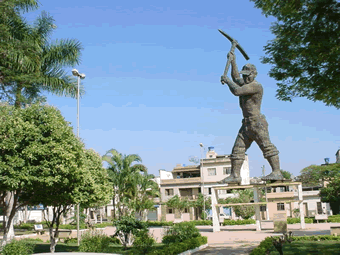
Muriaé sits in the Brazilian state of Minas Gerais at an elevation of 209 m above sea level, within the America/Sao_Paulo timezone and a tropical climate that shapes daily life year round. The city holds a population of 85 thousand, and expats who settle here overwhelmingly choose the Centro neighborhood, the one popular expat area in town. That choice makes practical sense: Centro puts newcomers within reach of shops, services, and the routines of a midsize interior city, while the wider municipality spreads outward into quieter residential streets. The tropical setting means warm conditions dominate, and the pace of life stays distinctly local rather than international. With an expat community size described as very few, those who arrive in Muriaé should expect to be a small presence rather than part of an established foreign crowd.
Living costs in Muriaé are low even by Brazilian standards, with a cost of living index of 33/100 against a New York City baseline of 100. A one-bedroom apartment in the city centre rents for $100/mo, while the same outside the centre drops to $80/mo. Three-bedroom units run $179/mo in the centre and $149/mo outside it. Utilities come to $75/mo, internet to $20/mo, and a mobile phone plan to $8/mo. A monthly public transport pass costs $80/mo, and a gym membership runs $50/mo. Eating out is inexpensive: an inexpensive restaurant meal is $6 per person, a mid-range restaurant meal for two with three courses is $38, and a cappuccino is $2. For a single adult, monthly costs excluding rent total $420/mo, while a family of four spends $1,450/mo excluding rent. Budget, mid-range, and comfortable tiers for a single adult, rent included, come to $329/mo, $478/mo, and $574/mo respectively. Against those figures, the average monthly net salary locally is $598/mo, which means a local wage covers essentials but leaves little room for imported comforts or frequent travel.
Safety in Muriaé lands in moderate territory, with a safety index of 55/100 and a crime index of 45/100, where a lower crime figure indicates a safer environment. Air quality is reasonable, registering 45 on an index where lower is better. Healthcare quality is rated as fair, so residents should plan for routine care locally while keeping larger or specialized needs in mind. English proficiency is limited, which means daily interactions, paperwork, and medical visits will go more smoothly with at least basic Portuguese. The combination of a small expat community and limited English makes it important to build local relationships early, since informal networks often fill the gaps that formal services leave.
For stays beyond tourism, Brazil offers the VITEM XIV retirement visa program, which requires a minimum monthly income of $2,000/mo, and the Brazil Digital Nomad Visa, which requires a minimum monthly income of $1,500/mo. The nearest airport is GIG, located 208 km away, so arrivals typically involve a longer overland leg after landing. Internet speeds average 60 Mbps, enough for remote work, video calls, and streaming without much friction. Muriaé scores 79/100 overall for expats, 81/100 on FIRE, 57/100 for retirees, and 61/100 for digital nomads. Those numbers point to a city best suited to remote workers, early retirees, and budget-focused savers who want low rent, quiet routines, and a genuinely Brazilian setting rather than an expat hub. It rewards patience, Portuguese, and a preference for everyday life over convenience.