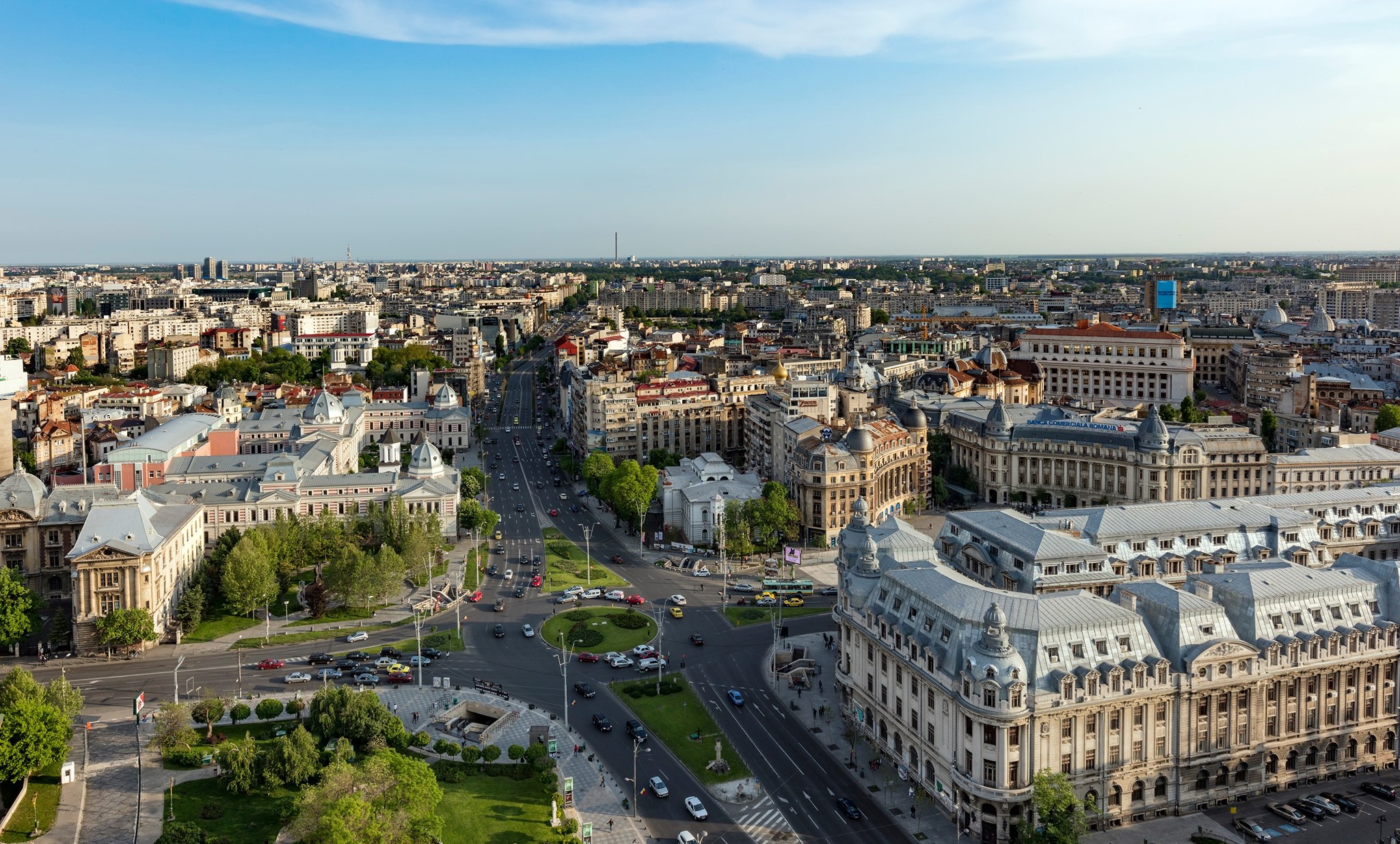
Romania's economic engine runs through this city, generating roughly 20% of national GDP from just 6% of the population. IT and software development dominate the professional landscape — Amazon, Microsoft, Oracle, and Accenture all have significant regional operations here, and a dense local startup ecosystem has grown around them. Salaries in tech can reach €2,000–€4,000/month net for senior roles, which is strong by local standards. Remote workers and digital nomads slot in easily: the infrastructure exists, the talent pool is real, and co-working spaces have multiplied across the center.
A one-bedroom in the city center runs around $780/month — noticeably higher than five years ago, but still roughly half what you'd pay in Warsaw or Prague. The metro is functional and cheap (a monthly pass costs about €12), though the bus network is chaotic and best avoided until you know the city. Healthcare is a genuine friction point: public hospitals are underfunded and often grim, so most expats pay out-of-pocket for private clinics, budgeting €50–€150 per visit. Romanian bureaucracy is slow and paper-heavy — registering for residency involves multiple offices and patience you'll need to manufacture. English is widely spoken in professional and younger circles, but government offices are Romanian-only.
Summers are genuinely hot and social — rooftop bars, outdoor festivals, and weekend trips to the Carpathians two hours north fill the calendar from May through September. Winters are cold, grey, and occasionally brutal, which drives people indoors to a surprisingly good restaurant scene (dinner for two at a mid-range place runs €25–€40). The expat community is real but not overwhelming — concentrated in Floreasca, Dorobanți, and around Victoriei, with Facebook groups and regular meetups. The food scene leans heavily local and Eastern European, with international options improving yearly. This city suits tech professionals, remote workers with above-average income, and FIRE-chasers who want a European capital lifestyle at a meaningful discount — as long as they can tolerate bureaucratic friction and grey winters.
Estimate the cost of moving to Bucharest, Romania
Get a free moving cost estimate for moving to Bucharest, Romania. Takes 10 seconds.
How much are you shipping?
When are you moving?
Powered by Sirelo. Free quotes from international movers.
🏚️ Cost of Living
💰 Budgets and Costs
$893/mo, one person, rent included
Selected: budget lifestyle
Bucharest at the budget tier comes to about $893 a month for one adult, with $451 of that going to rent. Beyond rent the estimate covers $115 on groceries, $59.00 on dining out, $36.00 on entertainment and lifestyle, $211 on utilities and connectivity and $21.00 on transport.
Rent
$451/mo
1BR outside the centre
Groceries
$115/mo
75% of mid-range grocery spend
Dining out
$59.00/mo
4 inexpensive meals
Entertainment & lifestyle
$36.00/mo
1 cinema trip, 8 cappuccinos
Utilities & connectivity
$211/mo
utilities, mobile, internet
Transport
$21.00/mo
Monthly pass
Budgets (excl. rent)
Single person$442/mo
Excludes rent. The total above is all-in, rent included.
$1,090/mo, one person, rent included
Selected: mid-range lifestyle
Bucharest at the mid-range tier comes to about $1,090 a month for one adult, with $451 of that going to rent. Beyond rent the estimate covers $153 on groceries, $146 on dining out, $108 on entertainment and lifestyle, $211 on utilities and connectivity and $21.00 on transport.
Rent
$451/mo
1BR outside the centre
Groceries
$153/mo
Staples basket scaled to a full month
Dining out
$146/mo
10 inexpensive meals
Entertainment & lifestyle
$108/mo
gym, 2 cinema trips, 12 cappuccinos
Utilities & connectivity
$211/mo
utilities, mobile, internet
Transport
$21.00/mo
Monthly pass
Budgets (excl. rent)
Single person$639/mo
Excludes rent. The total above is all-in, rent included.
$1,534/mo, one person, rent included
Selected: comfortable lifestyle
Bucharest at the comfortable tier comes to about $1,534 a month for one adult, with $677 of that going to rent. Beyond rent the estimate covers $214 on groceries, $258 on dining out, $153 on entertainment and lifestyle, $211 on utilities and connectivity and $21.00 on transport.
Rent
$677/mo
1BR in the centre
Groceries
$214/mo
140% of mid-range grocery spend
Dining out
$258/mo
6 inexpensive meals + 6 mid-range meals
Entertainment & lifestyle
$153/mo
gym, 4 cinema trips, 20 cappuccinos
Utilities & connectivity
$211/mo
utilities, mobile, internet
Transport
$21.00/mo
Monthly pass
Budgets (excl. rent)
Single person$857/mo
Excludes rent. The total above is all-in, rent included.
Estimates for one adult, built from this city's average prices and the usage shown for each tier. Your spending will differ with how often you eat out and where you live.
A 1BR in the center runs about $677.15/mo. If your income is in another currency, bank FX fees add up. A multi-currency account can cut that cost.
Bucharest feels safer than its reputation suggests, especially in central districts like Lipscani and Dorobanți. Daytime walking is straightforward and the city has a lived-in, European vibe. Nighttime safety depends heavily on neighborhood—main areas are reasonably walkable, though solo late-night walks aren't advisable. Most expats report feeling secure in their daily routines, though vigilance is standard for any major Eastern European capital.
Petty theft and pickpocketing occur in crowded areas, public transport, and tourist zones; keep valuables secured. Scams targeting foreigners include taxi overcharging and inflated bar bills in Old Town—use Uber or Bolt instead. Violent crime against expats is rare. Solo female travelers should exercise normal urban caution; harassment is occasional but not systemic. Avoid poorly lit peripheral neighborhoods at night and be cautious in Obor and Ferentari districts.
Romania's political system is stable and EU-integrated, with reliable police and low protest risk. Corruption exists but rarely affects expats directly. The judiciary is functional and property rights are protected. Bucharest is genuinely one of Eastern Europe's more livable capitals for remote workers and retirees—affordable, culturally rich, and reasonably secure if you use common sense. It's a solid choice for Americans seeking European living without Western prices.
Bucharest has a safety index of 60/100. Petty theft and lost belongings are the most common problems for newcomers. Compare travel insurance before you go.
See how Bucharest's digital nomad life compares with Sibiu
🧳 Expat Life
English Proficiency
Limited
Expat Community
Large & Active
Top Neighborhoods
Dorobanți, Floreasca, Primăverii
Banks Nearby
601
ATMs Nearby
238
Expat Life Notes
Bucharest is a booming eastern European hub with incredible internet, safety, and a very low cost of living.
Pros
✓ Excellent internet and tech scene
✓ Very safe capital
✓ Low cost of living
Cons
✗ Heavy traffic and pollution
✗ Fragmented infrastructure
✗ Bureaucracy
🏘️ Neighborhoods in Bucharest
Notable areas of Bucharest, with descriptions adapted from public reference sources. Rent figures are Numbeo's city-wide averages, not prices for a specific area.
Conditions can change from one block to the next, and these descriptions are general guides, not safety assessments. Before choosing where to stay or live, check current travel advisories, talk to people who live there, and visit in person if you can.
Lipscani
Lipscani is a street and district in Bucharest, Romania. From the Middle Ages into the early 19th century it was the most important commercial area of the city and Wallachia. It sits near the ruins of the old Princely Court built by Vlad III the Impaler.
Numbeo city average, center: $677 (updated Oct 8, 2026)
Băneasa is a borough on the north side of Bucharest, in Sector 1, near Băneasa Lake, covering 0.45 square kilometers. It borders Băneasa Forest and contains the Aurel Vlaicu International Airport, Zoo Băneasa, the Băneasa railway station, Băneasa Shopping City, and the Embassy of the United States. The area has become increasingly upmarket, with luxury apartment developments and villas built before the 1930s that were refurbished in the 1990s and 2000s.
Numbeo city average, outside-center: $451 (updated Oct 8, 2026)
Centrul Civic is a district in central Bucharest, Romania, that was completely rebuilt in the 1980s under the systematization scheme of dictator Nicolae Ceaușescu. The Bucharest Civic Centre was planned to become the new political-administrative center of Communist Romania.
Numbeo city average, center: $677 (updated Oct 8, 2026)
Piața Romană is a major traffic intersection in Sector 1, central Bucharest. Lascăr Catargiu Boulevard and Magheru Boulevard cross there, and Dacia Boulevard runs roughly east-west through the square. The Piața Romană metro station on Magheru Boulevard serves the square. The Academy of Economic Studies, founded in 1913, has its main building north of the square. Two Petrașcu Houses flank the square: No. 1, built in 1907 in Neo-Romanian style to designs by Ion Mincu, and No.
Numbeo city average, center: $677 (updated Oct 8, 2026)
Titan is a neighborhood in eastern Bucharest, part of Sector 3, surrounding Alexandru Ioan Cuza Park, formerly called Titan, I.O.R., and Balta Albă. The name comes from a 20th-century cement factory. Development began in the 1950s amid a housing crisis and lasted until the 1970s, when the park was built around Titan Lake. The park, over 85 ha, has a lake split by a road bridge with five small islands. The area is mostly housing.
Numbeo city average, outside-center: $451 (updated Oct 8, 2026)
Aviației is a district in Bucharest split between Sector 1 and Sector 2, mostly in Sector 1. Its name refers to its proximity to Aurel Vlaicu International Airport in neighboring Băneasa. The Ceaușescu regime developed it as a neighborhood for pilots and airport employees. Streets are named for aviation figures including Traian Vuia, Aurel Vlaicu, Henri Coandă, Nicolae Caranfil, and Alexandru Șerbănescu. Notable buildings include Oracle Tower, AVAS, the National Museum of Romanian Aviation, and Floreasca City Center.
Numbeo city average, outside-center: $451 (updated Oct 8, 2026)
Bucharest has a population of approximately 1,716,961 people.
A single person can expect to spend around $1,693 per month in Bucharest, including rent. A 1-bedroom apartment in the city center costs approximately $677/month.
The nearest airport to Bucharest is BBU, approximately 7.5km away.
Bucharest is considered relatively safe, with a safety index of 60.0. As with any city abroad, expats should research specific neighborhoods before committing to a location.
Bucharest has an average internet speed of 150 Mbps. It is considered a well-established digital nomad destination.
Genuinely painful. Non-EU expats need to visit multiple government offices, gather notarized documents, and often return several times due to unclear requirements. The process can take 2–4 months. EU citizens have it easier but still face paperwork. Hiring a local lawyer or relocation agent for €300–€500 is widely considered worth it.
Not to get by day-to-day — English is widely spoken in tech, hospitality, and among people under 40. But government offices, landlords outside the expat belt, and older residents often speak only Romanian. Learning basic Romanian significantly reduces friction with bureaucracy and makes social integration outside the expat bubble much easier.
Bucharest is very affordable. You can comfortably live on $1500-$2500 USD per month, including rent. Rent for a modern one-bedroom apartment in a central neighborhood like Dorobanti or Romana starts around $700-$1000, while groceries and dining out are significantly cheaper than in the US.
Bucharest has a mix of public and private healthcare. Private hospitals like Regina Maria and Medicover offer excellent care with English-speaking doctors, but you'll need private insurance. Public healthcare is available but may involve longer wait times and language barriers.
Generally, Bucharest is a safe city, but some areas are better than others. Safe and popular neighborhoods for expats include Dorobanti, Aviatorilor, Primaverii, and the Old Town (Centrul Vechi), though the Old Town can be noisy at night. Avoid more isolated areas on the outskirts.
Bucharest boasts some of the fastest internet speeds in Europe. You can easily find fiber optic connections with speeds of 500 Mbps or even 1 Gbps. Coworking spaces like TechHub Bucharest and Commons offer reliable internet and a professional environment.
Yes, English proficiency is quite high, especially among younger generations and in the service industry. You'll find many people who speak English in restaurants, shops, and tourist areas. However, learning some basic Romanian phrases will definitely enhance your experience.
Bucharest has a continental climate with hot summers and cold winters. Expect temperatures ranging from -5°C (23°F) in winter to 30°C (86°F) in summer. Spring and autumn are pleasant, but be prepared for occasional heavy rain.
Bucharest has a good public transportation system, including a metro, buses, trams, and trolleybuses. The metro is efficient and covers most of the city. Ride-sharing services like Uber and Bolt are also readily available and affordable.
Several international banks operate in Bucharest, including Raiffeisen Bank and UniCredit Bank. Opening a bank account is relatively straightforward with the right documents (passport, residency permit). ATMs are widely available, but be mindful of potential fees.
As a US citizen, you're still required to file US taxes even when living abroad. The Foreign Earned Income Exclusion (FEIE) can help you exclude a certain amount of your income from US taxes. Also, be aware of FBAR reporting requirements for foreign bank accounts.
Bucharest can be an excellent choice for early retirement, especially if you're on a fixed income. The low cost of living allows you to stretch your retirement savings further. With careful budgeting, you could live comfortably on $1500-$2000 per month.
Bucharest has a growing expat community, with many opportunities to connect with other foreigners. Online groups like InterNations and Facebook groups are great resources for meeting people and finding information. There are also regular expat events and meetups.
Bucharest has a vibrant culinary scene. For traditional Romanian food, try Caru' cu Bere or Hanu' lui Manuc. For international cuisine, explore the restaurants in the Old Town or on Calea Victoriei. There are also many trendy cafes in neighborhoods like Floreasca and Dorobanti.
Romania recently introduced a digital nomad visa, allowing non-EU citizens to live and work remotely from Romania for up to a year, with the possibility of extension. You'll need to prove a minimum monthly income, currently around €3,300, and have valid health insurance.
Romanians are generally warm and welcoming, but there are some cultural nuances to be aware of. Politeness and respect are important, and it's customary to greet people with a handshake. Also, be prepared for a more direct communication style than in the US.
Cost-of-living and visa updates for Bucharest and the rest of Romania. Free with RA Postcards.
By submitting your email address, you will receive a free subscription to RA Postcards and special offers from Rewire Abroad and our affiliates. You can unsubscribe at any time, and we encourage you to read more about our Privacy Policy.