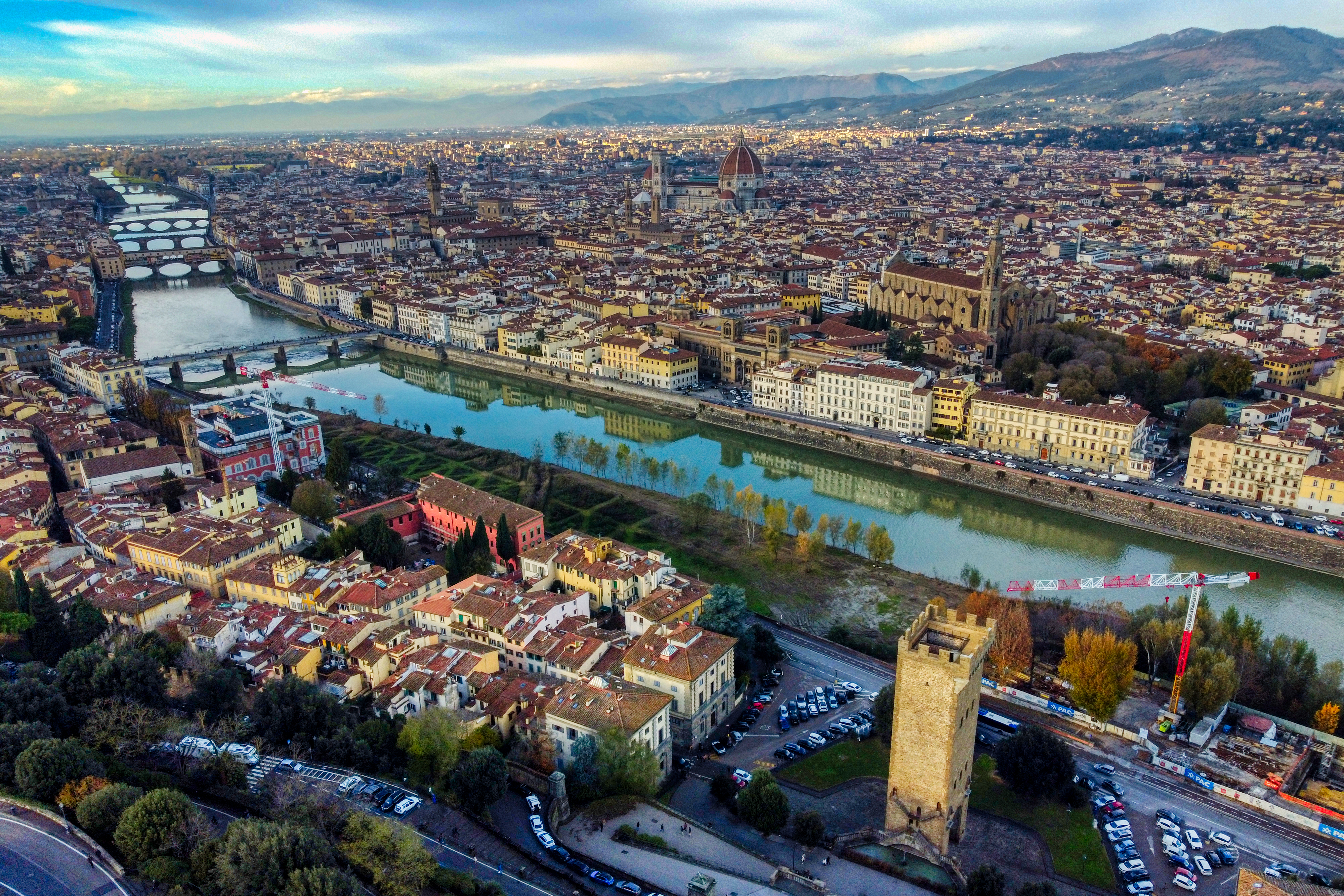
Florence sits at an elevation of 50 meters above sea level in the heart of Tuscany, operating on Central European Time (Europe/Rome). The city experiences a humid subtropical climate with very hot summers and cold winter nights, shaping life around its piazzas and riverbanks. For expats, the most popular neighborhoods cluster around the Ponte Vecchio area, where the large and active expat community tends to settle, drawn by the city's compact scale and walkable streets.
Living costs in Florence reflect its status as a mid-tier Italian city. A single adult's monthly budget excluding rent runs to $1,128, while a family of four spends $4,048 on the same essentials. Rents vary by location: a one-bedroom in the city center averages $1,563 per month, dropping to $1,042 outside the center; a three-bedroom in the center costs $2,752, versus $1,846 on the outskirts. Utilities add $245 monthly, internet $33, and a mobile phone plan $12. A monthly public transport pass is $44, a gym membership $63, an inexpensive restaurant meal $27 per person, a three-course mid-range dinner for two $78, and a cappuccino $2. The average monthly net salary locally is $1,992, and the overall cost of living index stands at 69 out of 100 (New York City equals 100).
Safety is a strong point: Florence has a safety index of 85 out of 100 and a crime index of just 15 out of 100 (lower is safer), making it one of Italy's more secure cities. Healthcare quality is rated as excellent, and English proficiency is common in tourist areas, easing daily life for newcomers. The air quality index is 55 (lower is better), and average internet speed is 90 Mbps, supporting remote work.
For those looking to stay long-term, two visa programs are available. The Italy Elective Residence Visa requires a minimum monthly income of $2,895, while the Italy Digital Nomad Visa sets the threshold at $2,615 per month. The nearest airport is Florence Airport (IATA: FLR), located 23 kilometers from the city center. With an overall expat score of 75 out of 100, a digital nomad score of 77, a FIRE score of 69, and a retiree score of 68, Florence suits a wide range of newcomers, from remote workers and early retirees to anyone seeking a safe, culturally rich base in central Italy.
Estimate the cost of moving to Florence, Italy
Get a free moving cost estimate for moving to Florence, Italy. Takes 10 seconds.
How much are you shipping?
When are you moving?
Powered by Sirelo. Free quotes from international movers.
🏚️ Cost of Living
💰 Budgets and Costs
$1,702/mo, one person, rent included
Selected: budget lifestyle
Florence at the budget tier comes to about $1,702 a month for one adult, with $1,042 of that going to rent. Beyond rent the estimate covers $190 on groceries, $107 on dining out, $29.00 on entertainment and lifestyle, $290 on utilities and connectivity and $44.00 on transport.
Rent
$1,042/mo
1BR outside the centre
Groceries
$190/mo
75% of mid-range grocery spend
Dining out
$107/mo
4 inexpensive meals
Entertainment & lifestyle
$29.00/mo
1 cinema trip, 8 cappuccinos
Utilities & connectivity
$290/mo
utilities, mobile, internet
Transport
$44.00/mo
Monthly pass
Budgets (excl. rent)
Single person$660/mo
Excludes rent. The total above is all-in, rent included.
$2,011/mo, one person, rent included
Selected: mid-range lifestyle
Florence at the mid-range tier comes to about $2,011 a month for one adult, with $1,042 of that going to rent. Beyond rent the estimate covers $254 on groceries, $269 on dining out, $112 on entertainment and lifestyle, $290 on utilities and connectivity and $44.00 on transport.
Rent
$1,042/mo
1BR outside the centre
Groceries
$254/mo
Staples basket scaled to a full month
Dining out
$269/mo
10 inexpensive meals
Entertainment & lifestyle
$112/mo
gym, 2 cinema trips, 12 cappuccinos
Utilities & connectivity
$290/mo
utilities, mobile, internet
Transport
$44.00/mo
Monthly pass
Budgets (excl. rent)
Single person$969/mo
Excludes rent. The total above is all-in, rent included.
$2,800/mo, one person, rent included
Selected: comfortable lifestyle
Florence at the comfortable tier comes to about $2,800 a month for one adult, with $1,563 of that going to rent. Beyond rent the estimate covers $355 on groceries, $396 on dining out, $152 on entertainment and lifestyle, $290 on utilities and connectivity and $44.00 on transport.
Rent
$1,563/mo
1BR in the centre
Groceries
$355/mo
140% of mid-range grocery spend
Dining out
$396/mo
6 inexpensive meals + 6 mid-range meals
Entertainment & lifestyle
$152/mo
gym, 4 cinema trips, 20 cappuccinos
Utilities & connectivity
$290/mo
utilities, mobile, internet
Transport
$44.00/mo
Monthly pass
Budgets (excl. rent)
Single person$1,237/mo
Excludes rent. The total above is all-in, rent included.
Estimates for one adult, built from this city's average prices and the usage shown for each tier. Your spending will differ with how often you eat out and where you live.
A 1BR in the center runs about $1563.15/mo. If your income is in another currency, bank FX fees add up. A multi-currency account can cut that cost.
Florence is genuinely safe for expats, with low violent crime and a strong police presence in tourist and residential areas. Petty theft—pickpocketing on crowded buses, bag snatching near the Duomo—remains the primary concern; use standard urban precautions. The historic center and neighborhoods like Santo Spirito are well-patrolled. Avoid isolated areas after dark and exercise normal vigilance with valuables. No significant geopolitical risks. For a 30-65 American, Florence presents a secure, stable environment with manageable, predictable risks typical of any European city.
Florence has a safety index of 57.85/100. Petty theft and lost belongings are the most common problems for newcomers. Compare travel insurance before you go.
Global cultural capital. Exceptionally walkable and safe with high English in tourist zones.
Pros
✓ History/Art
✓ Vibrant expat circle
✓ Safety
Cons
✗ Mass tourism
✗ Expensive housing
🏘️ Neighborhoods in Florence
Notable areas of Florence, with descriptions adapted from public reference sources. Rent figures are Numbeo's city-wide averages, not prices for a specific area.
Conditions can change from one block to the next, and these descriptions are general guides, not safety assessments. Before choosing where to stay or live, check current travel advisories, talk to people who live there, and visit in person if you can.
Metropolitan City of Florence
The Metropolitan City of Florence is a metropolitan city in Tuscany, Italy, with the city of Florence as its capital. It replaced the province of Florence after a reform of local authorities and became operative afterward. It covers many municipalities across its territory.
Novoli is a quarter in the northwestern section of Florence, Italy. It belonged to the former comune of Pellegrino until 1865, when it was incorporated into the comune of Florence.
Peretola is a Florence suburb at the city's northern edge. It falls under Quartiere 5 - Rifredi administratively. The nearby international airport takes its name from the area.
Coverciano is a neighborhood in southeastern Florence, bordered by the Affrico and Mensola streams, the slopes of the hills, and Via Aretina. It contains two parish churches, Santa Maria in Coverciano and St. Catherine of Siena. The area also holds the FIGC Centro Tecnico Federale di Coverciano, the Museo del Calcio, and the Florence section headquarters of the Italian Referees Association along with the sports judge of Florence.
Isolotto is a residential district in southwestern Florence, Tuscany, Italy. It is a well-known post-war neighborhood, developed mainly in the 1950s under the INA-Casa housing program. It is regarded as a significant example of post-war public housing and planning in Italy.
Florence has a population of approximately 253,565 people.
A single person can expect to spend around $3,908 per month in Florence, including rent. A 1-bedroom apartment in the city center costs approximately $1563/month.
The nearest airport to Florence is FLR, approximately 22.5km away.
Florence is considered moderate in terms of safety, with a safety index of 57.9. As with any city abroad, expats should research specific neighborhoods before committing to a location.
Florence has an average internet speed of 90 Mbps. It is considered a well-established digital nomad destination.
You need conversational Italian for daily life. While tourist areas have English speakers, dealing with bureaucracy, healthcare, landlords, and most jobs requires Italian. Basic survival Italian isn't enough—aim for intermediate level before moving.
Limited and competitive. English teaching, fashion internships, and tourism jobs are most accessible. Many positions are seasonal or part-time. Having EU citizenship helps significantly, as does Italian language skills and connections in fashion or cultural sectors.
No, Florence is among Italy's most expensive cities due to tourism. Rent, dining, and daily costs rival Milan and Rome. Budget €2,500-3,000/month for comfortable living in the center, or €2,000/month in outer neighborhoods.
Most Americans pursue either a student visa (if studying Italian or other subjects), an elective residency visa (requiring proof of substantial passive income), or a work visa (sponsored by an Italian employer). The elective residency visa requires demonstrating significant financial resources, typically upwards of €31,000 per year, and proof of health insurance.
Florence is generally a very safe city, especially compared to major US cities. Petty theft, like pickpocketing, is the most common concern, particularly in crowded tourist areas like the Duomo and Ponte Vecchio. Avoid poorly lit or deserted areas late at night, especially near the train station.
Expect to spend around €1,500-€2,500 per month, depending on your lifestyle. Rent for a one-bedroom apartment in a central neighborhood like Oltrarno or San Marco can range from €900-€1,500. Groceries will cost around €300-€500, and dining out can easily add another €300+.
Internet speeds in Florence are generally good, with fiber optic available in many areas. You can expect download speeds of 50-100 Mbps, which is sufficient for most remote work tasks. Check internet provider coverage maps before committing to a specific apartment.
Yes, Florence has a growing number of coworking spaces catering to digital nomads and freelancers. Popular options include Impact Hub Firenze, Regus, and Talent Garden Firenze. Expect to pay around €200-€300 per month for a dedicated desk.
Italy has a public healthcare system (Servizio Sanitario Nazionale - SSN) that provides excellent care, though navigating it can be challenging without Italian. Many private clinics and hospitals have English-speaking doctors. Consider supplemental private health insurance for faster access and more specialized care.
For more affordable living, consider neighborhoods like San Frediano, Campo di Marte, or Gavinana. These areas offer lower rents and a more local feel while still being well-connected to the city center by public transport.
Services like Wise (formerly TransferWise) and Revolut offer competitive exchange rates and lower fees compared to traditional bank transfers. Check ATM fees with your bank before withdrawing cash, and consider opening a local Italian bank account for day-to-day transactions.
Florence has a Mediterranean climate with hot, humid summers and cool, wet winters. Expect temperatures to range from 30-35°C (86-95°F) in July and August to 5-10°C (41-50°F) in December and January. Spring and fall offer pleasant weather for exploring.
Florence is a very walkable city, and most of the main attractions are within easy reach. The city also has a good public transport system, including buses and trams. Driving in the city center is not recommended due to traffic and limited parking.
Florence has a sizable and active expat community, with numerous groups and organizations catering to different interests. Joining these groups is a great way to meet people, get advice, and ease your transition to living in Florence. Check Facebook groups and InterNations for local events.
With careful budgeting, a couple could retire comfortably in Florence on €2,500-€3,500 per month, covering rent, groceries, healthcare, and some leisure activities. This assumes owning your own apartment or renting a smaller place outside the city center. A single person could manage on €1,800-€2,500.
As a US citizen, you're still required to file US taxes even when living abroad. The Foreign Earned Income Exclusion (FEIE) allows you to exclude a certain amount of your foreign-earned income from US taxes. You may also need to report foreign bank accounts (FBAR) if the combined value exceeds $10,000.
While Italian is prevalent, many cinemas show films in their original language (often English) with Italian subtitles. Several bookstores carry English-language books, and streaming services like Netflix and Amazon Prime offer English content. You can also find English-language newspapers and websites online.
Italians value personal relationships and take time to build trust. Be prepared for a slower pace of life and a more relaxed attitude towards schedules. Dress modestly when visiting churches and be mindful of noise levels, especially during the afternoon siesta (riposo).
Cost-of-living and visa updates for Florence and the rest of Italy. Free with RA Postcards.
By submitting your email address, you will receive a free subscription to RA Postcards and special offers from Rewire Abroad and our affiliates. You can unsubscribe at any time, and we encourage you to read more about our Privacy Policy.