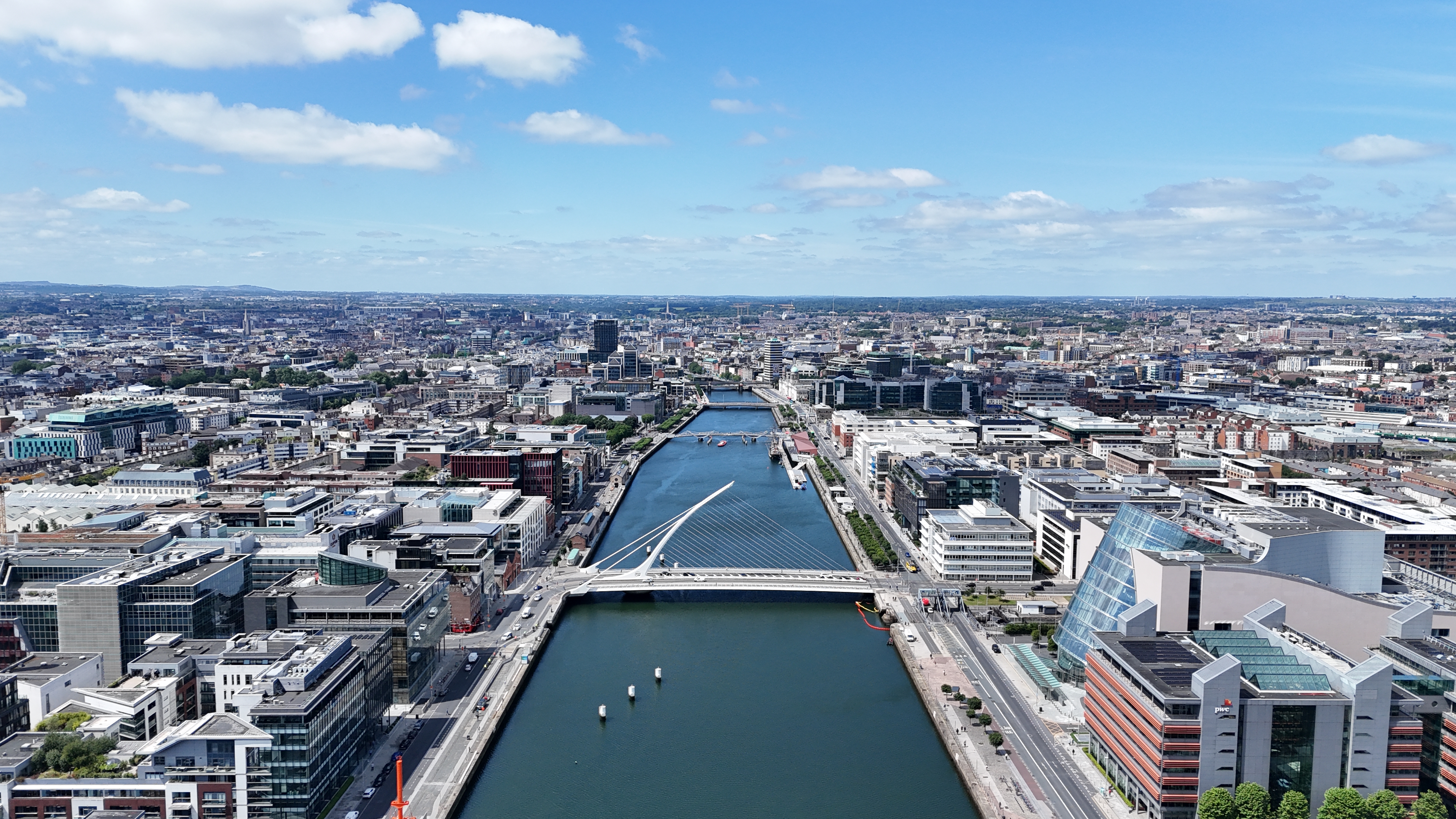
Dublin sits on Ireland's east coast at an elevation of 20 meters above sea level, enjoying a temperate climate. The city has a population of 593,000 and is home to a large and active expat community. Popular expat neighborhoods include Ranelagh and Rathmines.
Living costs in Dublin are significant. A single adult's monthly expenses excluding rent total $1,222. A one-bedroom apartment in the city center rents for $2,466 per month, while outside the center it costs $2,217. Three-bedroom units go for $4,423 in the center and $3,471 outside. Utilities run $278 monthly, internet $52, and a mobile phone plan $18. A monthly public transport pass is $107, a gym membership $69, an inexpensive restaurant meal $24, a three-course meal for two at a mid-range restaurant $101, and a cappuccino $5. The average monthly net salary locally is $3,862. The cost of living index is 75 out of 100 compared to New York City.
Dublin has a safety index of 80 out of 100 and a crime index of 20 out of 100, where lower is safer. Healthcare quality is rated as excellent. The air quality index is 32, with lower being better.
The nearest airport is DUB, located 17 kilometers from the city. For retirees, the Ireland Stamp 0 (Financially Independent) visa requires a minimum monthly income of $4,350. Dublin suits expats, digital nomads, and retirees, earning an overall expat score of 81 out of 100, a digital nomad score of 81, and a retiree score of 68.
Estimate the cost of moving to Dublin, Ireland
Get a free moving cost estimate for moving to Dublin, Ireland. Takes 10 seconds.
How much are you shipping?
When are you moving?
Powered by Sirelo. Free quotes from international movers.
🏚️ Cost of Living
💰 Budgets and Costs
$2,992/mo, one person, rent included
Selected: budget lifestyle
Dublin at the budget tier comes to about $2,992 a month for one adult, with $2,217 of that going to rent. Beyond rent the estimate covers $189 on groceries, $88.00 on dining out, $55.00 on entertainment and lifestyle, $336 on utilities and connectivity and $107 on transport.
Rent
$2,217/mo
1BR outside the centre
Groceries
$189/mo
75% of mid-range grocery spend
Dining out
$88.00/mo
4 inexpensive meals
Entertainment & lifestyle
$55.00/mo
1 cinema trip, 8 cappuccinos
Utilities & connectivity
$336/mo
utilities, mobile, internet
Transport
$107/mo
Monthly pass
Budgets (excl. rent)
Single person$775/mo
Excludes rent. The total above is all-in, rent included.
$3,287/mo, one person, rent included
Selected: mid-range lifestyle
Dublin at the mid-range tier comes to about $3,287 a month for one adult, with $2,217 of that going to rent. Beyond rent the estimate covers $252 on groceries, $221 on dining out, $154 on entertainment and lifestyle, $336 on utilities and connectivity and $107 on transport.
Rent
$2,217/mo
1BR outside the centre
Groceries
$252/mo
Staples basket scaled to a full month
Dining out
$221/mo
10 inexpensive meals
Entertainment & lifestyle
$154/mo
gym, 2 cinema trips, 12 cappuccinos
Utilities & connectivity
$336/mo
utilities, mobile, internet
Transport
$107/mo
Monthly pass
Budgets (excl. rent)
Single person$1,070/mo
Excludes rent. The total above is all-in, rent included.
$3,920/mo, one person, rent included
Selected: comfortable lifestyle
Dublin at the comfortable tier comes to about $3,920 a month for one adult, with $2,466 of that going to rent. Beyond rent the estimate covers $352 on groceries, $435 on dining out, $224 on entertainment and lifestyle, $336 on utilities and connectivity and $107 on transport.
Rent
$2,466/mo
1BR in the centre
Groceries
$352/mo
140% of mid-range grocery spend
Dining out
$435/mo
6 inexpensive meals + 6 mid-range meals
Entertainment & lifestyle
$224/mo
gym, 4 cinema trips, 20 cappuccinos
Utilities & connectivity
$336/mo
utilities, mobile, internet
Transport
$107/mo
Monthly pass
Budgets (excl. rent)
Single person$1,454/mo
Excludes rent. The total above is all-in, rent included.
Estimates for one adult, built from this city's average prices and the usage shown for each tier. Your spending will differ with how often you eat out and where you live.
A 1BR in the center runs about $2465.66/mo. If your income is in another currency, bank FX fees add up. A multi-currency account can cut that cost.
Dublin is genuinely safe for expats, with low violent crime and a welcoming atmosphere. Petty theft and pickpocketing occur in tourist areas (Temple Bar, city center) and on public transport during peak hours—standard urban precautions apply. Avoid poorly lit areas late at night and exercise normal city awareness. Drug-related activity exists in certain neighborhoods (parts of north inner city), but rarely affects residents in established expat areas like Ranelagh, Ballsbridge, or Rathmines. No significant geopolitical risks. Overall: a secure choice for remote workers and retirees seeking an English-speaking, stable European base.
Dublin has a safety index of 46.03/100. Petty theft and lost belongings are the most common problems for newcomers. Compare travel insurance before you go.
See how Dublin's digital nomad life compares with Carlow
🧳 Expat Life
English Proficiency
Widely Spoken
Expat Community
Large & Active
Top Neighborhoods
Ranelagh, Rathmines
Banks Nearby
129
ATMs Nearby
166
Expat Life Notes
A friendly global capital facing an extreme housing shortage but high quality of life.
Pros
✓ Native English
✓ Safe
✓ Vibrant socials
Cons
✗ Housing crisis
✗ High costs
🏘️ Neighborhoods in Dublin
Notable areas of Dublin, with descriptions adapted from public reference sources. Rent figures are Numbeo's city-wide averages, not prices for a specific area.
Conditions can change from one block to the next, and these descriptions are general guides, not safety assessments. Before choosing where to stay or live, check current travel advisories, talk to people who live there, and visit in person if you can.
Clontarf
Clontarf is an affluent coastal suburb on Dublin's Northside, in the Dublin 3 postal district. It was historically centered in two places: one on the coast toward the city, and the fishing village of Clontarf Sheds, farther north at what is now Vernon Avenue. Retail businesses are found in several locations, mostly around Vernon Avenue. It adjoins Fairview, Marino, Killester and Raheny, and falls under Dublin City Council.
Numbeo city average, center: $2,466 (updated Nov 13, 2026)
Temple Bar is an area in central Dublin, Ireland, on the south bank of the River Liffey. The Liffey lies to its north, Dame Street to its south, Westmoreland Street to its east, and Fishamble Street to its west. It is promoted as Dublin's cultural quarter and is a tourist destination known for nightlife in the city center. Temple Bar is in the Dublin 2 postal district.
Numbeo city average, center: $2,466 (updated Nov 13, 2026)
Rathgar is a Dublin suburb in Ireland that began as a village and was part of the Rathmines and Rathgar township from 1862. The expanding city absorbed it, and it became a suburb in 1930. It lies about three kilometres south of the city centre.
Numbeo city average, outside-center: $2,217 (updated Nov 13, 2026)
Ranelagh is an affluent residential area and urban village on the Southside of Dublin, Ireland, in postal district Dublin 6. It was originally a village called Cullenswood and was incorporated into Dublin in the 19th century. Ranelagh Gardens opened in the 1770s as an entertainment venue. The area has several primary and secondary schools, the Ranelagh Arts Centre, and sports clubs such as Ranelagh Gaels.
Numbeo city average, center: $2,466 (updated Nov 13, 2026)
Terenure is a middle class suburb of Dublin, Ireland, in the city's D6 and D6W postal districts. It was called Roundtown from around 1800 to 1870. The population of all electoral divisions labeled as Terenure was 17,972 as of the 2022 census.
Numbeo city average, outside-center: $2,217 (updated Nov 13, 2026)
Rathmines is an inner suburb on Dublin's Southside in Ireland, starting at the southern side of the Grand Canal and running along the Rathmines Road. It reaches Rathgar to the south, Ranelagh to the east, and Harold's Cross to the west, and lies in the D06 postal district. It is a commercial and social hub, known as "Flatland" for large Georgian and Victorian houses divided into rented flats, and as "Dublin Belgravia" in the 19th century.
Numbeo city average, center: $2,466 (updated Nov 13, 2026)
Dublin has a population of approximately 592,713 people.
A single person can expect to spend around $6,164 per month in Dublin, including rent. A 1-bedroom apartment in the city center costs approximately $2466/month.
The nearest airport to Dublin is DUB, approximately 17.4km away.
Dublin is considered moderate in terms of safety, with a safety index of 46.0. As with any city abroad, expats should research specific neighborhoods before committing to a location.
Dublin has an average internet speed of 150 Mbps. It is considered a well-established digital nomad destination.
Bluntly, yes — unless you're earning a tech or finance salary. A one-bedroom in the city center averages around $2,400/month, groceries and dining out are expensive by European standards, and private health insurance adds another €1,200–€1,800/year. On a local service-sector wage, the numbers don't work comfortably. On a multinational tech salary of €70,000+, it's manageable but not cheap.
No. Dublin operates entirely in English day-to-day. Irish is taught in schools and appears on signage, but you will never need it for work, bureaucracy, healthcare, or social life. This makes Dublin one of the most accessible cities in continental Europe for native English speakers, and straightforward for anyone with strong English as a second language.
Genuinely difficult. Dublin has one of the tightest rental markets in Europe — low supply, high demand, and landlords who often receive dozens of applications per listing. Expect to provide proof of employment, references, and sometimes several months' deposit upfront. Many expats arrive with temporary accommodation booked and spend weeks searching. Starting your search before you land, using Daft.ie, is strongly advised.
Expect mild, damp weather. Summers (June-August) are the driest, with average highs of 60-65°F (15-18°C). Winters (December-February) are cool and wet, with average highs of 45-50°F (7-10°C). Bring layers and waterproof gear, as rain is frequent.
Dublin is generally safe, but petty crime like pickpocketing and bag snatching can occur, especially in tourist areas like Temple Bar and on public transport. Be aware of your surroundings, especially at night, and avoid walking alone in poorly lit areas. Violent crime is relatively rare.
Consider areas like Rathmines, Drumcondra, or Phibsborough. These neighborhoods offer more affordable rental options compared to the city center while still being well-connected by public transport and having plenty of shops, restaurants, and amenities. They also tend to have a good mix of locals and expats.
Ireland doesn't have a specific retirement visa. Americans typically explore options like the Stamp 0 visa (for those with independent financial means and no intention to work), or long-stay visas requiring enrollment in a full-time course. Consulting with an immigration lawyer is crucial to determine the best path.
Ireland has a two-tiered healthcare system: public and private. Public healthcare is available to residents, but waiting lists can be long. Private health insurance provides faster access to care and a wider choice of doctors. Many doctors speak English, and the quality of care is generally high.
Dublin offers excellent internet speeds, with average download speeds exceeding 50 Mbps. Fiber optic connections are widely available, making it suitable for video conferencing and other bandwidth-intensive tasks. Coworking spaces typically have reliable, high-speed internet.
Yes, Dublin has a thriving coworking scene with numerous options to suit different budgets and needs. Popular choices include Dogpatch Labs, Iconic Offices, and WeWork. Expect to pay around €300-€500 per month for a dedicated desk.
Opening a bank account can be challenging, requiring proof of address (which can be difficult to obtain without a permanent residence) and identification. Some banks may require a letter from your employer or landlord. Consider opening an account with a digital bank like N26 or Revolut as an alternative.
As a US citizen, you're still required to file US taxes even when living abroad. The Foreign Earned Income Exclusion (FEIE) allows you to exclude a certain amount of foreign-earned income from US taxes. You may also need to report foreign bank accounts (FBAR) if the total value exceeds $10,000. Consult with a tax professional specializing in expat taxes.
Several options exist for transferring money, including bank transfers, online platforms like Wise (formerly TransferWise) and Remitly, and traditional money transfer services like Western Union. Compare fees and exchange rates to find the most cost-effective option. Wise often offers the best rates.
Dublin can be challenging for FIRE due to the high cost of living, especially housing. However, if you have a substantial passive income stream or are willing to live frugally outside the city center, it's possible. Consider the impact of Irish taxes on your investment income.
Dublin has a large and active expat community, making it easy to connect with people from around the world. Numerous expat groups and social events are organized through platforms like Meetup and InterNations. Irish people are generally friendly and welcoming, making it easy to integrate into local life.
Dublin has a decent public transportation system, including buses, trams (Luas), and trains (DART). Buses are the most extensive, but can be subject to traffic delays. The Luas and DART are generally reliable. Consider purchasing a Leap Card for discounted fares.
Cost-of-living and visa updates for Dublin and the rest of Ireland. Free with RA Postcards.
By submitting your email address, you will receive a free subscription to RA Postcards and special offers from Rewire Abroad and our affiliates. You can unsubscribe at any time, and we encourage you to read more about our Privacy Policy.