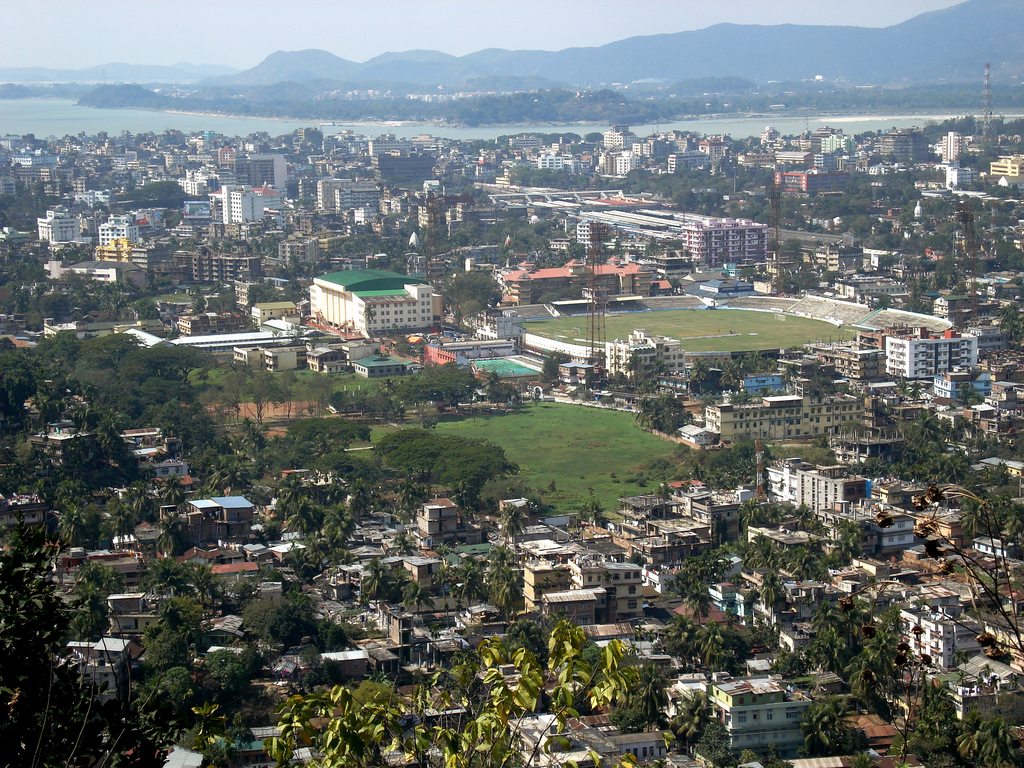
Guwahati sits in the state of Assam in northeastern India, on the south bank of the Brahmaputra River, at an elevation of 55 m above sea level. The city runs on Asia/Kolkata time and experiences a subtropical climate, with hot, humid summers, a heavy monsoon season, and mild winters. Home to roughly 1.1 million people, it is the largest urban center in the region and the gateway to the wider northeast. Expats who settle here tend to cluster in Ganeshguri and Christian Basti, two central neighborhoods that offer easy access to offices, markets, and restaurants. The expat community is small, so newcomers often find themselves building social circles from scratch, though the city's universities and growing tech and services sectors bring a steady trickle of foreign professionals and long-term visitors.
The cost of living is the headline attraction. A one-bedroom apartment in the city center rents for about $137/mo, while the same outside the center drops to $68/mo. Three-bedroom units run $288/mo in the center and $229/mo outside it. Utilities average $34/mo, internet $6/mo, and a mobile phone plan just $3/mo. A monthly public transport pass costs $5/mo and a gym membership $12/mo. Eating out is cheap: an inexpensive restaurant meal is around $3 per person, a three-course mid-range meal for two about $11, and a cappuccino $2. Excluding rent, a single person spends roughly $290/mo, and a family of four about $1,048/mo. Budget, mid-range, and comfortable tiers for a single adult, rent included, come to $151/mo, $218/mo, and $323/mo respectively. Against an average monthly net salary of $330/mo, local wages are modest, and the cost of living index of 18/100 against New York City shows how far a foreign income can stretch. Average internet speed is 40 Mbps, fast enough for remote work and streaming.
Safety is a mixed but generally manageable picture. The safety index stands at 65/100 and the crime index at 35/100, where lower is safer, suggesting a city where common street crime is not the dominant concern. Air quality is a real tradeoff: the air quality index of 140 points to pollution levels that can aggravate respiratory conditions, particularly in winter. Healthcare quality is rated fair, so routine care is available but complex or specialized treatment may mean traveling to larger Indian metros. Retirees score 60/100, reflecting the appeal of low costs against the limitations of healthcare and air quality.
Visas for India involve applying in advance through the appropriate government channels, and long-stay options exist for those with the right eligibility. The nearest airport is GAU, 17 km from the city, which connects Guwahati to the rest of India and a handful of international destinations. With an overall expat score of 85/100, a FIRE score of 87/100, and a digital nomad score of 65/100, the city suits budget-conscious remote workers, early retirees chasing a very low cost of living, and anyone drawn to a slower, less crowded side of India. English proficiency is limited, so a willingness to learn some Assamese or Hindi will make daily life considerably easier.