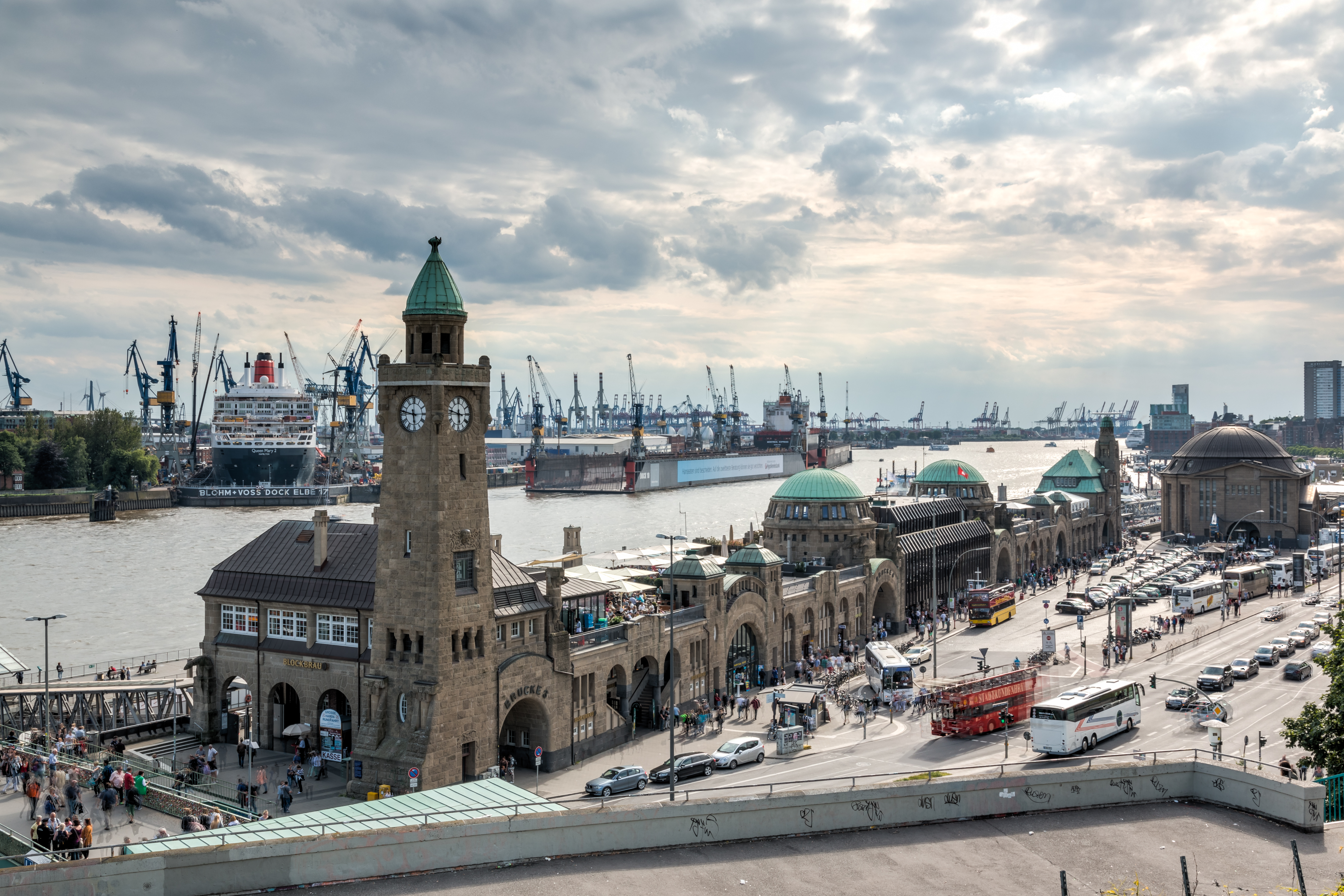
Hamburg sits in northern Germany on the Elbe River, about 10 km from Hamburg Airport (HAM), and rises just 9 m above sea level under a temperate climate that shapes daily life around the harbor and the water. The city runs on Europe/Berlin time and holds a population of 1.9 million, making it Germany's second-largest city and one of its most international. Expats tend to cluster in Eppendorf, Winterhude, and Ottensen, three neighborhoods that balance leafy residential streets with easy access to the center, the Alster, and the riverfront. English is widely spoken, and the expat community is large and active, which softens the landing for newcomers who arrive without German.
Rents reflect a city that is expensive by German standards but still far below New York. A one-bedroom apartment in the city center runs $1,650/mo, while the same outside the center drops to $1,250/mo. Three-bedroom units go for $3,100/mo centrally and $2,300/mo farther out. Beyond rent, a single adult spends about $1,250/mo, and a family of four about $3,700/mo. Utilities average $460/mo, internet $41/mo, and a mobile phone plan $26/mo. A monthly public transport pass costs $60/mo and a gym membership $28/mo. Eating out is moderate: an inexpensive restaurant meal is $13 per person, a three-course mid-range dinner for two is $67, and a cappuccino is $4. The average local net salary is $2,072/mo, and the cost of living index sits at 74/100 against New York at 100. Budget, mid-range, and comfortable tiers for a single adult come to $1,398/mo, $2,097/mo, and $2,699/mo respectively, rent included.
Safety is a strong point. The safety index is 80/100 and the crime index is 20/100, where a lower number means less crime. Air quality is good at 35, again with lower being better. Healthcare quality is rated excellent, which matters for families, retirees, and anyone managing a long-term condition. Internet averages 200 Mbps, fast enough for remote work, streaming, and video calls without strain. Together these numbers explain why the city scores 82/100 overall for expats, 84/100 for digital nomads, 70/100 for retirees, and 64/100 on FIRE.
For retirees, the §7 Abs. 1 S. 3 AufenthG route requires a minimum monthly income of $1,200/mo. For freelancers and remote workers, the Freelancer Residence Permit under Section 21 of the German Residence Act is the relevant path. Hamburg Airport (HAM) is the nearest airport, 10 km away, and the city's rail and transit links make the rest of Europe reachable without a car. Hamburg suits remote workers and digital nomads who want a large, well-organized European city with a moderate cost of living, a sizable expat community, and strong public services. It also fits retirees seeking excellent healthcare and a calm, temperate setting, and families who can absorb the higher housing costs in exchange for safety, green space, and a well-run urban life.