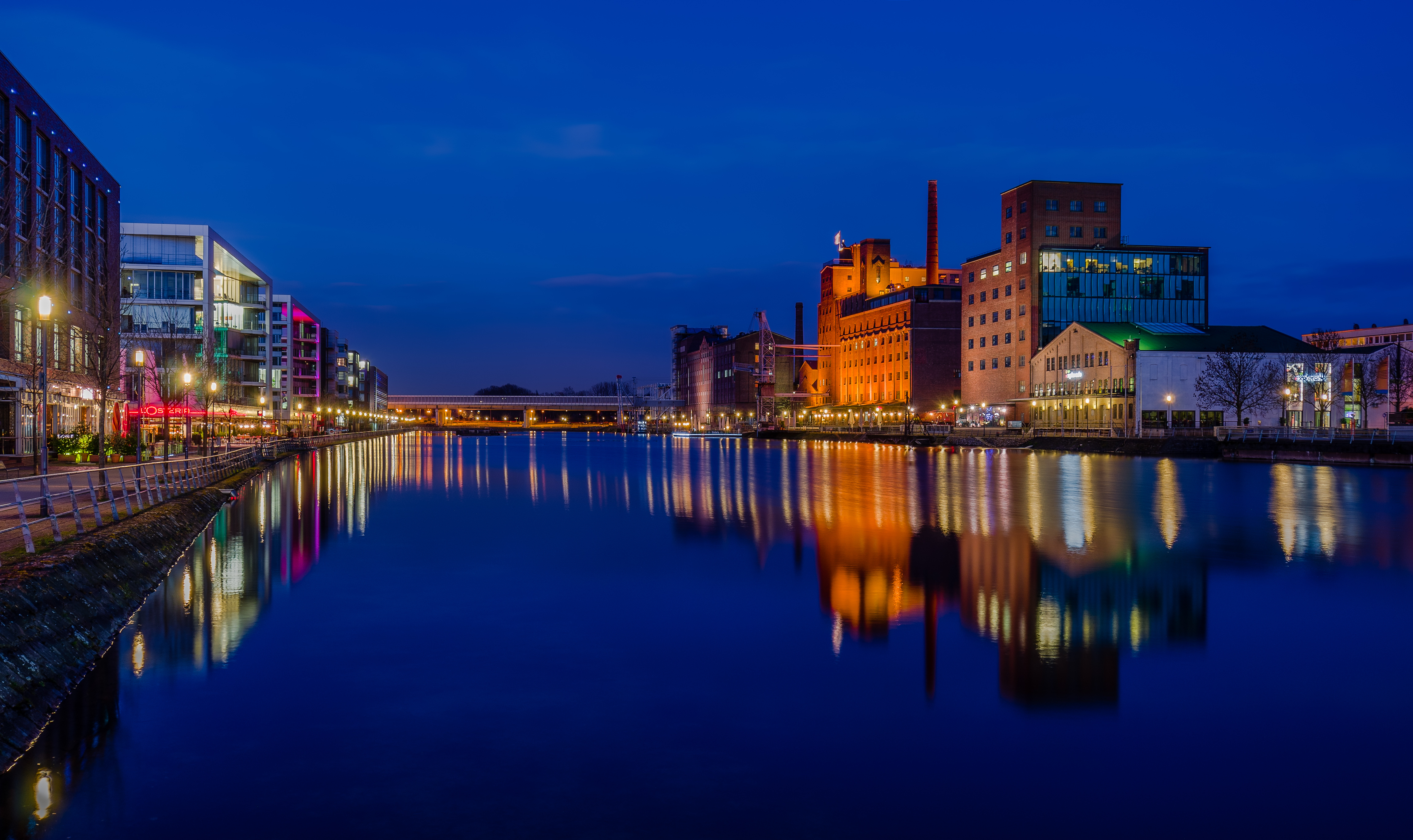
Logistics runs this city. Duisburg's inland port — the largest in the world — moves roughly 130 million tons of cargo annually and anchors a dense ecosystem of freight, warehousing, and supply chain companies. It's also the western terminus of the China–Europe rail corridor, which has drawn Chinese firms and trade offices to set up here. Beyond port operations, the economy spans chemicals, steel remnants, and a growing services sector. The University of Duisburg-Essen employs thousands and feeds research partnerships. Remote workers exist here, but the dominant earners are logistics professionals, engineers, and trade specialists.
A one-bedroom in the city center runs around $780/month — reasonable for western Germany, though noticeably cheaper options exist in outer districts. Public transit is solid: trams, buses, and S-Bahn connect you to Düsseldorf in under 30 minutes and Cologne in about 45. Healthcare access is good through the standard German statutory insurance system, though navigating Krankenkasse registration as a new arrival involves real paperwork friction. German is non-negotiable here — English gets you through tourist situations but not bureaucracy, banking, or landlord negotiations. Anmeldung (address registration) is mandatory and must happen within two weeks of arrival.
Winters are grey and damp from November through February, which is the honest version of 'temperate oceanic.' Summers are mild and genuinely pleasant, and Landschaftspark Duisburg-Nord — a decommissioned steel plant turned public park with climbing walls and dive center — is a legitimate weekend destination, not just a postcard. The food scene reflects the city's demographics: strong Turkish, Greek, and Middle Eastern options alongside German staples. The expat community skews toward logistics and trade professionals rather than lifestyle nomads. Duisburg suits people who want affordable western Germany with serious transport links and don't need a cosmopolitan social scene to feel at home.
Estimate the cost of moving to Duisburg, Germany
Get a free moving cost estimate for moving to Duisburg, Germany. Takes 10 seconds.
How much are you shipping?
When are you moving?
Powered by Sirelo. Free quotes from international movers.
🏚️ Cost of Living
💰 Budgets and Costs
$1,396/mo, one person, rent included
Selected: budget lifestyle
Duisburg at the budget tier comes to about $1,396 a month for one adult, with $533 of that going to rent. Beyond rent the estimate covers $164 on groceries, $54.00 on dining out, $49.00 on entertainment and lifestyle, $528 on utilities and connectivity and $68.00 on transport.
Rent
$533/mo
1BR outside the centre
Groceries
$164/mo
75% of mid-range grocery spend
Dining out
$54.00/mo
4 inexpensive meals
Entertainment & lifestyle
$49.00/mo
1 cinema trip, 8 cappuccinos
Utilities & connectivity
$528/mo
utilities, mobile, internet
Transport
$68.00/mo
Monthly pass
Budgets (excl. rent)
Single person$863/mo
Excludes rent. The total above is all-in, rent included.
$1,595/mo, one person, rent included
Selected: mid-range lifestyle
Duisburg at the mid-range tier comes to about $1,595 a month for one adult, with $533 of that going to rent. Beyond rent the estimate covers $219 on groceries, $135 on dining out, $112 on entertainment and lifestyle, $528 on utilities and connectivity and $68.00 on transport.
Rent
$533/mo
1BR outside the centre
Groceries
$219/mo
Staples basket scaled to a full month
Dining out
$135/mo
10 inexpensive meals
Entertainment & lifestyle
$112/mo
gym, 2 cinema trips, 12 cappuccinos
Utilities & connectivity
$528/mo
utilities, mobile, internet
Transport
$68.00/mo
Monthly pass
Budgets (excl. rent)
Single person$1,062/mo
Excludes rent. The total above is all-in, rent included.
$2,080/mo, one person, rent included
Selected: comfortable lifestyle
Duisburg at the comfortable tier comes to about $2,080 a month for one adult, with $703 of that going to rent. Beyond rent the estimate covers $307 on groceries, $299 on dining out, $175 on entertainment and lifestyle, $528 on utilities and connectivity and $68.00 on transport.
Rent
$703/mo
1BR in the centre
Groceries
$307/mo
140% of mid-range grocery spend
Dining out
$299/mo
6 inexpensive meals + 6 mid-range meals
Entertainment & lifestyle
$175/mo
gym, 4 cinema trips, 20 cappuccinos
Utilities & connectivity
$528/mo
utilities, mobile, internet
Transport
$68.00/mo
Monthly pass
Budgets (excl. rent)
Single person$1,377/mo
Excludes rent. The total above is all-in, rent included.
Estimates for one adult, built from this city's average prices and the usage shown for each tier. Your spending will differ with how often you eat out and where you live.
A 1BR in the center runs about $702.68/mo. If your income is in another currency, bank FX fees add up. A multi-currency account can cut that cost.
Duisburg is moderately safe for expats, with a Safety Index of 70 reflecting Germany's strong rule of law and police presence. The city has struggled with economic decline and higher-than-average petty crime, particularly theft and pickpocketing in central areas like the Innenstadt and around the main train station. Avoid walking alone late at night in Marxloh and Bruckhausen neighborhoods, which have higher crime concentrations. Violent crime against expats is rare. Overall, Duisburg is safer than many comparable post-industrial cities globally, though it requires standard urban awareness—secure valuables, use well-lit routes, and stay alert in crowded transit areas.
🏥 Healthcare
Excellent
Public Hospitals
Yes
Private Clinics
Yes
English-Speaking Doctors
Available
See how Duisburg's healthcare compares with Brunswick
🌤️ Climate
Climate Zones
Temperate
Summer Temp
23°C
Winter Temp
1°C
Humidity
78%
Air Quality Index
45
Annual Rainfall
1346 mm
Best Months
MayJulAugSep
Climate Notes
Oceanic climate in the industrial Ruhr region.
💻 Digital Nomad
Avg Internet Speed
102 Mbps
Internet (monthly)
$41/mo
Coworking Availability
Limited
Coworking Spaces Nearby
1
Digital Nomad Score
64/100
Community Notes
A vibrant city with strong infrastructure for digital nomads.
See how Duisburg's digital nomad life compares with Brunswick
🧳 Expat Life
English Proficiency
Limited
Expat Community
Medium
Top Neighborhoods
Dellviertel, Duissern
Banks Nearby
79
ATMs Nearby
82
Expat Life Notes
A major industrial hub in the Ruhr valley with a gritty feel but affordable rents and good transport.
Pros
✓ Very affordable for Germany
✓ Strong industrial job market
✓ Centric location
Cons
✗ Industrial pollution concerns
✗ Gritty aesthetic
✗ Limited high-end nightlife
🏘️ Neighborhoods in Duisburg
Notable areas of Duisburg, with descriptions adapted from public reference sources. Rent figures are Numbeo's city-wide averages, not prices for a specific area.
Conditions can change from one block to the next, and these descriptions are general guides, not safety assessments. Before choosing where to stay or live, check current travel advisories, talk to people who live there, and visit in person if you can.
Ruhrort
Ruhrort is a district in the Homberg/Ruhrort/Baerl borough of Duisburg, Germany, located north of where the Ruhr and Rhine meet, in the western Ruhr area. It has the largest river harbor in the world, with quays running nearly 40 kilometers along the river, and it is the principal inland shipping port in Germany.
Numbeo city average, center: $703 (updated Oct 9, 2026)
Meiderich is a quarter of Duisburg, divided into Unter-, Mittel- and Obermeiderich. It belongs to the Meiderich/Beeck city district, established in 1975 during municipal reorganization. The quarter was first mentioned in the early 10th century as "Medriki," meaning "moist area," in a document of Werden Abbey, and its first church was built in the 13th century. The MSV Duisburg football club has roots in Meiderich.
Numbeo city average, center: $703 (updated Oct 9, 2026)
Duisburg has a population of approximately 503,707 people.
A single person can expect to spend around $1,757 per month in Duisburg, including rent. A 1-bedroom apartment in the city center costs approximately $703/month.
The nearest airport to Duisburg is ESS, approximately 7.5km away.
Duisburg is considered relatively safe, with a safety index of 70.0. As with any city abroad, expats should research specific neighborhoods before committing to a location.
Duisburg has an average internet speed of 102 Mbps. It is considered a well-established digital nomad destination.
Duisburg has a safety index of 70, which is reasonable, but safety varies significantly by neighborhood. Areas like Marxloh have a well-documented reputation for higher crime and social tension, while districts like Neudorf or Duissern are considerably calmer. Research specific neighborhoods before signing a lease rather than treating the city as uniform.
Yes, practically speaking. Unlike Frankfurt or Berlin, Duisburg has limited English infrastructure outside of university and corporate environments. Registering your address, dealing with health insurance, opening a bank account, and communicating with landlords will all require German or a patient bilingual helper. Basic German before arrival is strongly recommended.
It's genuinely excellent for this. Düsseldorf Airport is about 20 minutes away by S-Bahn, Cologne/Bonn Airport is under an hour, and high-speed rail puts you in Amsterdam in roughly 2.5 hours, Brussels in under 2, and Paris in about 3. The Rhine-Ruhr rail network means you can reach most of western Germany without a car.
Duisburg is quite affordable compared to many Western European cities. Expect to pay around €700-€1200 per month for a one-bedroom apartment, depending on the neighborhood. Groceries are reasonably priced, and you can find decent meals out for €10-€20.
While there isn't a specific 'retirement visa' for Germany, Americans can apply for a residence permit if they can prove sufficient financial resources and health insurance. You'll need to demonstrate a stable income, such as a pension or investments, to support yourself without relying on German social assistance.
Germany has an excellent healthcare system. As an expat, you'll likely need to obtain either public or private health insurance. Many doctors in Duisburg speak English, especially younger ones, but it's always good to have a phrasebook handy.
For budget-conscious expats, consider areas like Marxloh or Bruckhausen. These neighborhoods offer more affordable housing options. However, be aware that they may have fewer English speakers and require more integration into the local culture.
Duisburg has reliable and fast internet, suitable for remote work. You can expect speeds of 50-100 Mbps with most providers, which is sufficient for video conferencing and other online tasks. Coworking spaces are available, though not as abundant as in larger cities like Berlin.
Opening a bank account in Germany as an American requires some paperwork, including proof of address and identification. Deutsche Bank and Commerzbank are popular choices. Be prepared for potential fees for international transactions.
Duisburg has a temperate climate with four distinct seasons. Summers are mild and pleasant, while winters can be cold and damp. Expect rain throughout the year, so pack accordingly.
As a US citizen, you're still required to file US taxes even when living abroad. The Foreign Earned Income Exclusion (FEIE) can help you exclude a certain amount of your income from US taxation. Also, be aware of FBAR reporting requirements for foreign bank accounts.
While Duisburg doesn't have as large of an expat community as some other German cities, there are still opportunities to connect with other internationals. Online groups and language exchange events can be good ways to meet people.
Duisburg is generally a safe city, but like any urban area, it has its share of petty crime. Areas around the main train station (Hauptbahnhof) can be a bit rough at night. It's always wise to be aware of your surroundings.
Yes, Duisburg is definitely viable for early retirement on a budget of $2,500 (approximately €2,300) per month, especially if you're frugal. You'll need to be mindful of your spending, but it's possible to live comfortably and enjoy a good quality of life.
While German is the primary language, you'll find a decent number of English speakers, especially among younger people and in tourist areas. However, learning some basic German phrases will greatly enhance your experience and integration into the local community.
Duisburg offers a variety of attractions, including the Landschaftspark Duisburg-Nord, a former industrial site turned park, and the Innenhafen (Inner Harbour), a revitalized waterfront area with restaurants and museums. Exploring the local markets and attending cultural events are also great ways to experience the city.
Cost-of-living and visa updates for Duisburg and the rest of Germany. Free with RA Postcards.
By submitting your email address, you will receive a free subscription to RA Postcards and special offers from Rewire Abroad and our affiliates. You can unsubscribe at any time, and we encourage you to read more about our Privacy Policy.