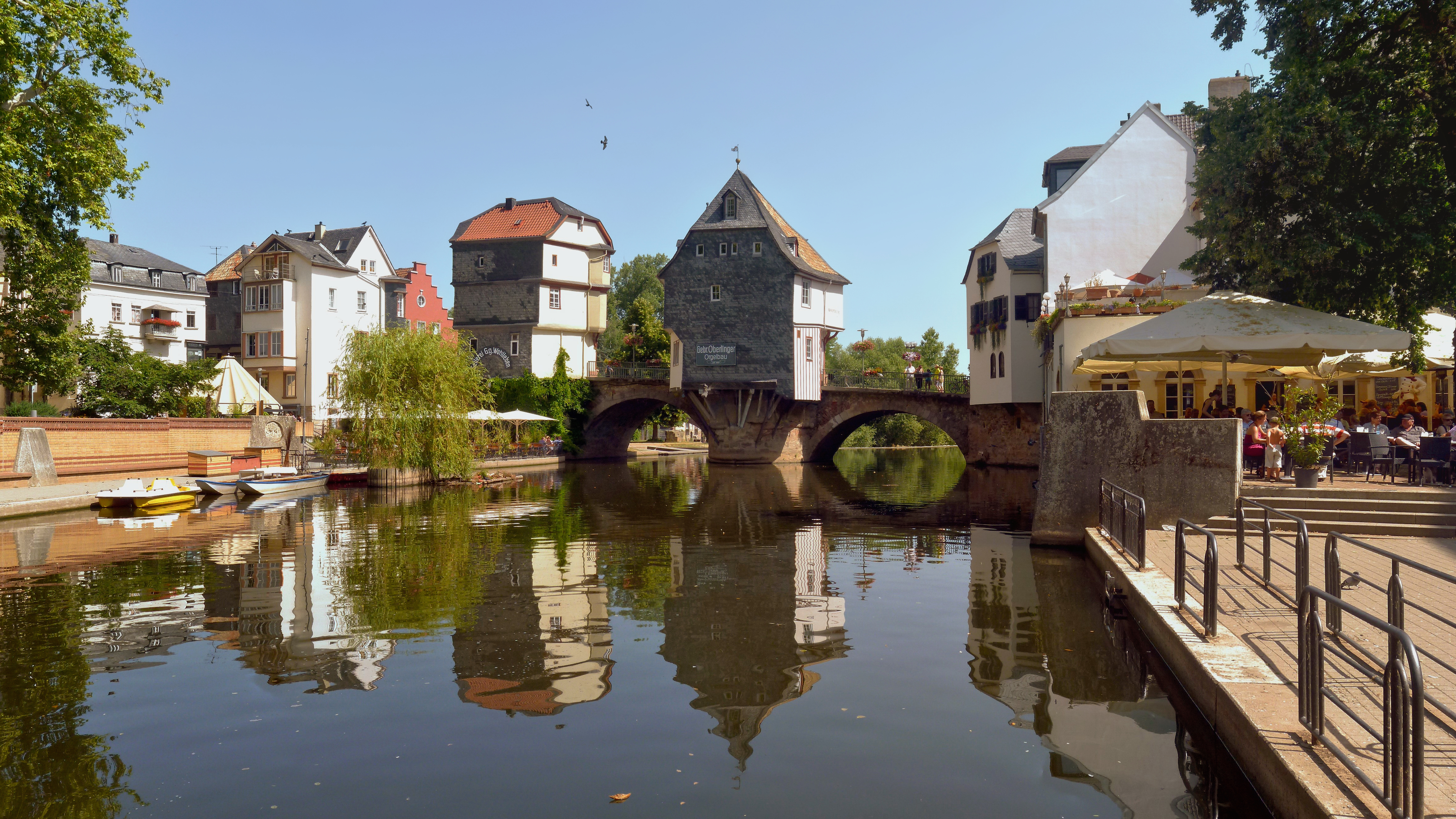
Bad Kreuznach sits in a temperate climate zone at 107 m above sea level, keeping the Europe/Berlin timezone and offering a pace of life that feels distinctly unhurried for a town of 53 thousand people. The Nahe river runs through the center, and the surrounding hills give the place a sheltered, almost basin-like feel that shapes both the weather and the mood. Expats who settle here tend to gravitate toward Innenstadt, the central district where daily errands, cafes, and the train station are all within walking distance. The expat community itself is small, and English is common mainly in tourist areas, so newcomers who make an effort with German tend to integrate faster and get more out of everyday life.
Renting in Bad Kreuznach is affordable by Western European standards, though the gap between central and peripheral locations is noticeable. A one-bedroom apartment in the city center runs $897/mo, while the same unit outside the center drops to $763/mo. Families or those needing more space will find three-bedroom places at $2,019/mo in the center or $1,290/mo farther out. Utilities add roughly $345/mo, internet $53/mo, and a mobile phone plan $32/mo. A monthly public transport pass costs $71/mo and a gym membership $73/mo. For a single adult, monthly costs excluding rent come to about $1,020/mo, while a family of four should budget around $3,400/mo before housing. Overall, a single adult can live on a budget tier of $1,144/mo, a mid-range tier of $1,735/mo, or a comfortable tier of $2,104/mo, all rent included. With an average monthly net salary of $3,007/mo and a cost of living index of 65 out of 100 against New York City, the math works in favor of those who earn locally or bring remote income.
Safety is one of the town's quiet strengths. The safety index stands at 78 out of 100, and the crime index is just 22 out of 100, meaning residents generally feel secure walking home at night or leaving a bike locked outside a bakery. Air quality is good, with an index of 35 where lower is better, helped by the surrounding vineyards and forested ridges. Healthcare quality is rated excellent, and the town's size means appointments and pharmacies are easy to reach without the wait times of a major metropolis.
For longer stays, Germany offers two relevant routes. Retirees can look at the §7 Abs. 1 S. 3 AufenthG permit, which requires a minimum monthly income of $1,200/mo. Freelancers and remote workers can explore the Freelancer Residence Permit under Section 21 of the German Residence Act. The nearest major airport is FRA, just 7 km away, making international arrivals and departures unusually convenient for a town this size. With an overall expat score of 72/100, a FIRE score of 74/100, a retiree score of 71/100, and a digital nomad score of 69/100, Bad Kreuznach suits budget-conscious retirees, remote freelancers, and anyone who wants a safe, walkable German town with fast airport access and a low cost of living rather than big-city energy.