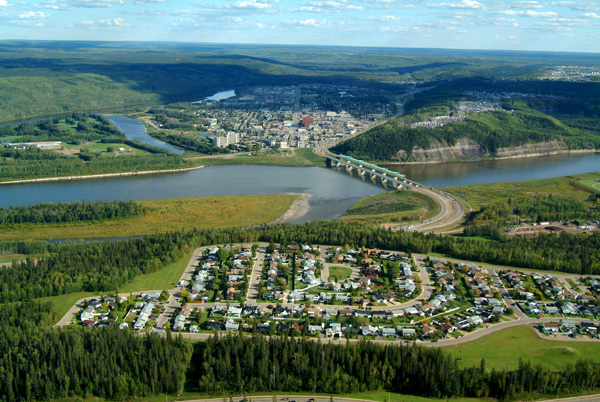
Fort McMurray sits in northern Alberta at an elevation of 260 m, on Mountain Standard Time under the America/Edmonton zone, with a continental climate that delivers sharply defined seasons. The population is 68 thousand, and the city has a medium expat community. Newcomers tend to settle in Timberlea, Eagle Ridge, and Thickwood, neighborhoods that offer a range of housing and everyday conveniences. The nearest airport is YMM, 13 km away, which keeps regional and connecting flights within easy reach.
Rents vary by location and unit size. A 1-bedroom in the city centre runs $890/mo, while outside the centre it is $956/mo. For larger households, a 3-bedroom in the city centre costs $1,590/mo, and outside the centre it is $1,637/mo. Utilities average $193/mo, internet $60/mo, and a mobile phone plan $48/mo. A monthly public transport pass is $49/mo, and a gym membership is $44/mo. Everyday food costs include $21 for an inexpensive restaurant meal per person, $56 for a mid-range restaurant meal for two with three courses, and $4 for a cappuccino. Excluding rent, a single person spends about $1,150/mo, and a family of four about $4,000/mo. Budget, mid-range, and comfortable tiers for a single adult, rent included, come to $1,156/mo, $1,778/mo, and $1,934/mo respectively. The average monthly net salary locally is $3,108/mo, and the cost of living index is 75/100 against New York City as 100.
Safety and health infrastructure support daily life. The safety index is 65/100 and the crime index is 35/100, with lower crime numbers indicating a safer environment. Air quality has an index of 45, where lower is better. Healthcare quality is rated Good. Average internet speed is 40 Mbps, which covers routine remote work and streaming.
For longer stays, the Canada Super Visa (Parents & Grandparents) serves retirement-oriented family visits, while the Canada Digital Nomad Visa supports remote workers. Overall expat, digital nomad, FIRE, and retiree scores are 62/100, 62/100, 59/100, and 58/100. English is widely spoken. The city suits resource-sector professionals, remote workers who value a quieter northern base, and families drawn by relatively contained housing costs and a compact urban footprint.